
Review
Sustainable Agriculture and Land Restoration: Insights from Bangladesh for Enhancing Global Resilience
 Download

This work is licensed under a Creative Commons Attribution-NonCommercial 4.0 International License.
Copyright
The authors shall retain the copyright of their work but allow the Publisher to publish, copy, distribute, and convey the work.
License
Land Management and Utilization (LMU) publishes accepted manuscripts under Creative Commons Attribution 4.0 International (CC BY 4.0). Authors who submit their papers for publication by Land Management and Utilization (LMU) agree to have the CC BY 4.0 license applied to their work, and that anyone is allowed to reuse the article or part of it free of charge for any purpose, including commercial use. As long as the author and original source is properly cited, anyone may copy, redistribute, reuse and transform the content.
Authors
-
Ripon Kumar Sikder
 World Bank Program, Agency Program Coordination Unit, Bangladesh Agricultural Development Corporation, Dhaka 1207, Bangladesh
-
Anika Tabassum
Research Cell, Bangladesh Agricultural Development Corporation, Dhaka 1000, Bangladesh
-
Mst. Jaitun Naher
Seed Distribution Division, Bangladesh Agricultural Development Corporation, Dhaka 1000, Bangladesh
-
Md. Nazmul Islam Manik
Research Cell, Bangladesh Agricultural Development Corporation, Dhaka 1000, Bangladesh
Received: 4 September 2025; Revised: 24 November 2025; Accepted: 28 December 2025; Published: 17 March 2026
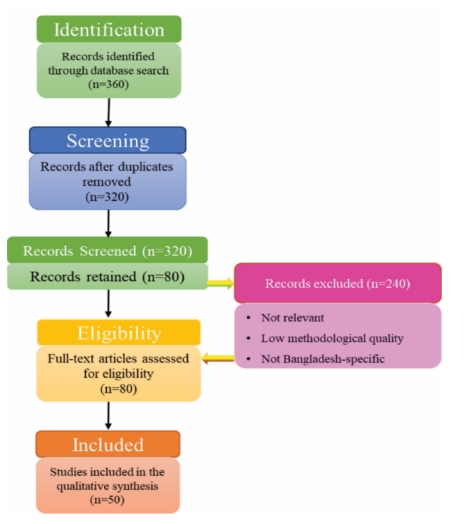
Bangladesh is emerging as a key case for climate-resilient agriculture in circumstances of land scarcity and environmental stress. This review collates existing evidence towards understanding the role of sustainable agriculture practices and land restoration interventions in supporting food security and resilience. Systematic literature review following Preferred Reporting Items for Systematic Reviews and Meta-Analyses (PRISMA) guidelines, integrating peer-reviewed studies and institutional reports. The system settings include four main interventions: climate-smart crop diversification, improved soil fertility management, efficient water resource management, and ecosystem restoration. Our findings demonstrate that, although these interventions led to higher productivity and adaptive capacity of beneficiaries as compared to non-beneficiaries, their effectiveness differs greatly across agro-ecological zones due to differences in access to inputs, institutional support and adoption by farmers. In addition to descriptive synthesis, this study employs a comparative and policy-oriented perspective by highlighting the technological, ecological and institutional dimensions of agricultural transformation. The results highlight that no single intervention is sufficient, and if anything, a coordinated and adaptive approach is necessary in order to make a sustainable impact. In the end, Bangladesh’s experience is transferable to other climate-vulnerable areas in how integrated and goal-oriented approaches can lead to adjusted resilience outcomes for smallholder farming systems, achieving productivity vs. environment sustainability balance with strong governance systems and sound extension service delivery.
Keywords:
Bangladesh Smallholder Farming Systems Climate-Smart Agriculture Land Restoration Sustainable Agriculture Agricultural ResilienceReferences
- Ahmed, A.U. Patterns of Food Consumption and Nutrition in Rural Bangladesh; International Food Policy Research Institute: Washington, DC, USA, 1993.
- Altieri, M.A.; Nicholls, C.I. The Adaptation and Mitigation Potential of Traditional Agriculture in a Changing Climate. Clim. Change 2017, 140, 33–45.
- Arannayk Foundation. Ecosystem Restoration in Bangladesh; Arannayk Foundation: Dhaka, Bangladesh, 2024.
- Brauman, K.A.; Richter, B.D.; Postel, S.; et al. Water depletion: An improved metric for incorporating seasonal and dry-year water scarcity into water risk assessments. Elementa 2016, 4, 000083.
- Challinor, A.J.; Watson, J.; Lobell, D.B.; et al. A meta-analysis of crop yield under climate change and adaptation. Nat. Clim. Change 2014, 4, 287–291.
- Dercon, S.; Christiaensen, L. Consumption Risk, Technology Adoption and Poverty Traps: Evidence from Ethiopia. J. Dev. Econ. 2011, 96, 159–173.
- FAO. Climate Change and Food Security: Risks and Responses; FAO: Rome, Italy, 2015.
- FAO. Climate-Smart Agriculture in Bangladesh; FAO: Rome, Italy, 2021.
- Feder, G.; Umali, D.L. The Adoption of Agricultural Innovations: A Review. Technol. Forecast. Soc. Change 1993, 43, 215–239.
- Foley, J.A.; Ramankutty, N.; Brauman, K.A.; et al. Solutions for a cultivated planet. Nature 2011, 478, 337–342.
- Garnett, T.; Appleby, M.C.; Balmford, A.; et al. Sustainable Intensification in Agriculture: Premises and Policies. Science 2013, 341, 33–34.
- Godfray, H.C.J.; Beddington, J.R.; Crute, I.R.; et al. Food Security: The Challenge of Feeding 9 Billion People. Science 2010, 327, 812–818.
- Gordon, L.J.; Bignet, V.; Crona, B.; et al. Rewiring food systems to enhance human health and biosphere stewardship. Environ. Res. Lett. 2017, 12, 100201.
- Grafton, R.Q.; Williams, J.; Jiang, Q. Possible Pathways and Tensions in the Food and Water Nexus: Poss Pathways and Tensions in the Nexus. Earths Future 2017, 5, 449–462.
- Herrero, M.; Mason-D’Croz, D.; Thornton, P.K.; et al. Livestock and sustainable food systems: Status, trends, and priority actions. In Science and Innovations for Food Systems Transformation; Springer: Cham, Switzerland, 2023; pp. 375–399.
- Akter, S.; Ahmed, J.U.; Begum, I.A.; et al. Integrated farming system-A means of improving farmers’ well-being in the wetland ecosystem of Bangladesh. Farming Syst. 2025, 3, 100127. DOI: https://doi.org/10.1016/j.farsys.2024.100127
- Islam, H. Salinity intrusion in coastal region of Bangladesh and its impact on human health and environment. Int. J. Geogr. Geol. Environ. 2025, 7, 25–32. DOI: https://doi.org/10.22271/27067483.2025.v7.i6a.372
- IPCC. Climate Change 2022: Impacts, Adaptation and Vulnerability; Cambridge University Press: Cambridge, UK, 2022.
- Zahid, A.; Kohinoor, N.; Shoaib, J.; et al. Land Degradation in Bangladesh 2020; Soil Resource Development Institute (SRDI): Dhaka, Bangladesh, 2022.
- Mwongera, C.; Lamanna, C.; Kamau, H.N.; et al. Scaling climate-smart agriculture for agricultural transformation in Southern Africa. In Transforming Agriculture in Southern Africa; CRC Press: Boca Raton, FL, USA, 2019.
- Nandi, R.; Krupnik, T.J.; Kabir, W. Crop diversification in Bangladesh: Public policy provisions and practice—A scoping review to inform policy and initiatives. J. Agric. Food Res. 2024, 18, 101486. DOI: https://doi.org/10.1016/j.jafr.2024.101486
- Kundu, S.; Kabir, M.E.; Morgan, E.A.; et al. Building coastal agricultural resilience in Bangladesh: A systematic review of progress, gaps and implications. Climate 2020, 8, 98. DOI: https://doi.org/10.3390/cli8090098
- Meijer, S.S.; Catacutan, D.; Ajayi, O.C.; et al. The Role of Knowledge, Attitudes and Perceptions in the Uptake of Agricultural and Agroforestry Innovations among Smallholder Farmers in Sub-Saharan Africa. Int. J. Agric. Sustain. 2015, 13, 40–54.
- Ministry of Finance. Bangladesh Economic Review, 2022; Government of Bangladesh: Dhaka, Bangladesh, 2022.
- Thornton, P.K.; Ericksen, P.J.; Herrero, M.; et al. Climate adaptation pathways. Nat. Clim. Change 2018, 8, 102–110.
- Pretty, J.; Bharucha, Z.P. Sustainable intensification in agricultural systems. Ann. Bot. 2014, 114, 1571–1596.
- Pretty, J.; Toulmin, C.; Williams, S. Sustainable intensification in African agriculture. Int. J. Agric. Sustain. 2011, 9, 5–24.
- Lipper, L.; Thornton, P.; Campbell, B.M.; et al. Climate-smart agriculture for food security. Nat. Clim. Change 2014, 4, 1068–1072.
- Tilman, D.; Balzer, C.; Hill, J.; et al. Global food demand and the sustainable intensification of agriculture. Proc. Natl. Acad. Sci. U. S. A. 2011, 108, 20260–20264.
- Mirza, M.M. Climate change, flooding in South Asia and implications. Reg. Environ. Change 2011, 11, 95–107.
- Moher, D.; Liberati, A.; Tetzlaff, J.; et al. Preferred Reporting Items for Systematic Reviews and Meta-Analyses: The PRISMA Statement. PLoS Med. 2009, 6, e1000097.
- OECD. Agriculture and Climate Policy; OECD: Paris, France, 2021.
- Rosenstock, T.S.; Lamanna, C.; Chesterman, S.; et al. Climate-smart agriculture: Evidence and trade-offs. Agric. Syst. 2016, 151, 172–181.
- Lal, R. Soil degradation as a reason for inadequate human nutrition. Food Secur. 2009, 1, 45–57.
- Anantha, K.H.; Raju, K.V. Groundwater depletion and coping strategies of farming communities in southern peninsular India. Asia Pac. Trade Invest. Rev. 2010, 17, 119–144. DOI: https://doi.org/10.18356/a7e0d5f2-en
- Miah, M.M.; Kamal, M.Z.U.; Salam, M.A.; et al. Impact of salinity intrusion on agriculture of Southwest Bangladesh: A review. Int. J. Agric. Policy Res. 2020, 8, 40–47. DOI: https://doi.org/10.15739/IJAPR.20.005
- Page, M.J.; McKenzie, J.E.; Bossuyt, P.M.; et al. The PRISMA 2020 statement: An updated guideline for reporting systematic reviews. Br. Med. J. 2021, 372, n71.
- Pawson, R.; Greenhalgh, T.; Harvey, G.; et al. Realist review—A new method of systematic review designed for complex policy interventions. J. Health Serv. Res. Policy 2005, 10, 21–34.
- Pingali, P.L. Green Revolution: Impacts, limits, and the path ahead. Proc. Natl. Acad. Sci. U. S. A. 2012, 109, 12302–12308.
- Wheeler, T.; von Braun, J. Climate change impacts on global food security. Science 2013, 341, 508–513.
- World Bank. The World Bank Annual Report 2021: From Crisis to Green, Resilient, and Inclusive Recovery; World Bank: Washington, DC, USA, 2021.
- World Bank. World Bank Helps Bangladesh Improve Irrigation-Based Agricultural Productivity. World Bank: Washington, DC, USA, 2021. Available online: https://share.google/QwsqQ7V7E2gdEWR6f
- Khalafallah, M.; Mubeen, A.; Ruangpan, L.; et al. Adaptation pathways for climate change mitigation using nature-based solutions: Assessing retention ponds for flood hazard mitigation in the Tamnava Basin. Blue-Green Syst. 2025, 7, 170–187. DOI: https://doi.org/10.2166/bgs.2025.003
- Tamburini, G.; De Simone, S.; Sigura, M.; et al. Conservation Tillage Mitigates the Negative Effect of Landscape Simplification on Biological Control. J. Appl. Ecol. 2016, 53, 233–241.
- Wada, Y.; van Beek, L.P.H.; Bierkens, M.F.P. Global Depletion of Groundwater Resources. Geophys. Res. Lett. 2010, 37, L20402.
- Vermeulen, S.J.; Campbell, B.M.; Ingram, J.S.I. Climate change and food systems. Annu. Rev. Environ. Resour. 2012, 37, 195–222.
- Rockström, J.; Williams, J.; Daily, G.; et al. Sustainable intensification of agriculture for human prosperity and global sustainability. Ambio 2017, 46, 4–17.
- Springmann, M.; Clark, M.; Mason-D’Croz, D.; et al. Options for keeping the food system within environmental limits. Nature 2018, 562, 519–525.
- UNDP. Climate-Resilient Agriculture Framework; UNDP: New York, NY, USA, 2020.
- Rahman, M.M.; Lateh, H.; Islam, M.N. Climate of Bangladesh: Temperature and rainfall changes, and impact on agriculture and groundwater—A GIS-based analysis. In Bangladesh I: Climate Change Impacts, Mitigation and Adaptation in Developing Countries; Springer: Cham, Switzerland, 2018. DOI: https://doi.org/10.1007/978-3-319-26357-1_2