
Article
From Traditional to Intelligent: How AI Transforms English Language Learning and Teaching
 Download

This work is licensed under a Creative Commons Attribution 4.0 International License.
Copyright
The authors shall retain the copyright of their work but allow the Publisher to publish, copy, distribute, and convey the work.
License
Digital Technologies Research and Applications (DTRA) publishes accepted manuscripts under Creative Commons Attribution 4.0 International (CC BY 4.0). Authors who submit their papers for publication by DTRA agree to have the CC BY 4.0 license applied to their work, and that anyone is allowed to reuse the article or part of it free of charge for any purpose, including commercial use. As long as the author and original source are properly cited, anyone may copy, redistribute, reuse, and transform the content.
Authors

Received: 20 January 2026; Revised: 22 February 2026; Accepted: 16 March 2026; Published: 7 May 2026
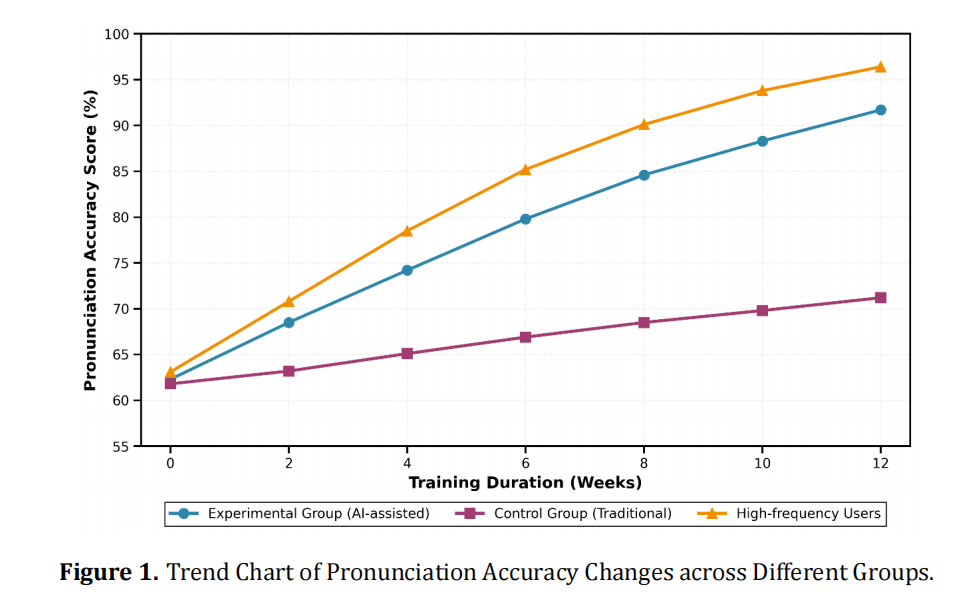
In recent years, artificial intelligence has developed quickly, which is changing the English teaching and training in a radical way; the focus is shifting from the original mode to smart tools and software. In light of this, we adopted mixed research methods to investigate such changes in the present study. The research lasted for 16 weeks, using a quasi-experiment research method. Specifically, we explored what the functions of AI are in English learning and teaching. There were a total of 120 undergraduate students and 12 teacher participants in our research. Multiple data collection tools were used: questionnaire survey, class observation, interview, and analysis of learning behavior data. We found that there were obvious improvements in some respects. For example, intelligent pronunciation correction systems improved scores by 29.4 points; AI writing assistant tools brought about gains of 19.5 points; Conversational robots promoted oral ability growth of 20.9 points, with d = 1.96. The adaptive learning platform achieved personalized recommendation accuracy of 87.3%, while differentiated instruction enabled low-proficiency learners to improve by 43.0%. Teacher roles shifted markedly from knowledge transmission toward facilitation, with direct instruction time declining from 62% to 28%. Despite these promising outcomes, challenges including algorithmic bias, technology overdependence, data privacy risks, and digital equity concerns warrant careful consideration. The study concludes that optimal English education requires organic integration of technological efficiency and humanistic pedagogy.
Keywords:
Artificial Intelligence English Teaching Personalized Learning Blended Instruction Pedagogical AssessmentReferences
- Luo, Y.M. Application of generative AI language models in college English writing instruction. J. Taiyuan Urban Vocat. Coll. 2025, 88–90. DOI: https://doi.org/10.16227/j.cnki.tycs.2025.0613 (in Chinese)
- Giuliano, M.R. Echoes of myth and magic in the language of Artificial Intelligence. AI Soc. 2020, 35, 1009–1024. DOI: https://doi.org/10.1007/s00146-020-00966-4
- Banegas, L.D.; Sacchi, F.; Martín, S.G.M.; et al. Teachers’ and student teachers’ conceptualisations and enactment of social justice in English language teaching: A case in Argentinian secondary schools. Teach. Teach. 2025, 31, 1377–1395. DOI: https://doi.org/10.1080/13540602.2024.2411957
- Wirawan, T.K.; Sukarsa, M.I.; Bayupati, A.P.I. Balinese Historian Chatbot Using Full-Text Search and Artificial Intelligence Markup Language Method. Int. J. Intell. Syst. Appl. (IJISA) 2019, 11, 21–34.
- Hwayoung, Y.; Hyegyeong, B.; Deokyu, P. A Study on the Way of the Korean Language Education using the Multiple Intelligence Theory in the Era Artificial Intelligence. Stud. Linguist. 2019, 52, 127–154. DOI: https://doi.org/10.17002/sil..52.201907.127 (in Korean)
- Enríquez, T.; Alonso-Stuyck, P.; Martínez-Villaseñor, L. The Language of Nature and Artificial Intelligence in Patient Care. Int. J. Environ. Res. Public Health 2023, 20, 6499. DOI: https://doi.org/10.3390/IJERPH20156499
- Ballens, M.Y.B.; Prieto, M.A.J. The Impact of Using Sitcoms in English Language Teaching: A Literature Review. Engl. Lang. Teach. 2025, 18. DOI: https://doi.org/10.5539/ELT.V18N11P195
- Kolhar, M.; Alameen, A. Artificial Intelligence Based Language Translation Platform. Intell. Autom. Soft Comput. 2021, 28, 1–9. DOI: https://doi.org/10.32604/IASC.2021.014995
- Li, Z.X. Research on AI language model-empowered strategies for college English reading and writing instruction. J. Qiqihar Junior Teach. Coll. 2025, 137–140. DOI: https://doi.org/10.16322/j.cnki.23-1534/z.2025.03.036 (in Chinese)
- Chang, C.-H.; Kidman, G. The rise of generative artificial intelligence (AI) language models—Challenges and opportunities for geographical and environmental education. Int. Res. Geogr. Environ. Educ. 2023, 32, 85–89. DOI: https://doi.org/10.1080/10382046.2023.2194036
- Choi, E.P.H.; Lee, J.J.; Ho, M.-H.; et al. Chatting or cheating? The impacts of ChatGPT and other artificial intelligence language models on nurse education. Nurse Educ. Today 2023, 125, 105796.
- Pourhoseingholi, M.A.; Hatamnejad, M.R.; Solhpour, A. Does ChatGPT (or any other artificial intelligence language tool) deserve to be included in authorship list? Gastroenterol. Hepatol. Bed Bench 2023, 16, 435–437.
- Xu, F. Constructing teaching and research framework for AI-enabled cognitive development in English reading and writing. Foreign Lang. Educ. Res. Front. 2025, 8, 38–48. DOI: https://doi.org/10.20083/j.cnki.fleic.2025.0058 (in Chinese)
- Munn, L.; Magee, L.; Arora, V. Truth machines: Synthesizing veracity in AI language models. AI Soc. 2023, 39, 2759–2773. DOI: https://doi.org/10.1007/S00146-023-01756-4
- Sathe, A.; Seth, I.; Bulloch, G.; et al. The role of artificial intelligence language models in dermatology: Opportunities, limitations and ethical considerations. Australas. J. Dermatol. 2023, 64, 548–552.
- Berşe, S.; Akça, K.; Dirgar, E.; et al. The Role and Potential Contributions of the Artificial Intelligence Language Model ChatGPT. Ann. Biomed. Eng. 2023, 52, 130–133. DOI: https://doi.org/10.1007/S10439-023-03296-W
- Aghemo, A.; Forner, A.; Valenti, L. Should Artificial Intelligence-based language models be allowed in developing scientific manuscripts? A debate between ChatGPT and the editors of Liver International. Liver Int. 2023, 43, 956–957.
- Wang, X.Y. Reconstruction and application of AI-enabled dynamic evaluation system for junior high school English reading comprehension. Huaxia Teach. 2025, 109–111. DOI: https://doi.org/10.16704/j.cnki.hxjs.2025.36.023 (in Chinese)
- Brandsen, S.; Chandrasekhar, T.; Franz, L.; et al. Prevalence of bias against neurodivergence-related terms in artificial intelligence language models. Autism Res. 2024, 17, 234–248. DOI: https://doi.org/10.1002/AUR.3094
- Margetts, J.T.; Karnik, J.S.; Wang, S.H.; et al. Use of AI Language Engine ChatGPT 4.0 to Write a Scientific Review Article Examining the Intersection of Alzheimer’s Disease and Bone. Curr. Osteoporos. Rep. 2024, 22, 177–181. DOI: https://doi.org/10.1007/S11914-023-00853-Z
- Yang, Y. Corpus-Driven Analysis of Conceptual Metaphor in Artificial Intelligence Language: A Sample of ChatGPT-Written Speeches. J. Contemp. Educ. Res. 2023, 7, 77–85. DOI: https://doi.org/10.26689/JCER.V7I12.5713
- Danesh, A.; Pazouki, H.; Danesh, K.; et al. The performance of artificial intelligence language models in board-style dental knowledge assessment: A preliminary study on ChatGPT. J. Am. Dent. Assoc. 2023, 154, 970–974. DOI: https://doi.org/10.1016/J.ADAJ.2023.07.016
- Chen, Y.P. Application and pathway exploration of AI in English personalized teaching. J. Huaiyin Norm. Univ. Nat. Sci. Ed. 2025, 24, 365–368. DOI: https://doi.org/10.16119/j.cnki.issn1671-6876.2025.04.015 (in Chinese)
- Morales Ojeda, L.A.; Montero, S.; Mehta, A. Artificial Intelligence Language Models and the Future of Academic Research in Surgery: Exploring Opportunities and Concerns. Ann. Plast. Surg. 2024, 93, 1–2. DOI: https://doi.org/10.1097/SAP.0000000000003935
- Jalali, S.M.; Akhavan, A. Integrating AI language models in qualitative research: Replicating interview data analysis with ChatGPT. Syst. Dyn. Rev. 2024, 40, e1772. DOI: https://doi.org/10.1002/SDR.1772
- Raval, M.D.; Rathod, M.V. The Trend of Using AI Language Models such as ChatGPT in Research and Publication: How to Keep it in Check? J. Assoc. Physicians India 2024, 72, 112–112. DOI: https://doi.org/10.59556/JAPI.72.0519
- Daungsupawong, H.; Wiwanitkit, V. Artificial intelligence language model and burns first aid information: Comment. Burns 2024, 50, 1710–1711. DOI: https://doi.org/10.1016/J.BURNS.2024.03.026
- Baldwin, J.A. An artificial intelligence language model improves readability of burns first aid information. Burns 2024, 50, 1122–1127. DOI: https://doi.org/10.1016/J.BURNS.2024.03.005
- Bilgiç, E.Z.; Demir, K.Ö. Supporting English language learning for students with attention deficit hyperactivity disorder through total physical response and multiple intelligences theory. Front. Educ. 2025, 10, 1661792. DOI: https://doi.org/10.3389/FEDUC.2025.1661792
- Rosati, A.; Criscione, M.; Oliva, R.; et al. The Role of AI Language Models as a Clinical Decision Support System (CDSS) or Consultation Service Platform (CSP) in Gynecologic Oncology: A Systematic Review of the Literature. Int. J. Gynecol. Cancer 2025, 35, 100963. DOI: https://doi.org/10.1016/J.IJGC.2024.100963
- Brandenberger, J.; Stedman, I.; Stancati, N.; et al. Using artificial intelligence based language interpretation in non-urgent paediatric emergency consultations: A clinical performance test and legal evaluation. BMC Health Serv. Res. 2025, 25, 138. DOI: https://doi.org/10.1186/S12913-025-12263-1
- Mohan, S.; Souza, S.; Fakurnejad, S.; et al. Utility of an Artificial Intelligence Language Model for Post-Operative Patient Instructions Following Facial Trauma. Craniomaxillofac. Trauma Reconstr. 2024, 17, 291–294. DOI: https://doi.org/10.1177/19433875231222803
- Kim, S.B.; Jo, H. Why can't artificial language contain the truth? A focus on Foucault's and Heidegger's discussions. Humanities Soc. Sci. Commun. 2024, 11, 1230. DOI: https://doi.org/10.1057/S41599-024-03648-4
- Liu, K. Research on application of AI-assisted English learning tools in English vocabulary learning. China Adult Educ. 2024, 19, 65–71.
- Donner, S. What kind of documents can AI language model outputs be? The concept of artificially blended testimony. J. Doc. 2025, 81, 788–809. DOI: https://doi.org/10.1108/JD-11-2024-0271
- Kuru, E.H.; Aşık, A.; Demir, M.D. Can Artificial Intelligence Language Models Effectively Address Dental Trauma Questions? Dent. Traumatol. 2025, 41, 567–580. DOI: https://doi.org/10.1111/EDT.13063
- Yoo, D.; Kang, H.; Oh, C. Deciphering Deception: How Different Rhetoric of AI Language Impacts Users' Sense of Truth in LLMs. Int. J. Hum. Comput. Interact. 2025, 41, 2163–2183. DOI: https://doi.org/10.1080/10447318.2024.2316370
- Dillion, D.; Mondal, D.; Tandon, N.; et al. AI language model rivals expert ethicist in perceived moral expertise. Sci. Rep. 2025, 15, 4084. DOI: https://doi.org/10.1038/S41598-025-86510-0
- Hou, W.Z. New engine for higher vocational English teaching: Empowerment practice and challenge response of AI assistants. J. Wuhan Inst. Vocat. Technol. 2025, 24, 80–84. DOI: https://doi.org/10.19899/j.cnki.42-1669/Z.2025.10.013 (in Chinese)
- Bauer, C.; Dang, D.T.L.; Beucken, D.V.T.; et al. Systematic analysis of hepatotoxicity: combining literature mining and AI language models. Front. Artif. Intell. 2025, 8, 1561292. DOI: https://doi.org/10.3389/FRAI.2025.1561292
- Yiğit, S.; Berşe, S.; Dirgar, E.; et al. Views of health sciences undergraduates on ChatGPT, an artificial intelligence-powered language model: A qualitative study. Innov. Educ. Teach. Int. 2025, 62, 1258–1272. DOI: https://doi.org/10.1080/14703297.2024.2391044
- Sathe, A.; Chikanna, H. Short Research Article: Evaluation of an artificial intelligence language model in psychiatric patient education. Child Adolesc. Ment. Health 2025, 30, 265–271. DOI: https://doi.org/10.1111/CAMH.70000
- Pisarcik, D.; Kissling, M.; Heimer, J.; et al. Artificial Intelligence Language Models to Translate Professional Radiology Mammography Reports Into Plain Language—Impact on Interpretability and Perception by Patients. Acad. Radiol. 2025, 32, 4988–4996. DOI: https://doi.org/10.1016/J.ACRA.2025.05.065
- Rahimi, R.A. Developing and validating the scale of language teachers' design thinking competency in artificial intelligence language teaching (LTDTAILT). Comput. Educ. Artif. Intell. 2025, 8, 100420. DOI: https://doi.org/10.1016/J.CAEAI.2025.100420
- Muhammad, A.; Yusri, Y.; Mantasiah, R.; et al. English, German and Indonesian nominalizations: A contrastive study and their application in teaching English to Indonesian learners of German. J. Appl. Res. High. Educ. 2025, 17, 1695–1707. DOI: https://doi.org/10.1108/JARHE-01-2024-0055
- Huang, Y.; Chen, H.; Hu, C. L2 growth mindset in AI-mediated language learning: Effects of perceived usability and presence of generative AI chatbots. Front. Psychol. 2025, 16, 1700117. DOI: https://doi.org/10.3389/FPSYG.2025.1700117
- Loyens, J.; Slinger, G.; Doornebal, N.; et al. AI language model applications for early diagnosis of childhood epilepsy based on unstructured first-visit patient narratives: A cohort study. Epileptic Disord. 2025, 27, 1263–1274. DOI: https://doi.org/10.1002/EPD2.70109
- Rad, S.H.; Roohani, A. AI Language Alchemists: Unleashing Task-Based Chatbots to Enhance Speaking Proficiency, Shape Attitudes, and Foster a Translanguaging Space. J. Educ. Comput. Res. 2025, 63, 1659–1688. DOI: https://doi.org/10.1177/07356331251363281
- Carevic, G.; Floyd, W.; Kleber, T.; et al. AI Language Model Performance in Retrieving Phase III Radiotherapy Trials across Multiple Cancers. Int. J. Radiat. Oncol. Biol. Phys. 2025, 123, e721. DOI: https://doi.org/10.1016/J.IJROBP.2025.06.3123
- Fraidan, A.A. AI language and emotional support as a physician assistant in hypertension management: An N-of-1 case study on virtual encouragement and blood pressure control. Humanities Soc. Sci. Commun. 2025, 12, 1229. DOI: https://doi.org/10.1057/S41599-025-05635-9