
Article
User Interface Design of the JOFF Evaluation Application as a Derivative of DIVAYANA Evaluation Model
 Download

This work is licensed under a Creative Commons Attribution 4.0 International License.
Copyright
The authors shall retain the copyright of their work but allow the Publisher to publish, copy, distribute, and convey the work.
License
Digital Technologies Research and Applications (DTRA) publishes accepted manuscripts under Creative Commons Attribution 4.0 International (CC BY 4.0). Authors who submit their papers for publication by DTRA agree to have the CC BY 4.0 license applied to their work, and that anyone is allowed to reuse the article or part of it free of charge for any purpose, including commercial use. As long as the author and original source are properly cited, anyone may copy, redistribute, reuse, and transform the content.
Authors
-
Dewa Gede Hendra Divayana
 Department of Informatics Education, Universitas Pendidikan Ganesha, Singaraja 81116, Indonesia
-
P. Wayan Arta Suyasa
Department of Informatics Education, Universitas Pendidikan Ganesha, Singaraja 81116, Indonesia
-
Made Susi Lissia Andayani
Department of Informatics Education, Universitas Pendidikan Ganesha, Singaraja 81116, Indonesia
-
Agus Adiarta
Department of Electrical Education, Universitas Pendidikan Ganesha, Singaraja 81116, Indonesia
-
I. Putu Wisna Ariawan
Department of Mathematics Education, Universitas Pendidikan Ganesha, Singaraja 81116, Indonesia
-
I. Made Sugiarta
Department of Mathematics Education, Universitas Pendidikan Ganesha, Singaraja 81116, Indonesia
Received: 1 February 2026; Revised: 4 March 2026; Accepted: 18 March 2026; Published: 23 April 2026
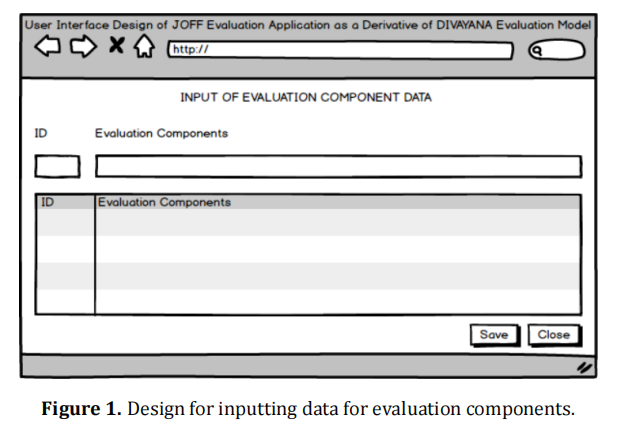
The user interface design of an application is not limited to applications in the field of informatics, but also applies to various fields that utilize information technology. This also applies to educational evaluation. A good evaluation application is the result of a good user interface design. The aim of this study is to demonstrate the user interface design of the JOFF (Justification–Observation–Finalization–Functionalization) evaluation application which is derived from the DIVAYANA (Description–Input–Verification–Action–Yack–Analysis–Nominate–Actualization) evaluation model. The improved version used is Borg and Gall with a focus on three stages, together with: layout development, preliminary trying out, and revision of the initial checking out effects. The number of respondents involved in conducting the initial testing of the user interface design of the JOFF evaluation application was 44 people. Four experts and 40 IT vocational school teachers at several IT vocational schools in Bali. The statistical series device in this study turned into a questionnaire. Questionnaires are used to obtain quantitative data from subjects (respondents) who have completed initial trials. Analysis techniques of quantitative records accumulated from the preliminary trials were then used to analyze the usage of quantitative descriptive strategies. The effects of the study confirmed the great person interface layout of the JOFF evaluation software, which is a derivative of the DIVAYANA evaluation model, is classified as superb with a pleasant percent of 87.81%. The impact of this research on the field of educational evaluation is the existence of new knowledge about the importance of good user interface design.
Keywords:
User Interface Design Evaluation Application JOFF Model Derivation DIVAYANAReferences
- Sugandini, W.; Heryanda, K.K.; Sugiarta, I.M.; et al. Fliperentiation Learning using a Mix of Tat Twam Asi and HOTS-Superitem Logic Based on the Kelase Platform as a Renewable Learning Model. In Proceedings of the 2024 11th International Conference on Electrical Engineering, Computer Science and Informatics, Yogyakarta, Indonesia, 26–27 September 2024; pp. 749–755.
- Divayana, D.G.H.; Adiarta, A.; Suyasa, P.W.A. JOFF Model in the Frame of Asta Amertaning DIVAYANA Model as a Form of Metamorphosis Evaluation Model for Determining the Psychofun-Hybrid Learning Quality. Int. J. Inf. Educ. Technol. 2025, 15, 1201–1210.
- Schuessler, K.; Striewe, M.; Pueschner, D.; et al. Developing and Evaluating an E-Learning and E-Assessment Tool for Organic Chemistry in Higher Education. Front. Educ. 2024, 9, 1–18.
- Ningsih, W. Lecturers’ Perceptions of the Use of E-Evaluation in Assessing the Academic Achievement of Students of the Islamic Religious Education Study Program. Fitrah J. Islam. Educ. 2024, 5, 74–97.
- Bahattab, A.; Hanna, M.; Voicescu, G.T.; et al. e-Learning Evaluation Framework and Tools for Global Health and Public Health Education: Protocol for a Scoping Review. JMIR Res. Protoc. 2023, 12, e49955.
- Wulandari, D.A.P. Analysis and Evaluation of SIDUN Mobile Application in UEQ-Based User Experience Perspective. J. Comput. Netw. Archit. High Perform. Comput. 2025, 7, 554–561.
- Shapiro, S.; Lam, V. Artificial Intelligence in Program Evaluation: Insights and Applications. Can. J. Program Eval. 2025, 39, 382–391.
- Musdi, E.; Syaputra, H.; Arnellis; et al. Students’ Mathematics Communication Behavior: Assessment Tools and Their Application. J. Math. Educ. 2024, 15, 317–338.
- Mawardi, L.N.M.; Rustandi, A. Kahoot Application as a Formative Evaluation Media in Students’ Comprehension of the Aspect of Writing Narrative Text in Online Class (Qualitative Case Study at One of Senior High School). J. Engl. Educ. Program 2024, 11, 93–100.
- Nasrah; Hamdanah; Kaharuddin; et al. The Effectiveness of Using Google Form Application as an Evaluation Tool for Islamic Education Learning at SDN 019 Mambu, Luyo District, Polewali Mandar Regency. Int. J. Health Econ. Soc. Sci. 2024, 6, 1063–1069.
- Castillo-Manzano, J.I.; Castro-Nuño, M.; López-Valpuesta, L.; et al. Evaluating the Design of Digital Tools for the Transition to an E-Continuous Assessment in Higher Education. J. Comput. High. Educ. 2024, 36, 875–893.
- Kurniawan, M.F.; Ihsan, N.; Irawan, R.; et al. Development of Android-based Self-Assessment Application for Basic Pencak Silat Techniques. Res. Dev. Educ. 2024, 4, 863–875.
- Chang, Z. Design and Application of Evaluation Method for Civics Classroom Based on Critic Fuzzy Algorithm. EAI Endorsed Trans. Scalable Inf. Syst. 2023, 11, 1–11.
- Jamaludin, D.A.; Henderi, H.; Bin Ladjamudin, A.B. Development of Android Application-Based E-Learning Learning Media Using the Borg and Gall Method. JINAV J. Inf. Vis. 2024, 5, 171–180.
- Wulandari, T.; Widiastuti, A.; Nasiwan; et al. Development of Learning Models for Inculcating Pancasila Values. Int. J. Eval. Res. Educ. 2023, 12, 1364–1374.
- Riyanda, A.R.; Jalinus, N.; Ahyanuardi; et al. Enhancing Higher-Order Thinking Skills through Case-Project-Based Learning in Algorithms and Data Structures Courses. J. Hunan Univ. Nat. Sci. 2024, 51, 164–176.
- Purwiyanto. Developing Special Product Development Models. Int. J. Humanit. Educ. Soc. Sci. 2023, 2, 1292–1300.
- Timbi-Sisalima, C.; Sánchez-Gordón, M.; Hilera-Gonzalez, J.R.; et al. Quality Assurance in E-Learning: A Proposal from Accessibility to Sustainability. Sustainability 2022, 14, 3052.
- Nokas, K.; Hakim, A.; Masrianih; et al. The Influence of Breakfast Habits on Students’ Learning Activities Class X SMAN 5 Palu. Int. J. Curr. Sci. Res. Rev. 2025, 8, 1538–1542.
- Naibaho, L. Online Learning Evaluation During Covid-19 Using CSE-UCLA Evaluation Model at English Education Department Universitas Kristen Indonesia. Budapest Int. Res. Critics Inst. J. 2021, 4, 1987–1997.
- Indah, P. Development of HOTS (High Order Thinking Skill) Oriented Learning through Discovery Learning Model to Increase the Critical Thinking Skill of High School Students. Int. J. Chem. Educ. Res. 2020, 4, 26–32.
- Levy-Feldman, I. The Role of Assessment in Improving Education and Promoting Educational Equity. Educ. Sci. 2025, 15, 224.
- Mesny, A.; Roberge-Maltais, I.; Galy, A. Innovative Assessment and Grading Practices in Higher Education: A Critical Exploration for Management Educators. Int. J. Manag. Educ. 2026, 24, 101307.
- Jafar, A.A.; Hardiyanti, M.; Swari, R.A. Interface Design of Quranic Application Using Design Science Research Methodology: A Comparison of Gamification and Non-Gamification Design. Int. J. Recent Educ. Res. 2025, 6, 94–115.
- Maringka, R.; Lumingkewas, C. Designing User Interface (UI) and User Experience (UX) of a Sport Space Rental Application Using Design Thinking Method. CogITo Smart J. 2024, 10, 192–203.
- Cahyani, D.E.; Wahyuningsih, S.; Rahmadani, D.; et al. User Interface Design for Dyslexia Children Learning Application Using Design Thinking Approach. Int. J. Interact. Mob. Technol. 2024, 18, 84–96.
- Adiarta, A.; Divayana, D.G.H.; Ariawan, I.P.W.; et al. User Interface Design of a Sengkedan Concept-Based Digital Test. Int. J. Adv. Appl. Sci. 2024, 13, 478–486.
- Liu, Z. Augmented Reality User Interface: Analysing the Design Principles and Evaluation Methods of Augmented Reality (AR) User Interfaces to Enhance User Interaction and Experience. Int. J. Comput. Sci. Inf. Technol. 2024, 3, 22–31.
- Wijaya, E.Y.; Arif, M.; Aini, N.; et al. UI/UX Web Based Learning Design with UCD Approach to Basic Programming Using FIGMA. bit-Tech 2024, 6, 412–420. DOI: https://doi.org/10.32877/bt.v6i3.1534
- Faudzi, M.A.; Cob, Z.C.; Ghazali, M.; et al. User Interface Design in Mobile Learning Applications: Developing and Evaluating a Questionnaire for Measuring Learners' Extraneous Cognitive Load. Heliyon 2024, 10, e37494.
- Stewart, B.T.; Menge, K.; Kurien, T.V.; et al. Optimizing the User-Experience (UX) and Interface (UI) of a mHealth Application to Aid Recovery from Burn Injury (BurnCORE) through a User-Centered Design Approach. Burns Open 2025, 11, 1–8.
- Costa, A.; Silva, F.; Moreira, J.J. Towards an AI-Driven User Interface Design for Web Applications. Procedia Comput. Sci. 2024, 237, 179–186.
- Oliveri, L.; Chiacchio, F.; Iacono, N.L.; et al. Enhancing Maintenance Operations in Industry 5.0: A Conceptual User Interface Design for Task Assignment. Procedia Comput. Sci. 2025, 253, 3015–3024.