
Article
Digital Innovation and Supply Chain Performance: Investigating the Moderating Effect of Technology Usage on Risk Management-Resilience-Performance Linkages
 Download

This work is licensed under a Creative Commons Attribution 4.0 International License.
Copyright
The authors shall retain the copyright of their work but allow the Publisher to publish, copy, distribute, and convey the work.
License
Digital Technologies Research and Applications (DTRA) publishes accepted manuscripts under Creative Commons Attribution 4.0 International (CC BY 4.0). Authors who submit their papers for publication by DTRA agree to have the CC BY 4.0 license applied to their work, and that anyone is allowed to reuse the article or part of it free of charge for any purpose, including commercial use. As long as the author and original source are properly cited, anyone may copy, redistribute, reuse, and transform the content.
Authors
-
Mingyu Lei
 Faculty of Management, Universiti Teknologi Malaysia, Johor Bahru 81310, Malaysia
College of Accounting and Finance, Jiangxi Tourism and Commerce Vocational College, Nanchang 330100, China -
Norhayati Zakuan
Faculty of Management, Universiti Teknologi Malaysia, Johor Bahru 81310, Malaysia
-
Mohd Zulfabli Hasan
Faculty of Management, Universiti Teknologi Malaysia, Johor Bahru 81310, Malaysia
-
Muhamad Zameri Mat Saman
Faculty of Mechanical, Universiti Teknologi Malaysia, Johor Bahru 81310, Malaysia
-
Xin Chen
Faculty of Management, Shanxi Vocational University of Engineering Science and Technology, Jinzhong 030619, China
Received: 16 January 2026; Revised: 13 February 2026; Accepted: 5 March 2026; Published: 27 April 2026
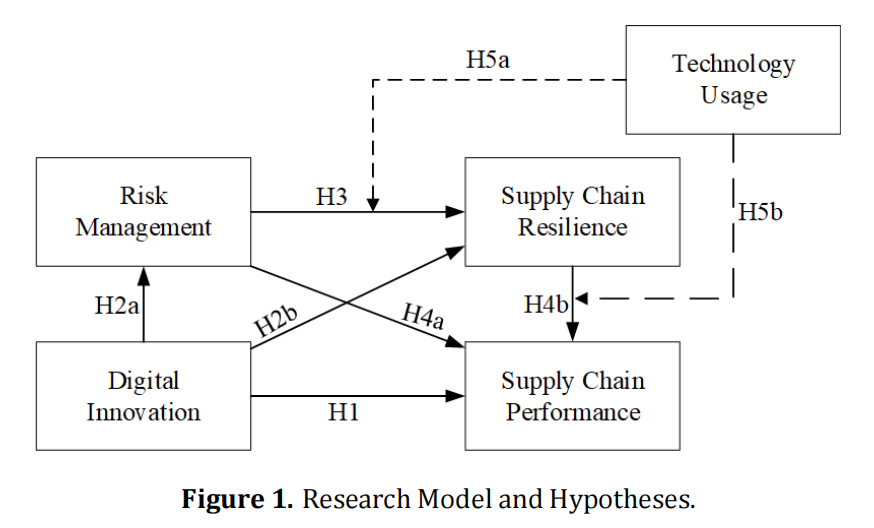
This study aims to investigate the interrelations among digital innovation, risk management, resilience, and performance in supply chain contexts, in which technology utilization is conceptualized as a moderator. Based on the concepts of dynamic capabilities and the resource-based view, the proposed model suggests risk management and resilience as sequential mediators between digital innovation and performance. The model is empirically validated using Partial Least Squares Structural Equation Modeling (PLS-SEM) with a sample of 256 manufacturing and service organizations selected from the World Bank Enterprise Surveys dataset. Findings show that digital innovation has both direct (β = 0.218) and indirect effects on supply chain performance through risk management and resilience. Digital innovation exhibits the strongest association with supply chain risk management (β = 0.521), followed by risk management's effect on resilience (β = 0.489) and resilience's effect on performance (β = 0.372). Technology usage strengthens both the risk management–resilience path (β = 0.127) and the resilience–performance path (β = 0.143). Sequential mediation accounts for 53.3% of the total effect, as measured by the Variance Accounted For (VAF) index, confirming partial mediation. This study also contributes to the supply chain management literature by providing empirical specification for the integrated paths in which digital innovation drives performance through risk management and resilience capabilities, and technology application as a boundary condition in these paths. The results indicate that supply chain managers should integrate digital innovation investments with risk management and resilience capabilities for the best performance in supply chain management.
Keywords:
Digital Innovation Supply Chain Resilience Risk Management Supply Chain Performance Technology UsageReferences
- Zhao, N.; Hong, J.; Lau, K.H. Impact of supply chain digitalization on supply chain resilience and performance: A multi-mediation model. Int. J. Prod. Econ. 2023, 259, 108817.
- Ivanov, D.; Dolgui, A. A digital supply chain twin for managing the disruption risks and resilience in the era of Industry 4.0. Prod. Plan. Control 2021, 32, 775–788.
- Ivanov, D.; Dolgui, A. The shortage economy and its implications for supply chain and operations management. Int. J. Prod. Res. 2022, 60, 7141–7154.
- El Baz, J.; Ruel, S. Can supply chain risk management practices mitigate the disruption impacts on supply chains’ resilience and robustness? Evidence from an empirical survey in a COVID-19 outbreak era. Int. J. Prod. Econ. 2021, 233, 107972.
- Nambisan, S.; Lyytinen, K.; Majchrzak, A.; et al. Digital Innovation Management: Reinventing Innovation Management Research in a Digital World. MIS Q. 2017, 41, 223–238.
- Vial, G. Understanding digital transformation: A review and a research agenda. J. Strateg. Inf. Syst. 2019, 28, 118–144.
- Hanelt, A.; Bohnsack, R.; Marz, D.; et al. A systematic review of the literature on digital transformation: Insights and implications for strategy and organizational change. J. Manag. Stud. 2021, 58, 1159–1197.
- Büyüközkan, G.; Göçer, F. Digital supply chain: Literature review and a proposed framework for future research. Comput. Ind. 2018, 97, 157–177.
- Jing, H.; Fan, Y. Digital transformation, supply chain integration and supply chain performance: Evidence from Chinese manufacturing listed firms. SAGE Open 2024, 14, 21582440241281616.
- Madzík, P.; Falát, L.; Copuš, L.; et al. Resilience in supply chain risk management in disruptive world: Rerouting research directions during and after pandemic. Ann. Oper. Res. 2024, 1–33.
- Chowdhury, M.M.H.; Quaddus, M. Supply chain resilience: Conceptualization and scale development using dynamic capability theory. Int. J. Prod. Econ. 2017, 188, 185–204.
- Jidda Jidda, D.; Zhen, L.; Ashraf, S.F.; et al. Value of enterprise risk management integration and supply chain performance: Mediating role of firm’s resilience capability. SAGE Open 2025, 15, 21582440241305618.
- Wu, L.; Zhang, Z.; Huang, J.; et al. Digital technologies and supply chain resilience: A resource-action-performance perspective. Inf. Syst. Front. 2025, 27, 2137–2158.
- Wang, H.; Chen, Y.; Xie, J.; et al. Research on digital empowerment, innovation vitality and manufacturing supply chain resilience mechanism. PLoS ONE 2025, 20, e0316183.
- He, J.; Fan, M.; Fan, Y. Digital transformation and supply chain efficiency improvement: An empirical study from a-share listed companies in China. PLoS ONE 2024, 19, e0302133.
- Ning, L.; Yao, D. The impact of digital transformation on supply chain capabilities and supply chain competitive performance. Sustainability 2023, 15, 10107.
- Barney, J. Firm resources and sustained competitive advantage. J. Manag. 1991, 17, 99–120.
- Helfat, C.E.; Peteraf, M.A. The dynamic resource‐based view: Capability lifecycles. Strateg. Manag. J. 2003, 24, 997–1010.
- Teece, D.J. Explicating dynamic capabilities: The nature and microfoundations of (sustainable) enterprise performance. Strateg. Manag. J. 2007, 28, 1319–1350.
- Stadtfeld, G.M.; Gruchmann, T. Dynamic capabilities for supply chain resilience: A meta-review. Int. J. Logist. Manag. 2024, 35, 623–648.
- Oubrahim, I.; Sefiani, N.; Happonen, A. The influence of digital transformation and supply chain integration on overall sustainable supply chain performance: An empirical analysis from manufacturing companies in Morocco. Energies 2023, 16, 1004.
- Dubey, R.; Bryde, D.J.; Dwivedi, Y.K.; et al. Dynamic digital capabilities and supply chain resilience: The role of government effectiveness. Int. J. Prod. Econ. 2023, 258, 108790.
- Iftikhar, A.; Ali, I.; Arslan, A.; et al. Digital innovation, data analytics, and supply chain resiliency: A bibliometric-based systematic literature review. Ann. Oper. Res. 2024, 333, 825–848.
- Türkeș, M.C. How digitalization drives supply chain performance in the Romanian industry: The roles of sustainability, resilience, risk management, and integration. Sustainability 2025, 17, 9895.
- Shahadat, M.H.; Chowdhury, A.Y.; Jahed, M.A.; et al. Innovativeness, visibility, and collaboration effect on supply chain performance: Moderating role of digital supply chain integration. Cogent Bus. Manag. 2024, 11, 2390168.
- Balakrishnan, A.; Ramanathan, U. The role of digital technologies in supply chain resilience for emerging markets’ automotive sector. Supply Chain Manag. 2021, 26, 654–671.
- Han, N.; Um, J. Risk management strategy for supply chain sustainability and resilience capability. Risk Manag. 2024, 26, 6.
- Hosseini, S.; Ivanov, D.; Dolgui, A. Review of quantitative methods for supply chain resilience analysis. Transp. Res. Part E 2019, 125, 285–307.
- Liu, C.-L.; Lee, M.-Y. Integration, supply chain resilience, and service performance in third-party logistics providers. Int. J. Logist. Manag. 2018, 29, 5–21.
- Chowdhury, M.M.H.; Quaddus, M.; Agarwal, R. Supply chain resilience for performance: Role of relational practices and network complexities. Supply Chain Manag. 2019, 24, 659–676.
- Panigrahi, R.R.; Jena, D.; Meher, J.R.; et al. Assessing the impact of supply chain agility on operational performances-a PLS-SEM approach. Meas. Bus. Excell. 2023, 27, 1–24.
- Teece, D.J. Dynamic capabilities and (digital) platform lifecycles. In Entrepreneurship, Innovation, and Platforms; Emerald Publishing Limited: Bingley, UK, 2017; 37, pp. 211–225.
- Huang, K.; Wang, K.; Lee, P.K.; et al. The impact of industry 4.0 on supply chain capability and supply chain resilience: A dynamic resource-based view. Int. J. Prod. Econ. 2023, 262, 108913.
- Dubey, R.; Gunasekaran, A.; Childe, S.J.; et al. Empirical investigation of data analytics capability and organizational flexibility as complements to supply chain resilience. Int. J. Prod. Res. 2021, 59, 110–128.
- Belhadi, A.; Mani, V.; Kamble, S.S.; et al. Artificial intelligence-driven innovation for enhancing supply chain resilience and performance under the effect of supply chain dynamism: An empirical investigation. Ann. Oper. Res. 2024, 333, 627–652.
- Kock, N.; Hadaya, P. Minimum sample size estimation in PLS‐SEM: The inverse square root and gamma‐exponential methods. Inf. Syst. J. 2018, 28, 227–261.
- Hair, J.F. A Primer on Partial Least Squares Structural Equation Modeling (PLS-SEM); Sage: Thousand Oaks, CA, USA, 2014.
- OECD. Oslo Manual 2018: Guidelines for Collecting, Reporting and Using Data on Innovation, 4th ed.; OECD: Paris, France, 2018.
- Belhadi, A.; Kamble, S.; Jabbour, C.J.C.; et al. Manufacturing and service supply chain resilience to the COVID-19 outbreak: Lessons learned from the automobile and airline industries. Technol. Forecast. Soc. Change 2021, 163, 120447.
- Hair, J.F.; Risher, J.J.; Sarstedt, M.; et al. When to use and how to report the results of PLS-SEM. Eur. Bus. Rev. 2019, 31, 2–24.