
Article
Designing and Governing Trustworthy AI Marketing Systems in Educational Technology: A Managerial and Implementation Framework
 Download

This work is licensed under a Creative Commons Attribution 4.0 International License.
Copyright
The authors shall retain the copyright of their work but allow the Publisher to publish, copy, distribute, and convey the work.
License
Digital Technologies Research and Applications (DTRA) publishes accepted manuscripts under Creative Commons Attribution 4.0 International (CC BY 4.0). Authors who submit their papers for publication by DTRA agree to have the CC BY 4.0 license applied to their work, and that anyone is allowed to reuse the article or part of it free of charge for any purpose, including commercial use. As long as the author and original source are properly cited, anyone may copy, redistribute, reuse, and transform the content.
Authors
-
Chuntie Chen
 Azman Hashim International Business School, Universiti Teknologi Malaysia (UTM), Kuala Lumpur 56100, Malaysia
-
Nor Hidayati Binti Zakaria
Azman Hashim International Business School, Universiti Teknologi Malaysia (UTM), Kuala Lumpur 56100, Malaysia
-
Wei Deng
School of Economics and Management, Huizhou University, Huizhou 516000, China
-
Xiaoli Xu
Department of Accounting, Guizhou Electronic Commerce Vocational College, Guiyang 550000, China
-
Youyu Xu
Azman Hashim International Business School, Universiti Teknologi Malaysia (UTM), Kuala Lumpur 56100, Malaysia
Received: 9 January 2026; Revised: 11 February 2026; Accepted: 19 March 2026; Published: 24 April 2026
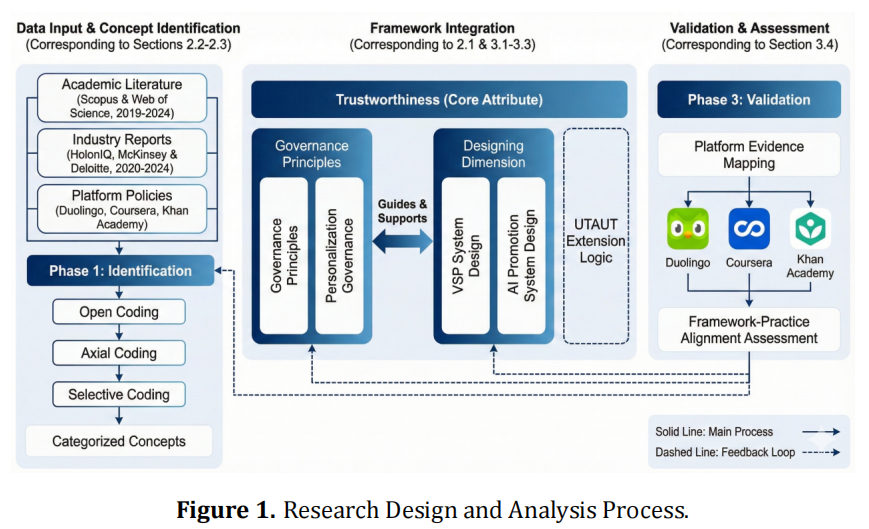
This study proposes a dual-dimensional framework to design such technologies in the EdTech industry using the conceptual framework methodology, which is based on thematic content analysis and theory-driven and evidence-based validation using scholarly literature, industry reports, and policies from the top EdTech organizations worldwide. The framework identifies trustworthiness as the key construct that integrates two interrelated dimensions. The governing dimension is operational at the managerial level and includes governance principles based on an extended Unified Theory of Acceptance and Use of Technology (UTAUT) framework and personalization governance principles based on three dimensions, such as intensity, tempo, and boundaries. The designing dimension is operational at the implementation level and identifies the technical requirements related to virtual sales personnel systems and AI promotion systems. The results of the validation process against known platform practices demonstrate a mixed pattern of alignment, with stronger support in regulatory-related areas and weaker support in governance-intensive domains where the framework extends current industry practice. The extension of the UTAUT model from personal acceptance to organizational governance represents a theoretical contribution with a link to existing research in personal acceptance and its expanded applicability. The three-dimensional personalization governance model has more detailed mechanisms than the current one-dimensional approaches. For educational technology organizations, the framework offers systematic guidance in the development of AI-based marketing systems that are trustworthy to users while being effective for organizational goals. Validation results indicate tempo governance and recommendation explainability as areas that need development in the industry for effective engagement with users in a sustainable manner.
Keywords:
AI Marketing Systems Educational Technology Trustworthiness Governance Framework UTAUT ExtensionReferences
- Huang, M.-H.; Rust, R.T. A strategic framework for artificial intelligence in marketing. J. Acad. Mark. Sci. 2021, 49, 30–50.
- Dwivedi, Y.K.; Hughes, L.; Ismagilova, E.; et al. Artificial Intelligence (AI): Multidisciplinary perspectives on emerging challenges, opportunities, and agenda for research, practice and policy. Int. J. Inf. Manag. 2021, 57, 101994.
- Haleem, A.; Javaid, M.; Qadri, M.A.; et al. Artificial intelligence (AI) applications for marketing: A literature-based study. Int. J. Intell. Netw. 2022, 3, 119–132.
- Zawacki-Richter, O.; Marín, V.I.; Bond, M.; et al. Systematic review of research on artificial intelligence applications in higher education—Where are the educators? Int. J. Educ. Technol. High. Educ. 2019, 16, 39.
- Holmes, W.; Tuomi, I. State of the art and practice in AI in education. Eur. J. Educ. 2022, 57, 542–570.
- Gao, Y.; Liu, H. Artificial intelligence-enabled personalization in interactive marketing: A customer journey perspective. J. Res. Interact. Mark. 2023, 17, 663–680.
- Chi, N.T.K.; Hoang Vu, N. Investigating the customer trust in artificial intelligence: The role of anthropomorphism, empathy response, and interaction. CAAI Trans. Intell. Technol. 2023, 8, 260–273.
- Strzelecki, A. To use or not to use ChatGPT in higher education? A study of students' acceptance and use of technology. Interact. Learn. Environ. 2024, 32, 5142–5155.
- Al-Adwan, A.S.; Li, N.; Al-Adwan, A.; et al. Extending the technology acceptance model (TAM) to Predict University Students' intentions to use metaverse-based learning platforms. Educ. Inf. Technol. 2023, 28, 15381–15413.
- Berendt, B.; Littlejohn, A.; Blakemore, M. AI in education: Learner choice and fundamental rights. Learn. Media Technol. 2020, 45, 312–324.
- Kasneci, E.; Sessler, K.; Küchemann, S.; et al. ChatGPT for good? On opportunities and challenges of large language models for education. Learn. Individ. Differ. 2023, 103, 102274.
- Gołąb-Andrzejak, E. AI-powered digital transformation: Tools, benefits and challenges for marketers–case study of LPP. Procedia Comput. Sci. 2023, 219, 397–404.
- Venkatesh, V.; Thong, J.Y.; Xu, X. Consumer acceptance and use of information technology: Extending the unified theory of acceptance and use of technology. MIS Q. 2012, 36, 157–178.
- Bag, S.; Srivastava, G.; Bashir, M.M.A.; et al. Journey of customers in this digital era: Understanding the role of artificial intelligence technologies in user engagement and conversion. Benchmarking 2022, 29, 2074–2098.
- Shin, D. The effects of explainability and causability on perception, trust, and acceptance: Implications for explainable AI. Int. J. Hum.-Comput. Stud. 2021, 146, 102551.
- Ferrario, A.; Loi, M. How explainability contributes to trust in AI. In Proceedings of the 2022 ACM Conference on Fairness, Accountability, and Transparency, Seoul, Republic of Korea, 21–24 June 2022; pp. 1457–1466.
- Chan, C.K.Y. A comprehensive AI policy education framework for university teaching and learning. Int. J. Educ. Technol. High. Educ. 2023, 20, 38.
- Chiu, T.K. The impact of Generative AI (GenAI) on practices, policies and research direction in education: A case of ChatGPT and Midjourney. Interact. Learn. Environ. 2024, 32, 6187–6203.
- Miao, F.; Holmes, W. AI and Education: Guidance for Policy-Makers; UNESCO Publishing: Paris, France, 2021.
- Okonkwo, C.W.; Ade-Ibijola, A. Chatbots applications in education: A systematic review. Comput. Educ. Artif. Intell. 2021, 2, 100033.
- Chen, Y.; Jensen, S.; Albert, L.J.; et al. Artificial intelligence (AI) student assistants in the classroom: Designing chatbots to support student success. Inf. Syst. Front. 2023, 25, 161–182.
- Essel, H.B.; Vlachopoulos, D.; Tachie-Menson, A.; et al. The impact of a virtual teaching assistant (chatbot) on students' learning in Ghanaian higher education. Int. J. Educ. Technol. High. Educ. 2022, 19, 57.
- Jabareen, Y. Building a conceptual framework: Philosophy, definitions, and procedure. Int. J. Qual. Methods 2009, 8, 49–62.
- Braun, V.; Clarke, V. Thematic Analysis: A Practical Guide; Sage Publications Ltd: Los Angeles, LA, USA, 2021.
- Xue, L.; Rashid, A.M.; Ouyang, S. The unified theory of acceptance and use of technology (UTAUT) in higher education: A systematic review. SAGE Open 2024, 14, 21582440241229570.
- Tamilmani, K.; Rana, N.P.; Dwivedi, Y.K. Consumer acceptance and use of information technology: A meta-analytic evaluation of UTAUT2. Inf. Syst. Front. 2021, 23, 987–1005.
- García de Blanes Sebastián, M.; Sarmiento Guede, J.R.; Antonovica, A. Application and extension of the UTAUT2 model for determining behavioral intention factors in use of the artificial intelligence virtual assistants. Front. Psychol. 2022, 13, 993935.
- Filgueiras, F. Artificial intelligence and education governance. Educ. Citizensh. Soc. Justice 2024, 19, 349–361.
- Labadze, L.; Grigolia, M.; Machaidze, L. Role of AI chatbots in education: Systematic literature review. Int. J. Educ. Technol. High. Educ. 2023, 20, 56.
- Leichtmann, B.; Humer, C.; Hinterreiter, A.; et al. Effects of Explainable Artificial Intelligence on trust and human behavior in a high-risk decision task. Comput. Hum. Behav. 2023, 139, 107539.
- de Brito Duarte, R.; Correia, F.; Arriaga, P.; et al. AI trust: Can explainable AI enhance warranted trust? Hum. Behav. Emerg. Technol. 2023, 2023, 4637678.
- Chang, C.Y.; Hwang, G.J.; Gau, M.L. Promoting students' learning achievement and self‐efficacy: A mobile chatbot approach for nursing training. Br. J. Educ. Technol. 2022, 53, 171–188.