
Review
The Impact of Artificial Intelligence Tools on Developing and Improving Academic Writing
 Download

This work is licensed under a Creative Commons Attribution 4.0 International License.
Copyright
The authors shall retain the copyright of their work but allow the Publisher to publish, copy, distribute, and convey the work.
License
Digital Technologies Research and Applications (DTRA) publishes accepted manuscripts under Creative Commons Attribution 4.0 International (CC BY 4.0). Authors who submit their papers for publication by DTRA agree to have the CC BY 4.0 license applied to their work, and that anyone is allowed to reuse the article or part of it free of charge for any purpose, including commercial use. As long as the author and original source are properly cited, anyone may copy, redistribute, reuse, and transform the content.
Authors

Received: 22 December 2025; Revised: 23 February 2026; Accepted: 12 March 2026; Published: 9 May 2026
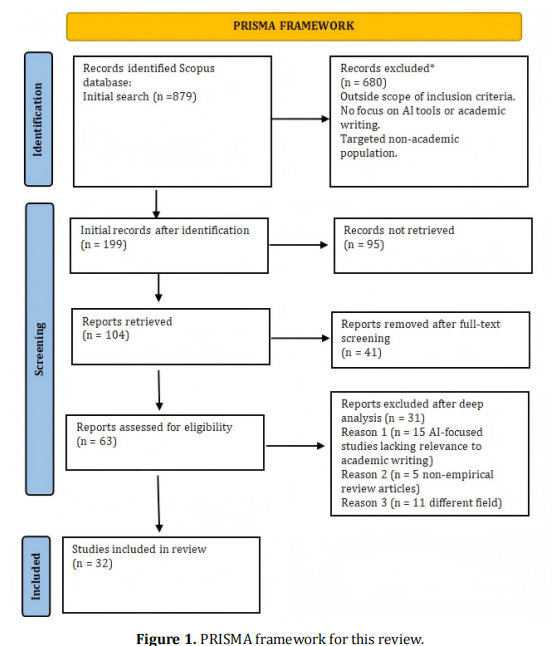
This study explores how artificial intelligence (AI) tools influence the development and improvement of academic writing practices in higher education. To address this objective, a systematic literature review (SLR) was conducted to examine scholarly work related to the use of AI in academic writing. An initial search identified 199 documents, from which 32 studies were retained after applying predefined inclusion and exclusion criteria based on methodological rigor, relevance, and thematic alignment with the research focus. The review integrates systematic literature review procedures with bibliometric and narrative synthesis approaches to examine publication patterns, leading countries and institutions, dominant theoretical perspectives, and emerging research directions in this field. The findings indicate that AI tools increasingly support academic writing through functions such as language generation, editing assistance, idea organization, and improved research efficiency. At the same time, literature highlights important ethical, methodological, and pedagogical challenges that accompany the growing adoption of AI technologies in academic environments. The analysis further identifies several research gaps, particularly in relation to academic integrity, institutional governance, and the development of AI literacy among students and researchers. In response, the study proposes a set of practical recommendations aimed at promoting responsible and effective use of AI in academic writing. These include the development of structured training programmers, clearer institutional guidelines on ethical AI use, and stronger collaboration among educational institutions to enhance responsible technological integration and support the advancement of scientific research.
Keywords:
Artificial Intelligence Academic Writing Systematic Literature Review (SLR)References
- Prakash, A.; Aggarwal, S.; Varghese, J.J. Writing without borders: AI and cross-cultural convergence in academic writing quality. Humanit. Soc. Sci. Commun. 2025, 12, 1058. DOI: https://doi.org/10.1057/s41599-025-05484-6
- Al-Hattami, H.M.; Al-Bukhrani, M.A.; Almasria, N.A.; et al. Exploring student acceptance of digital accounting courses: An empirical analysis. J. Int. Educ. Bus. 2025. DOI: https://doi.org/10.1108/JIEB-01-2025-0009
- Awashreh, R.; Al Ghunaimi, H.; Hassiba, A. A comparison of traditional, online, and hybrid learning models in accounting and finance education: Student perceptions and academic outcomes. Int. J. Adv. Appl. Sci. 2025, 12, 21–34. DOI: https://doi.org/10.21833/ijaas.2025.06.003
- Kelder, J.A.; Crawford, J.; Al Naabi, I.; et al. Enhancing digital productivity and capability in higher education through authentic leader behaviors: A cross-cultural structural equation model. Educ. Inf. Technol. 2025, 30, 17751–17767. DOI: https://doi.org/10.1007/s10639-025-13422-x
- Khalifa, M.; Albadawy, M. Using artificial intelligence in academic writing and research: An essential productivity tool. Comput. Methods Programs Biomed. Update 2024, 5, 100145.
- Alshamy, A.; Al-Harthi, A.S.A.; Abdullah, S. Perceptions of generative AI tools in higher education: Insights from students and academics at Sultan Qaboos University. Educ. Sci. 2025, 15, 501. DOI: https://doi.org/10.3390/educsci15040501
- Wang, L.; Ren, B. Enhancing academic writing in a linguistics course with Generative AI: An empirical study in a higher education institution in Hong Kong. Educ. Sci. 2024, 14, 1329. DOI: https://doi.org/10.3390/educsci14121329
- Kasneci, E.; Seßler, K.; Küchemann, S.; et al. ChatGPT for good? On opportunities and challenges of large language models for education. Learn. Individ. Differ. 2023, 103, 102274.
- Cukurova, M. The interplay of learning, analytics and artificial intelligence in education: A vision for hybrid intelligence. Br. J. Educ. Technol. 2025, 56, 469–488. DOI: https://doi.org/10.1111/bjet.13514
- Nguyen, K.V. The use of generative AI tools in higher education: Ethical and pedagogical principles. J. Acad. Ethics 2025, 23, 1435–1455. DOI: https://doi.org/10.1007/s10805-025-09607-1
- Cotton, D.R.E.; Cotton, P.A.; Shipway, J.R. Chatting and cheating? Ensuring academic integrity in the era of ChatGPT. Innov. Educ. Teach. Int. 2024, 61, 228–239. DOI: https://doi.org/10.1080/14703297.2023.2190148
- Awashreh, R.; Ghunaimi, H.A. Bridging cultural gaps: Enhancing student motivation and academic integrity in Oman’s universities. Forum Linguist. Stud. 2025, 7, 265–279. DOI: https://doi.org/10.30564/fls.v7i2.8300
- Hosseini, M.; Resnik, D.B.; Holmes, K. The ethics of disclosing the use of artificial intelligence tools in writing scholarly manuscripts. Res. Ethics 2023, 19, 361–373. DOI: https://doi.org/10.1177/17470161231180449
- Nasr, N.R.; Tu, C.H.; Werner, J.; et al. Exploring the impact of generative AI (ChatGPT) on critical thinking in higher education: Passive AI-directed use or human–AI supported collaboration? Educ. Sci. 2025, 15, 1198. DOI: https://doi.org/10.3390/educsci15091198
- Almasri, F. Exploring the impact of artificial intelligence in teaching and learning of science: A systematic review of empirical research. Res. Sci. Educ. 2024, 54, 977–997. DOI: https://doi.org/10.1007/s11165-024-10176-3
- Alamäki, A.; Nyberg, C.; Kimberley, A.; et al. Artificial intelligence literacy in sustainable development: A learning experiment in higher education. Front. Educ. 2024, 9, 1343406. DOI: https://doi.org/10.3389/feduc.2024.1343406
- Moher, D.; Liberati, A.; Tetzlaff, J.; et al. Preferred reporting items for systematic reviews and meta-analyses: The PRISMA statement. BMJ 2009, 339, b2535.
- Al Ghunaimi, H.; Almaqtari, F.A.; Almamari, S.; et al. The Role of Digital Advancement and Artificial Intelligence in Improving the Efficiency of Accounting Software to Facilitate Optimal Tax Procedures and Prevent Legal Appeals. In Digital Transformation in Customs and Taxation: A Catalyst for Economic Resilience; Auerbach Publications: Boca Raton, FL, USA, 2025. DOI: https://doi.org/10.1201/9781003498315-8
- Akhmadieva, R.S.; Kalmazova, N.A.; Belova, T.; et al. Research trends in the use of artificial intelligence in higher education. Front. Educ. 2024, 9, 1438715. DOI: https://doi.org/10.3389/feduc.2024.1438715
- Matos, T.; Santos, W.; Zdravevski, E.; et al. A systematic review of artificial intelligence applications in education: Emerging trends and challenges. Decis. Anal. J. 2025, 5, 100027.
- Bulathwela, S.; Pérez-Ortiz, M.; Holloway, C.; et al. Artificial intelligence alone will not democratise education: On educational inequality, techno-solutionism and inclusive tools. Sustainability 2024, 16, 781. DOI: https://doi.org/10.3390/su16020781
- Bahroun, Z.; Anane, C.; Ahmed, V.; et al. Transforming education: A comprehensive review of generative artificial intelligence in educational settings through bibliometric and content analysis. Sustainability 2023, 15, 12983.
- Maphoto, K.B.; Sevnarayan, K.; Mohale, N.E.; et al. Advancing students' academic excellence in distance education: Exploring the potential of generative AI integration to improve academic writing skills. Open Praxis 2024, 16, 142–159.
- Sykes, E.R. AI-Assisted academic writing: A comparative study of student-crafted and ChatGPT-enhanced critiques in ubiquitous computing. Int. J. Adv. Comput. Sci. Appl. 2024, 15. DOI: https://doi.org/10.14569/ijacsa.2024.0150905
- Melliti, M. AI in MA thesis writing: The use of lexical patterns to study the ChatGPT influence. Int. J. TESOL Stud. 2024. DOI: https://doi.org/10.58304/ijts.20240305
- Krajka, J.; Olszak, I. Artificial intelligence tools in academic writing instruction: Exploring the potential of on-demand AI assistance in the writing process. Rocz. Humanist. 2024, 72, 123–140.
- Desaire, H.; Isom, M.; Hua, D. Almost nobody is using ChatGPT to write academic science papers (yet). Big Data Cogn. Comput. 2024, 8, 133.
- Rojas, A.J. An investigation into ChatGPT’s application for a scientific writing assignment. J. Chem. Educ. 2024, 101, 1959–1965.
- Kong, S.C.; Lee, J.C.K.; Tsang, O. A pedagogical design for self-regulated learning in academic writing using text-based generative artificial intelligence tools: 6-P pedagogy of plan, prompt, preview, produce, peer-review, portfolio-tracking. Res. Pract. Technol. Enhanc. Learn. 2024, 19, 030.
- Durak, G.; Cankaya, S. Are alarm bells ringing in academia? ChatGPT as a sample of using chatbots in education. Turk. Online J. Distance Educ. 2024, 25, 1–17.
- Olszak, I. “AI, will you help?” How learners use artificial intelligence when writing. XLinguae 2024, 17, 1–18.
- Werdiningsih, I.; Marzuki; Rusdin, D. Balancing AI and authenticity: EFL students’ experiences with ChatGPT in academic writing. Cogent Arts Humanit. 2024, 11, 2392388.
- Sharifzadeh, R. ChatGPT as co-author? AI and research ethics. Ethics Prog. 2024, 15, 155–173.
- AlAfnan, M.A.; MohdZuki, S.F. Do artificial intelligence chatbots have a writing style? An investigation into the stylistic features of ChatGPT-4. J. Artif. Intell. Technol. 2023, 3, 85–94.
- Nakazawa, E.; Udagawa, M.; Akabayashi, A. Does the use of AI to create academic research papers undermine researcher originality? AI 2022, 3, 702–706.
- Rafida, T.; Suwandi, S.; Ananda, R. EFL students’ perception in Indonesia and Taiwan on using artificial intelligence to enhance writing skills. J. Ilm. Peuradeun 2024, 12, 987–1016.
- Kurt, G.; Kurt, Y. Enhancing L2 writing skills: ChatGPT as an automated feedback tool. J. Inf. Technol. Educ. Res. 2024, 23, 24.
- Teng, M.F. Scientific writing, reviewing, and editing for open-access TESOL journals: The role of ChatGPT. Int. J. TESOL Stud. 2023, 5, 87–91.
- Wang, C.; Li, Z.; Bonk, C. Understanding self-directed learning in AI-assisted writing: A mixed methods study of postsecondary learners. Comput. Educ. Artif. Intell. 2024, 6, 100247.
- Gralha, J.G.; Pimentel, A.S. Gotcha GPT: Ensuring the integrity in academic writing. J. Chem. Inf. Model. 2024, 64, 8091–8097. DOI: https://doi.org/10.1021/acs.jcim.4c01203
- Gawlik-Kobylińska, M. Harnessing artificial intelligence for enhanced scientific collaboration: Insights from students and educational implications. Educ. Sci. 2024, 14, 1132.
- Nguyen, A.; Hong, Y.; Dang, B.; et al. Human–AI collaboration patterns in AI-assisted academic writing. Stud. High. Educ. 2024, 49, 847–864. DOI: https://doi.org/10.1080/03075079.2024.2323593
- Mahapatra, S. Impact of ChatGPT on ESL students’ academic writing skills: A mixed methods intervention study. Smart Learn. Environ. 2024, 11, 9. DOI: https://doi.org/10.1186/s40561-024-00295-9
- Balachandar, A.; Gurusamy, R. Leveraging generative AI tools for effective academic writing. Rev. Educ. Derecho 2024, 30, 1–15. DOI: https://doi.org/10.1344/REYD2024.30.46080
- Parker, J.; Richard, V.M.; Acabá, A.; et al. Negotiating Meaning with Machines: AI's Role in Doctoral Writing Pedagogy. Int. J. Artif. Intell. Educ. 2025, 35, 1218–1238. DOI: https://doi.org/10.1007/s40593-024-00425-x
- Mohammad, T.; Alzubi, A.A.; Nazim, M.; et al. Paraphrasing prowess: Unveiling the insights of EFL students and teachers on QuillBot mastery. Int. J. Inf. Educ. Technol. 2024, 14, 642–650.
- Muthukrishnan, P.; Koo, A.C.; Kunalan, R.; et al. Prospective teachers’ AI literacy and responsible use of AI in assignment writing. Pak. J. Life Soc. Sci. 2024, 22, 7245–7263.
- Teng, M.F. “ChatGPT is the companion, not enemies”: EFL learners’ perceptions and experiences in using ChatGPT for feedback in writing. Comput. Educ. Artif. Intell. 2024, 7, 100270.
- Muhaemin, E.; Lusiana, E.; Khadijah, U.L.S. The correlation between students' information literacy and the utilisation of AI text generator in completing academic studies. Rec. Libr. J. 2024, 10, 319–330.
- He, Y. The metaphor of AI in writing in English: A reflection on EFL learners’ motivation to write, enjoyment of writing, academic buoyancy, and academic success in writing. Int. Rev. Res. Open Distrib. Learn. 2024, 25, 271–286.
- Sword, H.; Rudolph, J.; Ismail, F.; et al. The oxymoronic pursuit of pleasurable academic writing: An interview with Helen Sword. J. Appl. Learn. Teach. 2024, 7. DOI: https://doi.org/10.37074/jalt.2024.7.2.36
- Kramar, N.; Bedrych, Y.; Shelkovnikova, Z. Ukrainian PhD students' attitudes toward AI language processing tools in the context of English for academic purposes. Adv. Educ. 2024, 24, 41–57. DOI: https://doi.org/10.20535/2410-8286.305061
- Santiago, C.S.; Embang, S.I.; Acanto, R.B.; et al. Utilization of writing assistance tools in research in selected higher learning institutions in the Philippines: A text mining analysis. Int. J. Learn. Teach. Educ. Res. 2023, 22, 259–284.