
Articles
Decoding Gendered Symbolism and Motifs in Penina Muhando’s Nguzo Mama: A Computational Literary Analysis
 Download
Authors

Received: 6 September 2025; Revised: 1 October 2025; Accepted: 13 November 2025; Published: 15 December 2025
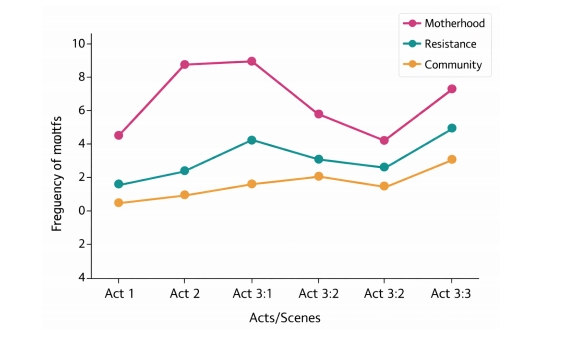
This study offers a computational examination of gendered symbolism and recurring motifs in Penina Muhando’s Nguzo Mama, demonstrating how digital methods can deepen traditional literary interpretation. Employing natural language processing (NLP), topic modeling, and sentiment analysis, the research analyzes patterns of gendered language, thematic structures, and character interactions to uncover how femininity, motherhood, authority, and social agency are symbolically constructed within the narrative. The analysis identifies consistent lexical clusters and thematic networks that foreground women’s roles and highlight tensions embedded in socio-cultural expectations. Sentiment mapping and motif frequency analysis reveal how symbolic imagery and narrative positioning contribute to the negotiation of gender identities and power relations. These findings show that computational techniques can detect latent structures and recurring narrative patterns that may not be immediately apparent through close reading alone. Rather than replacing qualitative interpretation, the study positions computational analysis as a complementary and scalable framework that enhances interpretive depth. By integrating feminist literary theory with digital humanities methodologies, the research contributes to interdisciplinary scholarship and proposes a replicable model for analysing gender representation in literary texts. The study also reflects on methodological considerations, including algorithmic bias, contextual sensitivity, and the interpretive limits of quantitative analysis, underscoring the importance of balanced, theoretically informed application of digital tools in literary studies.
Keywords:
Computational Literary Analysis Gendered Motifs Symbolism Digital Humanities NLP Topic Modeling Sentiment Analysis Feminist Literary StudiesReferences
- Cuddon, J.A. A Dictionary of Literary Terms and Literary Theory, 5th ed.; Wiley-Blackwell: London, UK, 2013. DOI: https://doi.org/10.1002/9781118325988
- Barthes, R. Mythologies; The Noonday Press: New York, NY, USA, 1972.
- Eco, U. A Theory of Semiotics; Indiana University Press: Bloomington, IN, USA, 1976.
- Fitzgerald, F.S. The Great Gatsby; Charles Scribner's Sons: New York, NY, USA, 1925.
- Hawthorne, N. The Scarlet Letter; Cambridge University Press: Cambridge, UK, 2012.
- Achebe, C. Things Fall Apart; Heinemann: London, UK, 1958.
- Orlikowski, W.J.; Baroudi, J. Studying Information Technology in Organisations: Research Approaches and Assumptions. Inf. Syst. Res. 1991, 2, 1–28. DOI: https://doi.org/10.1287/isre.2.1.1
- Moretti, F. Distant Reading; Verso Books: London, UK, 2013.
- Underwood, T. Distant Horizons: Digital Evidence and Literary Change; University of Chicago Press: Chicago, IL, USA, 2019.
- Jockers, M.L. Macroanalysis: Digital Methods and Literary History; University of Illinois Press: Urbana, IL, USA, 2013. Available online: https://www.jstor.org/stable/10.5406/j.ctt2jcc3m
- Blei, D.M.; Ng, A.Y.; Jordan, M.I. Latent Dirichlet Allocation. J. Mach. Learn. Res. 2003, 3, 993–1022.
- Jurafsky, D.; Martin, J.H. Speech and Language Processing; Prentice Hall: Upper Saddle River, NJ, USA, 2020.
- Devlin, J.; Chang, M.W.; Lee, K.; et al. BERT: Pre-Training of Deep Bidirectional Transformers for Language Understanding. In Proceedings of the 2019 Conference of the North American Chapter of the Association for Computational Linguistics: Human Language Technologies, Minneapolis, MN, USA, June 2019; pp. 4171–4186. DOI: https://doi.org/10.18653/v1/N19-1423
- Caria, F.; Mathiak, B. Annotation in Digital Humanities. In Digital Cultural Heritage; Springer: Cham, Switzerland, 2020; pp. 39–50. DOI: https://doi.org/10.1007/978-3-030-15200-0_3
- Smith, R.; Zhang, H.; Li, Y. Overcoming Challenges in the Integration of Information Systems for Strategic Management. Int. J. Inf. Manag. 2023, 68, 102–112.
- Campbell, J.E.; Drucker, D.J. Pharmacology, Physiology, and Mechanisms of Incretin Hormone Action. Cell Metab. 2013, 17, 819–837. DOI: https://doi.org/10.1016/j.cmet.2013.04.008
- Showalter, E. The New Feminist Criticism: Essays on Women, Literature and Theory; Pantheon Books: New York, NY, USA, 1985.
- Smith, J.H.; Kerrigan, W. Pragmatism’s Freud: The Moral Disposition of Psychoanalysis. J. Aesthet. Art Crit. 1987, 45, 427–429.
- Kwon, H.J.; Koo, H.I.; Cho, N.I. Understanding and Explaining Convolutional Neural Networks Based on Inverse Approach. Cogn. Syst. Res. 2022, 77, 142–152. DOI: https://doi.org/10.1016/j.cogsys.2022.10.009
- Aidoo, A.A. Anowa; The Feminist Press: New York, NY, USA, 1993.
- Dangarembga, T. Nervous Conditions; The Women’s Press: London, UK, 1988.
- Bâ, M. So Long a Letter; ProQuest LLC: Cambridge, UK, 2009.
- Arndt, J.; Goldenberg, J.L. From threat to sweat: The role of physiological arousal in the motivation to maintain self-esteem. In Self and Motivation: Emerging Psychological Perspectives; American Psychological Association: Washington, DC, USA, 2002.
- Nnaemeka, O. Nego-Feminism: Theorizing, Practicing and Pruning Africa’s Way. Signs 2004, 29, 357–385. DOI: https://doi.org/10.1086/378553
- Urama, E.N. African Feminist Writers’ Creation of Powerful Voices through Female Characters’ Silence. Vienna J. Afr. Stud. 2024, 24, 135–151.
- Singh, D. Feminist Perspectives in Contemporary African Literature. IOSR J. Res. Method Educ. 2024, 14, 73–80.
- Udom, C.A.; Udom, K.O.; Nkanta, N.C. Women and Role Conflict: Implications for Organizational Growth in Nigeria. In Sociology on the Ascent: A Festschrift in Honour of Professor Ekong Edem Ekong, OFR, FNRSA; University of Uyo: Uyo, Nigeria, 2023; pp. 293–305.
- Goredema, R. African Feminism: The African Woman’s Struggle for Identity. J. Gender Stud. Afr. 2020, 18, 55–70.
- Musila, G. A Death-Retold in African Feminist Texts: Writing, Mourning, and Memory; Routledge: London, UK, 2016.
- Finnegan, R. Oral Literature in Africa; Oxford University Press: Oxford, UK, 2012.
- Chemakh, F. Women and African Drama; Academia: San Francisco, CA, USA, 2014.
- Williams, R. Marxism and Literature; Oxford University Press: Oxford, UK, 1977.
- Lihamba, A. Women, Culture and Development: The Tanzanian Experience; Dar es Salaam Press: Dar es Salaam, Tanzania, 2000.
- Ved, P. Digital humanities and the study of literature. Int. J. Soc. Impact 2025, 10, 212–222. DOI: https://doi.org/10.25215/2455/100119
- Liu, Y.; Ott, M.; Goyal, N.; et al. RoBERTa: A Robustly Optimized BERT Pretraining Approach. arXiv preprint 2020, arXiv:1907.11692.
- Hämäläinen, M.; Pirinen, F.; Macias, M.; et al. The 9th International Workshop on Computational Linguistics for Uralic Languages; Association for Computational Linguistics: Helsinki, Finland, 2024.
- Onunka, O.; Onunka, T. Transforming Library Systems in Africa: Advancing Literacy and Cultural Preservation through Digital Innovation. World J. Adv. Res. Rev. 2024, 24, 1660–1671. DOI: https://doi.org/10.30574/wjarr.2024.24.1.3168
- Concannon, S.; Balaam, M.; Simpson, E.; et al. Applying Computational Analysis to Textual Data from the Wild: A Feminist Perspective. In Proceedings of the 2018 CHI Conference on Human Factors in Computing Systems, Montreal, QC, Canada, 21–26 April 2018. DOI: https://doi.org/10.1145/3173574.3173800
- Nyairo, J. Digital Humanities and African Literary Studies: Expanding Critical Horizons. Afr. Stud. Rev. 2021, 64, 567–582.
- Weena Mae, G. Voices of English Major Students in Literary Criticism Course in the Age of Artificial Intelligence. HCMCOUJS Soci. Educ. 2025, 16, 3–16.
- Jänicke, M. Horizontal and Vertical Reinforcement in Global Climate Governance. Energies 2015, 8, 5782–99. DOI: https://doi.org/10.3390/en8065782
- Underwood, T.; Kimutis, P.; Witte, J. Novel™ Datasets for English-Language Fiction, 1700–2009. J. Cult. Anal. 2020, 5. DOI: https://doi.org/10.22148/001c.13147
- Upadhye, A. A Comprehensive Survey of Text Data Cleaning Techniques: Challenges, Methods, and Best Practices. J. Sci. Eng. Res. 2020, 7, 205–210.
- Li, D.; Kan, W.; Lei, V. Applying Topic Modeling to Literary Analysis: A Review. Digit. Stud. Lang. Lit. 2024, 1, 113–141. DOI: https://doi.org/10.1515/dsll-2024-0010
- Mitlöhner, J.; Neumaier, S.; Umbrich, J.; et al. Characteristics of Open Data CSV Files. In Proceedings of the 2016 2nd International Conference on Open and Big Data (OBD), Vienna, Austria, 22–24 August 2016. DOI: https://doi.org/10.1109/OBD.2016.18
- Graham, N. Converting Books to JSON: A Digital Humanities Project. Available online: https://digitalborn.org/converting-books-to-json-a-digital-humanities-project/ (accessed on 17 March 2025).
- Moretti, F. Conjectures on World Literature. New Left Rev. 2014, 1, 54–68. DOI: https://doi.org/10.64590/hxj
- Hutto, C.J.; Gilbert, E. VADER: A Parsimonious Rule-Based Model for Sentiment Analysis of Social Media Text. Proc. Int. AAAI Conf. Weblogs Soc. Media 2014, 8, 216–225.
- Sawicki, J.; Ganzha, M.; Paprzycki, M. The State of the Art of Natural Language Processing—A Systematic Automated Review of NLP Literature Using NLP Techniques. Data Intell. 2023, 5, 707–749.
- Lim, C.V.; Park, H.-W. Understanding public reactions across time: A sentiment analysis of Itaewon Halloween crowd crush. Digital 2025, 5, 65. DOI: https://doi.org/10.3390/digital5040065
- Elson, D.; Dames, N.; McKeown, K. Extracting Social Networks from Literary Fiction. In Proceedings of the 48th Annual Meeting of the Association for Computational Linguistics, Uppsala, Sweden, July 2010; pp. 138–147.
- Babenko, A.; Athavale, A. Validation Strategies in Computational Literary Studies: Ensuring Reliability in Digital Humanities Research. Digit. Humanit. Q. 2025, 19, 88–104.
- Sanga, D.N. Unpacking Mlama’s Insights on Tanzanian Plays: Towards a Framework for Playwriting. Jarida la Kiswahili 2025, 88, 57–76. DOI: https://doi.org/10.56279/jk.v88i1.4
- Sherstinova, T.; Moskvina, A.; Kirina, M.; et al. Sentiment Analysis of Literary Texts vs. Reader's Emotional Responses. In Proceedings of the 2023 33rd Conference of Open Innovations Association (FRUCT), Zilina, Slovakia, 24–26 May 2023. DOI: https://doi.org/10.23919/FRUCT58615.2023.10143070
- Lomotey, B.A. African women writers across generations: Navigating local contexts and evolving feminist approaches. Gender Stud. 2024, 23, 93–119. DOI: https://doi.org/10.2478/genst-2024-0007
- Darkwah, A.K.; Manuel, S.; Ossome, L.; et al. Feminist Africa; Institute of African Studies, University of Ghana: Accra, Ghana, 2024. Available online: https://feministafrica.net/wp-content/uploads/2024/08/FA-Volume-5-Issue-2.pdf
- Munyangeyo, T. Negotiating Gender-Based Intersecting Cultural Dynamics: Identity, Tradition, and Modern Narratives. Int. J. Afr. Stud. 2025, 8, 45–62.
- Kiritu, E.W.; Mwihia, M.N.; Mwangi, P.M. Reconstructing Masculine Identity in Feminist Literature: A Critical Analysis of Four African Feminist Texts. East Afr. J. Humanit. Soc. Sci. 2025, 4, 201–207.
- Radha, G.; Chandrashekhar, K. Sentiment Analysis on Social Media Opinions: A Survey of Machine Learning and Lexicon-Based Approaches. J. Neonatal Surg. 2025, 14, 24–29. DOI: https://doi.org/10.52783/jns.v14.2176
- Lapina, M.; Prakasha, G.S.; Balakrishnan, D.; et al. DET-2024: International Conference on Distance Education Technologies; Springer: Cham, Switzerland, 2025.