
Research Article
Exploring the Acceptability of AI-Generated Art in a Dementia Care Setting: A Pilot Study
 Download

This work is licensed under a Creative Commons Attribution 4.0 International License.
Copyright
The authors shall retain the copyright of their work but allow the Publisher to publish, copy, distribute, and convey the work.
License
Creative Therapeutic (CT) publishes accepted manuscripts under Creative Commons Attribution 4.0 International (CC BY 4.0). Authors who submit their papers for publication by TI agree to have the CC BY 4.0 license applied to their work, and that anyone is allowed to reuse the article or part of it free of charge for any purpose, including commercial use. As long as the author and original source are properly cited, anyone may copy, redistribute, reuse, and transform the content.
Authors
-
Elizabeta B. Mukaetova-Ladinska
 Department of Psychology and Visual Sciences, University of Leicester, Leicester LE1 7RH, UK
The Evington Centre, Leicester General Hospital, Leicestershire Partnership NHS Trust, Leicester LE5 4QF, UK -
Tracy Harwood
The Evington Centre, Leicester General Hospital, Leicestershire Partnership NHS Trust, Leicester LE5 4QF, UK
Received: 23 February 2025; Revised: 14 April 2025; Accepted: 29 May 2025; Published: 23 June 2025
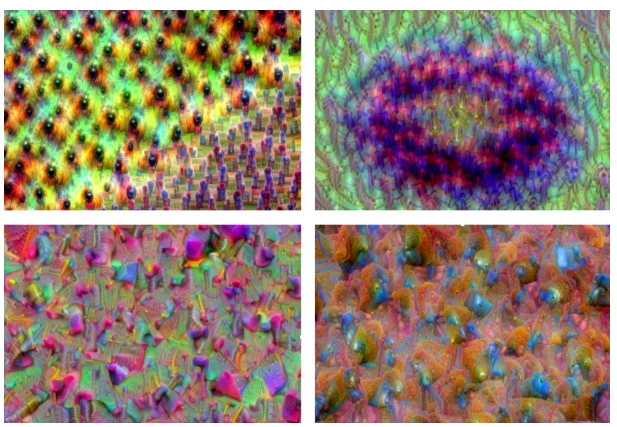
Art enhances both cognitive and non-cognitive, behavioral abilities in people with dementia, as well as overall wellbeing. The use of contemporary art technologies, i.e., creative artificial intelligence (AI), in people with dementia has not been researched to date. We studied the reception of AI art by Gene Kogan, created using Google Deep Dream and Inceptionism algorithms, installed for 4 weeks in a memory clinic. The study consisted of an observational arm of 2,200 service users and their carers attending the memory clinic. Their comments were collected informally by clinical staff. Only three service users (0.1364% visitors) reported an adverse reaction to the exhibited AI-generated art. 17 people (two people with dementia, three carers and 12 healthcare professionals) took part in the quantitative arm using a questionnaire containing the PANAS scale to evaluate perception of and responses to the AI art by older people. Video AI art was well accepted by service users, their carers and healthcare professionals - it resulted in positive emotions and a low rate of negative side effects as demonstrated with the PANAS emotional scale. The uncanny valley effects previously reported in medical studies using assistive technology were not observed, suggesting that older adults irrespective of memory problems may have a distinct acceptance of new emerging technologies. AI art perception was like that of classical art and suggests that AI art has a potential to be used in dementia care, similarly to that of classical and contemporary art.
Keywords:
Artificial Intelligence Art Dementia Service Users CarersReferences
- Fowler, S. Sensory Stimulation: Sensory-Focused Activities for People with Physical and Multiple Disabilities; Jessica Kingsley Publishers: London, UK, 2007.
- Strøm, B.S.; Ytrehus, S.; Grov, E.K. Sensory stimulation for persons with dementia: A review of the literature. J. Clin. Nurs. 2016, 25, 1805–1834. DOI: https://doi.org/10.1111/jocn.13169
- Emblad, S.Y.M.; Mukaetova-Ladinska, E.B. Creative art therapy as a non-pharmacological intervention for dementia: A systematic review. J. Alzheimers Dis. Rep. 2021, 5, 353–364. DOI: https://doi.org/10.3233/ADR-201002
- Zhao, Y.; Li, T.; Wang, H.; et al. Visual art therapy for cognitive and emotional enhancement in aging and dementia: A structured narrative review. J. Alzheimers Dis. Rep. 2025, 9. DOI: https://doi.org/10.1177/25424823251383728
- Chao, S.-Y.; Chen, H.-M.; Su, B.-Y. Shadow puppetry therapy enhances dementia-related cognitive function and interpersonal relationship. Exp. Gerontol. 2025, 199, 112667. DOI: https://doi.org/10.1016/j.exger.2024.112667
- Healy, T.-L.; Thompson, G.; Archibald, M.M. The role of reminiscence in arts-based interventions for dementia care: A scoping review. Dementia 2025, 24, 1334–1351. DOI: https://doi.org/10.1177/14713012251355292
- Christidou, D.; Pierroux, P. Art, touch and meaning making: An analysis of multisensory interpretation in the museum. Mus. Manag. Curatorship 2018, 34, 96–115. DOI: https://doi.org/10.1080/09647775.2018.1516561
- Kjellmer, V. Scented scenographics and olfactory art: Making sense of scent in the museum. Konsthist. Tidskr. 2021, 90, 72–87. DOI: https://doi.org/10.1080/00233609.2020.1775696
- Harwood, T.; Maltby, J.; Mukaetova-Ladinska, E.B. Role of artificial intelligence (AI) art in care of ageing society: Focus on dementia. OBM Geriatr. 2019, 3, 062. DOI: https://doi.org/10.21926/obm.geriatr.1903062
- Hendriks, I.; Meiland, F.J.M.; Slotwinska, K.; et al. How do people with dementia respond to different types of art? An explorative study into interactive museum programs. Int. Psychogeriatr. 2019, 31, 857–868. DOI: https://doi.org/10.1017/S1041610218001266
- Linden, M.; Schermuly-Haupt, M.-L. Definition, assessment and rate of psychotherapy side effects. World Psychiatry 2014, 13, 306–309. DOI: https://doi.org/10.1002/wps.20153
- Watson, D.; Clark, L.A.; Tellegen, A. Development and validation of brief measures of positive and negative affect: The PANAS scales. J. Pers. Soc. Psychol. 1988, 54, 1063–1070. DOI: https://doi.org/10.1037//0022-3514.54.6.1063
- Mori, M. The uncanny valley. Energy 1970, 7, 33–35. (in Japanese)
- Graham, D.; Stockinger, S.; Leder, H. An island of stability: Art images and natural scenes–but not natural faces–show consistent esthetic response in Alzheimer's-related dementia. Front. Psychol. 2013, 4, 107. DOI: https://doi.org/10.3389/fpsyg.2013.00107
- Selberg, S. Modern art as public care: Alzheimer's and the aesthetics of universal personhood. Med. Anthropol. Q. 2015, 29, 473–491. DOI: https://doi.org/10.1111/maq.12199
- Hernández Belver, M.; Hernández Ullán, C. From Velázquez to Picasso: Proposal of artistic mediation activities for people with dementia. Barcelona Res. Art Creat. 2019, 7, 10–29. DOI: https://doi.org/10.17583/brac.2019.3820
- Shortway, K.M.; Prajapati, S.; Donald, B.; et al. A preliminary investigation of the effects of one yoga session for service recipients in a behavioral health intensive outpatient program. Complement. Ther. Clin. Pract. 2018, 31, 91–95. DOI: https://doi.org/10.1016/j.ctcp.2018.02.002
- Patel, N.K.; Nivethitha, L.; Mooventhan, A. Effect of a yoga based meditation technique on emotional regulation, self-compassion and mindfulness in college students. Explore (NY) 2018, 14, 443–447. DOI: https://doi.org/10.1016/j.explore.2018.06.008
- Mulasso, A.; Argiolu, L.; Roppolo, M.; et al. Emotion experience and frailty in a sample of Italian community-dwelling older adults. Clin. Interv. Aging 2017, 12, 2017–2024. DOI: https://doi.org/10.2147/CIA.S147121
- Tan, J.R.O.; Boersma, P.; Ettema, T.P.; et al. Getting to know the person: Participatory development of the artistic person-centered fotoscope web-app in Dutch nursing homes. Disabil. Rehabil. 2025, 48, 2447–2468. DOI: https://doi.org/10.1080/09638288.2025.2555967
- Littman-Ovadia, H.; Russo-Netzer, P. Prioritizing positivity across the adult lifespan: Initial evidence for differential associations with positive and negative emotions. Qual. Life Res. 2019, 28, 411–420. DOI: https://doi.org/10.1007/s11136-018-2012-3
- Henry, J.D.; Phillips, L.H.; Ruffman, T.; et al. A meta-analytic review of age differences in theory of mind. Psychol. Aging 2013, 28, 826–839. DOI: https://doi.org/10.1037/a0030677
- Rosenthal-von der Pütten, A.M.; Krämer, N.C.; Maderwald, S.; et al. Neural mechanisms for accepting and rejecting artificial social partners in the uncanny valley. J. Neurosci. 2019, 39, 6555–6570. DOI: https://doi.org/10.1523/JNEUROSCI.2956-18.2019
- Liu, A.; Jain, N.; Vyas, A.; et al. Ventromedial prefrontal cortex stimulation enhances memory and hippocampal neurogenesis in the middle-aged rats. eLife 2015, 4, e04803. DOI: https://doi.org/10.7554/eLife.04803
- Biddle, K.S.; Boggs, L.M.; Wolfe, M.L.; et al. Healing ceilings: A collaborative exploration of pediatric preferences in ceiling tile artwork. J. Pediatr. Nurs. 2025, 81, E96–E105. DOI: https://doi.org/10.1016/j.pedn.2025.02.005
- Nanda, U.; Chanaud, C.M.; Brown, L.; et al. Pediatric art preferences: Countering the "one-size-fits-all" approach. HERD-Health Env Res. 2009, 2, 46–61. DOI: https://doi.org/10.1177/193758670900200403
- Rogers, T.T.; Graham, K.S.; Patterson, K. Semantic impairment disrupts perception, memory, and naming of secondary but not primary colours. Neuropsychologia 2015, 76, 276–288. DOI: https://doi.org/10.1016/j.neuropsychologia.2015.05.022
- Kao, Y.; Huang, K.; Maybank, S. Hierarchical aesthetic quality assessment using deep convolutional neural networks. Signal Process. Image Commun. 2016, 47, 500–510. DOI: https://doi.org/10.1016/j.image.2016.05.004
- El Haj, M.; Antoine, P. Reduced contextual information during future thinking in Alzheimer's disease. Curr. Alzheimer Res. 2021, 18, 876–883. DOI: https://doi.org/10.2174/1567205019666211216101901
- Mangoulia, P.; Milionis, C.; Vlachou, E.; et al. The interrelationship between diabetes mellitus and emotional well-being: Current concepts and future prospects. Healthcare 2024, 12, 1457. DOI: https://doi.org/10.3390/healthcare12141457
- Parvari, P.R.; Schofield, D. Dementia therapy: The role of gamified AI and digital art in supporting cognitive and emotional well-being. Procedia Comput. Sci. 2025, 256, 1391–1398. DOI: https://doi.org/10.1016/j.procs.2025.02.253