
Review Article
Scientific Evidence Supporting Narrative Therapy and Therapeutic Writing in Treating Diseases—A Literature Review about Online Support Groups
 Download

This work is licensed under a Creative Commons Attribution 4.0 International License.
Copyright
The authors shall retain the copyright of their work but allow the Publisher to publish, copy, distribute, and convey the work.
License
Creative Therapeutic (CT) publishes accepted manuscripts under Creative Commons Attribution 4.0 International (CC BY 4.0). Authors who submit their papers for publication by TI agree to have the CC BY 4.0 license applied to their work, and that anyone is allowed to reuse the article or part of it free of charge for any purpose, including commercial use. As long as the author and original source are properly cited, anyone may copy, redistribute, reuse, and transform the content.
Authors
-
Catarina Santo
 Department of Psychology, Faculdade de Artes e Humanidades, Universidade da Madeira, 9000 Funchal, Portugal
-
Inês dos Santos Silva
2256.c.Health, 1269‑039 Lisboa, Portugal
-
Luísa Soares
Department of Psychology, Faculdade de Artes e Humanidades, Universidade da Madeira, 9000 Funchal, Portugal
Received: 15 April 2025; Revised: 2 June 2025; Accepted: 9 June 2025; Published: 16 June 2025
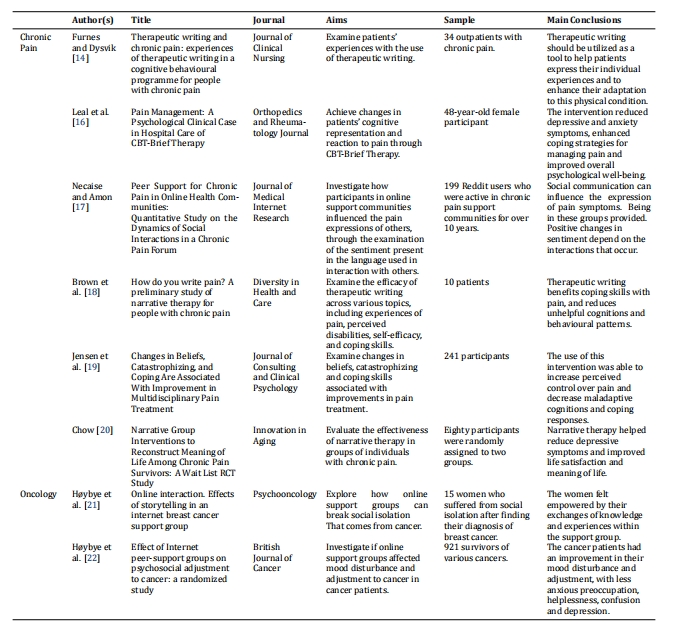
Illness of any kind entails a range of physical, cognitive, and, most notably, emotional consequences, which may lead to experiences of fear, pain, and social isolation. Narrative therapy and therapeutic writing, particularly when implemented in groups of individuals sharing similar conditions and facilitated through online platforms, offer valuable opportunities for sharing experiences and providing mutual support. This study aims to present an innovative perspective on the significance of online communities for patients and social support groups, emphasizing their potential to facilitate connections among individuals facing similar circumstances and to promote a sense of belonging, emotional support, and enhanced psychological well-being. A comprehensive literature review was conducted to identify and analyze scientific evidence on the effectiveness of narrative therapy and therapeutic writing in managing different health conditions. Searches were performed in databases such as PubMed, Scopus, PsycINFO, and Web of Science. The focus was on empirical research assessing psychological or physiological outcomes of narrative-based interventions. Relevant data were extracted and qualitatively synthesized through a integrative analysis to identify key findings, theoretical trends, and research gaps. The application of narrative therapy within online social support groups yielded positive outcomes, contributing to the alleviation of symptoms and improvement in emotional well-being among individuals affected by diverse health conditions. The integration of narrative therapy and therapeutic writing into online social support settings enables individuals to articulate their emotions, fears, and uncertainties in a supportive environment. This process cultivates a sense of community and belonging, thereby fostering emotional resilience and overall psychological well-being.
Keywords:
Narrative Therapy Therapeutic Writing Support Groups Informal Caregivers Online Communities Reframing WhatsAppReferences
- Santos, P.J.P. Research Studies in Narrative Clinical Psychology – Contributions of Narrative Therapy to the Process of Complicated Grief: A Systematic Review. Master’s Thesis, Universidade da Madeira, Funchal, Portugal, 2024. (in Portuguese)
- Ngazimbi, E.E.; Lambie, G.W.; Shillingford, M.A. The Use of Narrative Therapy with Clients Diagnosed with Bipolar Disorder. J. Creat. Ment. Health 2008, 3, 157–174. DOI: https://doi.org/10.1080/15401380802226661
- Chow, E.O. Narrative Therapy: An Evaluated Intervention to Improve Stroke Survivors’ Social and Emotional Adaptation. Clin. Rehabil. 2015, 29, 315–326. DOI: https://doi.org/10.1177/0269215514544039
- Koganei, K.; Asaoka, Y.; Nishimatsu, Y.; et al. Women’s Psychological Experiences in a Narrative Therapy-Based Group: An Analysis of Participants’ Writings and Beck Depression Inventory–Second Edition. Jpn. Psychol. Res. 2021, 63, 466–475. DOI: https://doi.org/10.1111/jpr.12326
- Percy, I.; Paré, D. Narrative Therapy and Mindfulness: Intention, Attention, Ethics. Part 2. J. Syst. Ther. 2021, 40, 1–11. DOI: https://doi.org/10.1521/jsyt.2021.40.4.1
- Paiva, T.C.; Faria, A.L.; Soares, L. Therapeutic Writing and the Grieving Process of Mothers Who Experienced Early Pregnancy Loss – Narrative Wellbeing. J. Poetry Ther. 2025, 38, 88–114. DOI: https://doi.org/10.1080/08893675.2024.2376105
- Paiva, T.C. Research Studies in Narrative Clinical Psychology – Therapeutic Writing and the Grieving Process of Mothers Who Experienced Early Pregnancy Loss: Narrative Well-Being. Master’s Thesis, Universidade da Madeira, Funchal, Portugal, 2024. (in Portuguese)
- Chow, E.O. Narrative Group Intervention to Reconstruct Meaning of Life among Stroke Survivors: A Randomized Clinical Trial Study. Neuropsychiatry 2018, 8, 1216–1226. DOI: https://doi.org/10.4172/Neuropsychiatry.1000450
- Buckman, R.; Kinney, D.; Reese, A. Narrative Therapies. In Theoretical Perspectives for Direct Social Work Practice; Coady, N., Lehmann, P., Eds.; Springer: New York, NY, USA, 2008; pp. 386–416.
- Babar, A.; Nosheen, N.; Ahsan, L. Exploring the Effectiveness of Narrative Therapy among Prolonged Grief Disorder. J. Asian Dev. Stud. 2024, 13, 66–81. DOI: https://doi.org/10.62345/jads.2024.13.4.5
- Burgin, E.C.; Gibbons, M.M. “More Life, Not Less”: Using Narrative Therapy with Older Adults with Bipolar Disorder. Adultspan J. 2016, 15, 49–61.
- Leal, T.V. Research Studies in Narrative Clinical Psychology – Therapeutic Writing in Palliative Care: A Systematic Review. Master’s Thesis, Universidade da Madeira, Funchal, Portugal, 2024.
- Bolton, G. “Writing Is a Way of Saying Things I Cannot Say”—Therapeutic Creative Writing: A Qualitative Study of Its Value to People with Cancer Cared for in Cancer and Palliative Healthcare. BMJ Support. Palliat. Care 2008, 34, 40–46. DOI: https://doi.org/10.1136/jmh.2007.000255
- Furnes, B.; Dysvik, E. Therapeutic Writing and Chronic Pain: Experiences of Therapeutic Writing in a Cognitive Behavioural Programme for People with Chronic Pain. J. Clin. Nurs. 2012, 21, 3372–3381.
- Crossley, M.L. Narrative Psychology, Trauma and the Study of Self/Identity. Theory Psychol. 2000, 10, 527–546. DOI: https://doi.org/10.1177/0959354300104005
- Leal, T.; Vieira, M.; Soares, L. Pain Management: A Psychological Clinical Case in Hospital Care of CBT-Brief Therapy. Orthop. Rheumatol. J. 2024, 23, 556113. DOI: https://doi.org/10.19080/OROAJ.2024.23.556113
- Necaise, A.; Amon, M.J. Peer Support for Chronic Pain in Online Health Communities: Quantitative Study on the Dynamics of Social Interactions in a Chronic Pain Forum. J. Med. Internet Res. 2024, 26, e45858.
- Brown, C.A.; Dick, B.D.; Berry, R. How Do You Write Pain? A Preliminary Study of Narrative Therapy for People with Chronic Pain. Divers. Health Care 2010, 7, 43–56.
- Jensen, M.P.; Turner, J.A.; Romano, J.M. Changes in Beliefs, Catastrophizing, and Coping Are Associated with Improvement in Multidisciplinary Pain Treatment. J. Consult. Clin. Psychol. 2001, 69, 655–662. DOI: https://doi.org/10.1037/0022-006X.69.4.655
- Chow, E. Narrative Group Interventions to Reconstruct Meaning of Life among Chronic Pain Survivors: A Wait-List RCT Study. Innov. Aging 2018, 2, 992.
- Høybye, M.T.; Johansen, C.; Tjørnhøj-Thomsen, T. Online Interaction: Effects of Storytelling in an Internet Breast Cancer Support Group. Psychooncology 2005, 14, 211–220. DOI: https://doi.org/10.1002/pon.837
- Høybye, N.T.; Dalton, S.O.; Deltour, I.; et al. Effect of Internet Peer-Support Groups on Psychosocial Adjustment to Cancer: A Randomized Study. Br. J. Cancer 2010, 102, 1348–1354. DOI: https://doi.org/10.1038/sj.bjc.6605646
- Klemm, P.; Bunnell, D.; Cullen, M.; et al. Online Cancer Support Groups. Comput. Inform. Nurs. 2003, 21, 136–142. DOI: https://doi.org/10.1097/00024665-200305000-00010
- Leykin, Y.; Thekdi, S.M.; Shumay, D.M.; et al. Internet Interventions for Improving Psychological Wellbeing in Psycho-Oncology: Review and Recommendations. Psychooncology 2012, 21, 1016–1025. DOI: https://doi.org/10.1002/pon.1993
- Iannopollo, L.; Cristaldi, G.; Feltrin, A. Self-Narrative in a Therapeutic Group Pathway for Cancer Patients. Behav. Sci. 2024, 14, 1–14. DOI: https://doi.org/10.3390/bs14050376
- Benson, J.J.; Oliver, D.P.; Washington, K.T.; et al. Online Social Support Groups for Informal Caregivers of Hospice Patients with Cancer. Eur. J. Oncol. Nurs. 2020, 44, 1–8. DOI: https://doi.org/10.1016/j.ejon.2019.101698
- Leal, T.; Soares, L. Therapeutic Writing in Palliative Care: A Systematic Review – A Death Free of Tubes with Narrative Communication Skills. J. Poetry Ther. 2024, 37, 1–20. DOI: https://doi.org/10.1080/08893675.2024.2413571
- Gavrilovici, O. Narrative Approaches in Palliative Care. Paliatia 2024, 17, 18–21.
- Laskow, T.; Small, L.; Wu, D.S. Narrative Interventions in the Palliative Care Setting: A Scoping Review. J. Pain Symptom Manag. 2019, 58, 696–706. DOI: https://doi.org/10.1016/j.jpainsymman.2019.06.009
- Roikjær, S.; Missel, M.; Bergenholtz, H.; et al. The Use of Personal Narratives in Hospital-Based Palliative Care Interventions: An Integrative Literature Review. Palliat. Med. 2019, 33, 1–17. DOI: https://doi.org/10.1177/0269216319866651
- Liu, Y.; Yang, X.; Zhu, X.; et al. Clinical Experiences of Perinatal Palliative Care after a Stillbirth: A Narrative Therapy for Grief. Am. J. Hosp. Palliat. Med. 2024, 41, 1511–1516. DOI: https://doi.org/10.1177/10499091241228976
- Fonseca, R.; Carvalho, M.; Querido, A.; et al. Therapeutic Letters: A Qualitative Study Exploring Their Influence on the Hope of Parents of Children Receiving Pediatric Palliative Care in Portugal. J. Spec. Pediatr. Nurs. 2021, 26, 1–10. DOI: https://doi.org/10.1111/jspn.12325
- Malik, S.H.; Coulson, N.S. Computer-Mediated Infertility Support Groups: An Exploratory Study of Online Experiences. Patient Educ. Couns. 2008, 73, 105–113. DOI: https://doi.org/10.1016/j.pec.2008.05.024
- Bernadette, S.; O’Connell, L.; Gelgoot, E.N.; et al. Psychological Distress and Use of an Online Infertility Peer Support Forum. Health Psychol. Behav. Med. 2021, 9, 128–148. DOI: https://doi.org/10.1080/21642850.2021.1884556
- Frederiksen, Y.; O’Toole, M.S.; Mehlsen, M.Y.; et al. The Effect of Expressive Writing Intervention for Infertile Couples: A Randomized Controlled Trial. Hum. Reprod. 2016, 32, 391–402. DOI: https://doi.org/10.1093/humrep/dew320
- Romney, J.; Fife, S.T.; Sanders, D.; et al. Treatment of Couples Experiencing Pregnancy Loss: Reauthoring Loss from a Narrative Perspective. Int. J. Syst. Ther. 2021, 32, 134–152. DOI: https://doi.org/10.1080/2692398X.2020.1855621
- Neimeyer, R.A.; Burke, L.; Mackay, M.; et al. Grief Therapy and the Reconstruction of Meaning: From Principles to Practice. J. Contemp. Psychother. 2010, 40, 73–83. DOI: https://doi.org/10.1007/s10879-009-9135-3
- Nelson, K.; Lukawiecki, J.; Waitschies, K.; et al. Exploring the Impacts of an Art and Narrative Therapy Program on Participants’ Grief and Bereavement Experiences. Omega (Westport) 2024, 90, 726–745. DOI: https://doi.org/10.1177/00302228221111726
- Elzen, K.D. Therapeutic Writing through the Lens of the Grief Memoir and Dialogical Self Theory. J. Constr. Psychol. 2021, 34, 218–230. DOI: https://doi.org/10.1080/10720537.2020.1717136
- Santos, P.; Soares, L. Narrative Therapy in Complicated Grief: A Systematic Literature Review. J. Chemother. Cancer Res. 2024, 2, 1–12. DOI: https://doi.org/10.61440/JCCR.2024.v2.13
- Frogge, S. Expressing Your Grief: Healing through Writing; Tragedy Assistance Program for Survivors, Inc.: Arlington, VA, USA, 2022.
- Robinson, C.; Pond, R. Do Online Support Groups for Grief Benefit the Bereaved? Systematic Review of the Quantitative and Qualitative Literature. Comput. Hum. Behav. 2019, 100, 48–59. DOI: https://doi.org/10.1016/j.chb.2019.06.011
- Toyama, H.; Honda, A. Using Narrative Approach for Anticipatory Grief among Family Caregivers at Home. Glob. Qual. Nurs. Res. 2016, 3, 1–15. DOI: https://doi.org/10.1177/2333393616682549
- McCormack, A. Individuals with Eating Disorders and the Use of Online Support Groups as a Form of Social Support. Comput. Inform. Nurs. 2010, 28, 12–19. DOI: https://doi.org/10.1097/NCN.0b013e3181c04b06
- Eichhorn, K.C. Soliciting and Providing Social Support over the Internet: An Investigation of Online Eating Disorder Support Groups. J. Comput.-Mediat. Commun. 2008, 14, 67–78. DOI: https://doi.org/10.1111/j.1083-6101.2008.01431.x
- Hopf, R.B.B.; Grange, D.L.; Moessner, M.; et al. Internet-Based Chat Support Groups for Parents in Family-Based Treatment for Adolescent Eating Disorders: A Pilot Study. Eur. Eat. Disord. Rev. 2012, 21, 215–223. DOI: https://doi.org/10.1002/erv.2196
- Jagfeld, G.; Lobban, F.; Humphreys, C.; et al. How People with a Bipolar Disorder Diagnosis Talk about Personal Recovery in Peer Online Support Forums: Corpus Framework Analysis Using the POETIC Framework. JMIR Med. Inform. 2023, 11, 1–12. DOI: https://doi.org/10.2196/46544
- Mehl-Madrona, L.; Mainguy, B. Comparisons of Narrative Psychotherapy to Conventional CBT for the Psychotherapy of Psychosis and Bipolar Disorder. Eur. Psychiatry 2020, 41, 779. DOI: https://doi.org/10.1016/j.eurpsy.2017.01.1480
- Bauer, R.; Bauer, M.; Spiessl, H.; et al. Cyber-Support: An Analysis of Online Self-Help Forums (Online Self-Help Forums in Bipolar Disorder). Nord. J. Psychiatry 2013, 67, 185–190. DOI: https://doi.org/10.3109/08039488.2012.700734
- Bauer, R.; Conell, J.; Glenn, T.; et al. International Multi-Site Survey on the Use of Online Support Groups in Bipolar Disorder. Nord. J. Psychiatry 2017, 71, 473–476. DOI: https://doi.org/10.1080/08039488.2017.1334819
- Vassallo, T. Narrative Group Therapy with the Seriously Mentally Ill: A Case Study. Aust. N. Z. J. Fam. Ther. 2013, 19, 15–26.
- Highton-Williamson, E.; Priebe, S.; Giacco, D. Online Social Networking in People with Psychosis: A Systematic Review. Int. J. Soc. Psychiatry 2015, 61, 92–101. DOI: https://doi.org/10.1177/0020764014556392
- Castelein, S.; Bruggeman, R.; van Busschbach, J.T.; et al. The Effectiveness of Peer Support Groups in Psychosis: A Randomized Controlled Trial. Acta Psychiatr. Scand. 2008, 118, 64–72. DOI: https://doi.org/10.1111/j.1600-0447.2008.01216.x
- Castelein, S.; Bruggeman, R.; Davidson, L.; et al. Creating a Supportive Environment: Peer Support Groups for Psychotic Disorders. Schizophr. Bull. 2015, 41, 1211–1213. DOI: https://doi.org/10.1093/schbul/sbv113
- Baumel, A.; Correll, C.U.; Birnbaum, M. Adaptation of a Peer-Based Online Emotional Support Program as an Adjunct to Treatment for People with Schizophrenia-Spectrum Disorders. Internet Interv. 2016, 4, 35–42. DOI: https://doi.org/10.1016/j.invent.2016.03.003
- Haker, H.; Lauber, C.; Rössler, W. Internet Forums: A Self-Help Approach for Individuals with Schizophrenia? Acta Psychiatr. Scand. 2005, 112, 474–477. DOI: https://doi.org/10.1111/j.1600-0447.2005.00662.x
- Chien, W.T.; Chan, S.; Morrissey, J.; et al. Effectiveness of a Mutual Support Group for Families of Patients with Schizophrenia. J. Adv. Nurs. 2005, 51, 595–608. DOI: https://doi.org/10.1111/j.1365-2648.2005.03545.x
- Choudhury, M.D.; Kiciman, E. The Language of Social Support in Social Media and Its Effect on Suicidal Ideation Risk. In Proceedings of the Eleventh International AAAI Conference on Web and Social Media, Montréal, QC, Canada, 15–18 May 2017.
- Sørensen, J.B.; Thomassen, J.L.; Konradsen, F.; et al. Online with Suicidal Ideation: How Individuals Communicate in and Perceive a Peer-to-Peer Mediated Social Media Group. Ment. Health Prev. 2023, 32, 1–7. DOI: https://doi.org/10.1016/j.mhp.2023.200303
- Wong, K.; Chan, C.S.; Chan, M.; et al. Who Seeks Help Online? Comparing Online and Offline Help-Seeking Preferences amongst Youths with Suicidal Ideation. J. Affect. Disord. 2021, 292, 21–29. DOI: https://doi.org/10.1016/j.jad.2021.05.056
- Gilat, I.; Tobin, Y.; Shahar, G. Offering Support to Suicidal Individuals in an Online Support Group. Arch. Suicide Res. 2011, 15, 195–206. DOI: https://doi.org/10.1080/13811118.2011.589675
- Direção-Geral da Saúde. Historical Highlights: Increase in the Number of Treatments for Patients with Acute Stroke. Available online: https://www.dgs.pt/em-destaque/aumenta-o-numero-de-tratamentos-a-doentes-com-avc-agudo.aspx (accessed on 7 February 2025). (in Portuguese)
- Soto, A.; Guillén-Grima, F.; Moralez, G.; et al. Prevalence and Incidence of Ictus in Europe: Systematic Review and Meta-Analysis. An. Sist. Sanit. Navar. 2022, 45, 1–16. DOI: https://doi.org/10.23938/ASSN.0979
- Silva, I.S.; Soares, L.; Nicolau, H. The Role of Technology in Enhancing Emotional Wellbeing in Recovery: Integrating WhatsApp for Mutual Support among Care Communities—A Case of Stroke Survivors. ATSK J. Psychol. 2024, 4, 11–26.
- Mulroue, A. Exploring How Narrative Therapy May Facilitate Psychosocial Adjustment Following Stroke. Master’s Thesis, Canterbury Christ Church University, Canterbury, UK, 2013.
- Large, R.; Samuel, V.; Morris, R. A Changed Reality: Experience of an Acceptance and Commitment Therapy (ACT) Group after Stroke. Neuropsychol. Rehabil. 2020, 30, 1477–1496. DOI: https://doi.org/10.1080/09602011.2019.1589531
- Silva, I.S. Emotions2Group—Exploring the Role of Social Media and Emotional Disclosure on a Care Community; Universidade de Lisboa, Instituto Superior Técnico: Lisbon, Portugal, 2025.
- Rodrigues, M.; Silva, I.S.; Soares, L. Supportive Conversations: WhatsApp as a Tool for Social Support among Women Stroke Survivors—A Case Study. Acta Sci. Women’s Health 2025, 7, 72–84.
- Smith, F.E.; Jones, C.; Gracey, F.; et al. Emotional Adjustment Post-Stroke: A Qualitative Study of an Online Stroke Community. Neuropsychol. Rehabil. 2019, 31, 414–431. DOI: https://doi.org/10.1080/09602011.2019.1702561
- Sanini, C.; Santos, L.D.N.; Sattler, M.K. Terapia Narrativa e Neuroplasticidade: Pensando suas Conexões. Pensando Famílias 2021, 25, 272–284.