
Research Article
Prediction of Groundwater Temperature Variation in Riverine Well for the Safe Operation of Groundwater Heat Pump (GWHP) System
 Download

This work is licensed under a Creative Commons Attribution-NonCommercial 4.0 International License.
Copyright
The authors shall retain the copyright of their work but allow the Publisher to publish, copy, distribute, and convey the work.
License
Clean Energy Technologies (CET) publishes accepted manuscripts under Creative Commons Attribution 4.0 International (CC BY 4.0). Authors who submit their papers for publication by Clean Energy Technologies (CET) agree to have the CC BY 4.0 license applied to their work, and that anyone is allowed to reuse the article or part of it free of charge for any purpose, including commercial use. As long as the author and original source is properly cited, anyone may copy, redistribute, reuse and transform the content.
Authors

Received: 1 July 2025 | Revised: 12 August 2025 | Accepted: 16 August 2025 | Published Online: 2 September 2025
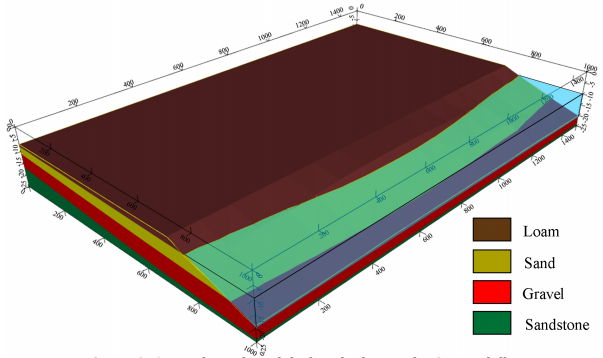
Riverbank filtration is used for producing a large amount of groundwater for a long time. The surface water infiltration is accompanied with riverbank filtration and may significantly affect the quality and temperature of pumping water if the pumping well is located nearby the river. A coupled groundwater flow and heat transport model was developed to estimate the influence of surface water on the temperature in pumping well for groundwater heat pump system at the riverbank. The model included the aquifers under river and considered the variation of surface water temperature with season and depth to simulate accurately pumping water temperature. To depict in detail the aquifers and riverbed sediment in contact with the river, the 3D geological model was developed by Geomodeller, and the numerical model was completed by FEFLOW. For model calibration, the simulation results were compared to the measured groundwater level and temperature data in pumping well during 2 years. The result showed high accuracy with the coefficient of determination (R2) of 0.971, root mean square error (RMSE) of 0.211 ℃. Using calibrated model, the groundwater temperature changes in pumping well were predicted for 15 years. The proposed modeling method can be used to estimate the groundwater flow, quality, and temperature change by the surface water infiltration in riverine aquifer.
Keywords:
Numerical Modeling Groundwater Flow Heat Transport Riverbank Filtration River‑Aquifer Interaction GWHPReferences
- Ray, C., Melin, G., Linsky, R.B., 2002. Riverbank Filtration. Kluwer Academic Publishers: Dordrecht, The Netherlands. pp. 1–72.
- Epting, J., Michel, A., Affolter, A., et al., 2021. Climate change effects on groundwater recharge and temperatures in Swiss alluvial aquifers. Journal of Hydrology X. 11, 100071. DOI: https://doi.org/10.1016/j.hydroa.2020.100071
- Mas-Pla, J., Font, E., Astui, O., et al., 2012. Development of a stream–aquifer numerical flow model to assess river water management under water scarcity in a Mediterranean basin. Science of the Total Environment. 440, 204–218. DOI: https://doi.org/10.1016/j.scitotenv.2012.07.012
- Rushton, K., 2007. Representation in regional models of saturated river–aquifer interaction for gaining/losing rivers. Journal of Hydrology. 334, 262–281. DOI: https://doi.org/10.1016/j.jhydrol.2006.10.008
- Doppler, T., Franssen, H.H., Kaiser, H.P., et al., 2007. Field evidence of a dynamic leakage coefficient for modelling river–aquifer interactions. Journal of Hydrology. 347, 177–187. DOI: https://doi.org/10.1016/j.jhydrol.2007.09.017
- Maharjan, M., Donovan, J.J., 2018. Heat flow into intermittently-pumped wells within unconfined alluvial aquifer. Journal of Hydrology. 567, 533–545. DOI: https://doi.org/10.1016/j.jhydrol.2018.10.052
- Gerecht, K.E., Cardenas, M.B., Guswa, A.J., et al., 2011. Dynamics of hyporheic flow and heat transport across a bed-to-bank continuum in a large regulated river. Water Resources Research. 47(3), 1–12. DOI: https://doi.org/10.1029/2010WR009794
- Ebrahim, G.Y., Hamonsts, K., Griensven, A., et al., 2013. Effect of temporal resolution of water level and temperature inputs on numerical simulation of groundwater–surface water flux exchange in a heavily modified urban river. Hydrological Processes. 27(11), 1634–1645. DOI: https://doi.org/10.1002/hyp.9310
- Hassen, I., Milnes, E., Gibson, H., et al., 2019. Impact of groundwater flow across tectonic aquifer compartments in a Miocene sandstone aquifer: three-dimensional hydrogeological modeling of the Kasserine aquifer system in central Tunisia and northeastern Algeria. Hydrogeology Journal. 27, 1345–1361. DOI: https://doi.org/10.1007/s10040-019-01931-2
- Henzler, A.F., Greskowiak, J., Massmann, G., 2014. Modeling the fate of organic micropollutants during river bank filtration (Berlin, Germany). Journal of Contaminant Hydrology. 156, 78–92. DOI: https://doi.org/10.1016/j.jconhyd.2013.10.005
- Al-Madhlom, Q., Jassim, S.A., Muttaleb, R., 2024. The influence of regional groundwater flow and a neighbouring river on the behaviour of an aquifer thermal energy storage system. Water. 16(4), 548. DOI: https://doi.org/10.3390/w16040548
- Matusiak, M., Dragon, K., Gorski, J., et al., 2021. Surface water and groundwater interaction at long-term exploited riverbank filtration site based on groundwater flow modeling (Mosina-Krajkowo Poland). Journal of Hydrology: Regional Studies. 37, 100882. DOI: https://doi.org/10.1016/j.ejrh.2021.100882
- Wang, W.S., Oswald, S.E., Graff, T., et al., 2019. Impact of river reconstruction on groundwater flow during bank filtration assessed by transient three-dimensional modeling of flow and heat transport. Hydrogeology Journal. 28, 723–743. DOI: https://doi.org/10.1007/s10040-019-02063-3
- Russo, S.L., Gnavi, L., Rocci, E., et al., 2014. Groundwater heat pump (GWHP) system modeling and thermal affected zone (TAZ) prediction reliability: influence of temporal variations in flow discharge and injection temperature. Geothermics. 51, 103–112. DOI: https://dx.doi.org/10.1016/j.geothermics.2013.10.008
- Rock, G., Kupfersberger, H., 2018. 3D modeling of groundwater heat transport in the shallow Westliches Leibnitzer Feld aquifer, Austria. Journal of Hydrology. 557, 668–678. DOI: https://doi.org/10.1016/j.jhydrol.2017.12.060
- Li, Y., Shu, L., Xiao, R., et al., 2023. How groundwater flow field change affects heat transfer in groundwater heat pumps based on physical experiments. Energy and Buildings. 282, 112804. DOI: https://doi.org/10.1016/j.enbuild.2023.112804
- Wu, Q., Xu, S.H., Zhou, W.F., et al., 2015. Hydrogeology and design of groundwater heat pump systems. Environmental Earth Sciences. 73, 3683–3695. DOI: https://doi.org/10.1007/s12665-014-3654-2
- Sezer, T., Sani, A.K., Singh, R.M., et al., 2024. Numerical investigation of a district scale groundwater heat pump system: a case study from Colchester, UK. Applied Thermal Engineering. 236, 121915. DOI: https://doi.org/10.1016/j.applthermaleng.2023.121915
- Permanda, R., Ohtani, T., 2022. Thermal impact by open-loop geothermal heat pump systems in two different local underground conditions on the alluvial fan of the Nagara River, Gifu City, Central Japan. Energies. 15, 6816. DOI: https://doi.org/10.3390/en15186816
- Baquedano, C., Garcia-Gil, A., Marazuela M.A., et al., 2022. The efficiency loss in groundwater heat pump systems triggered by thermal recycling. Renewable Energy. 200, 1458–1468. DOI: https://doi.org/10.1016/j.renene.2022.10.096
- Previati, A., Epting, J., Crosta, G.B., 2022. The subsurface urban heat island in Milan (Italy)—A modeling approach covering present and future thermal effects on groundwater regimes. Science of the Total Environment. 810, 152119. DOI: http://dx.doi.org/10.1016/j.scitotenv.2021.152119
- Derx, J., Blaschke, A.P., Blöschl, G., 2010. Three-dimensional flow patterns at the river–aquifer interface—A case study at the Danube. Advances in Water Resources. 33(11), 1375–1387. DOI: https://doi.org/10.1016/j.advwatres.2010.04.013
- Nützmann, G., Levers, C., Lewandowski, J., 2014. Coupled groundwater flow and heat transport simulation for estimating transient aquifer–stream exchange at the lowland River Spree (Germany). Hydrological Processes. 28(13), 4078–4090. DOI: https://doi.org/10.1002/hyp.9932
- Munz, M., Oswald, S.E., Schmidt, C., 2017. Coupled long-term simulation of reach-scale water and heat fluxes across the river–groundwater interface for retrieving hyporheic residence times and temperature dynamic. Water Resources Research. 53(11), 8900–8924. DOI: https://doi.org/10.1002/2017WR020667
- Banks, D., 2008. An Introduction to Thermogeology: Ground Source Heating and Cooling. Blackwell Publishing: Oxford, UK. pp. 33–56.