
Research Article
IoT‑Integrated Hydrogen Fuel Cells for Reliable and Sustainable Power Generation in China’s Inner Mongolia and Hebei Regions
 Download

This work is licensed under a Creative Commons Attribution-NonCommercial 4.0 International License.
Copyright
The authors shall retain the copyright of their work but allow the Publisher to publish, copy, distribute, and convey the work.
License
Clean Energy Technologies (CET) publishes accepted manuscripts under Creative Commons Attribution 4.0 International (CC BY 4.0). Authors who submit their papers for publication by Clean Energy Technologies (CET) agree to have the CC BY 4.0 license applied to their work, and that anyone is allowed to reuse the article or part of it free of charge for any purpose, including commercial use. As long as the author and original source is properly cited, anyone may copy, redistribute, reuse and transform the content.
Authors
-
Emran Ullah Khan
 Department of Electrical Engineering, CECOS University of IT and Emerging Sciences, Peshawar 25000, Pakistan
-
Ateeb Ali Khan
Department of Information Engineering Technology, University of Technology, Nowshera 24300, Pakistan
-
Saad Ijaz Majid
Department of Information Engineering Technology, University of Technology, Nowshera 24300, Pakistan
-
Muhammad Bilal
Department of Information Engineering Technology, University of Technology, Nowshera 24300, Pakistan
- Fozia Bari Hameed Awan and Associates, Peshawar 25100, Pakistan
Received: 9 July 2025 | Revised: 27 August 2025 | Accepted: 30 August 2025 | Published Online: 15 September 2025
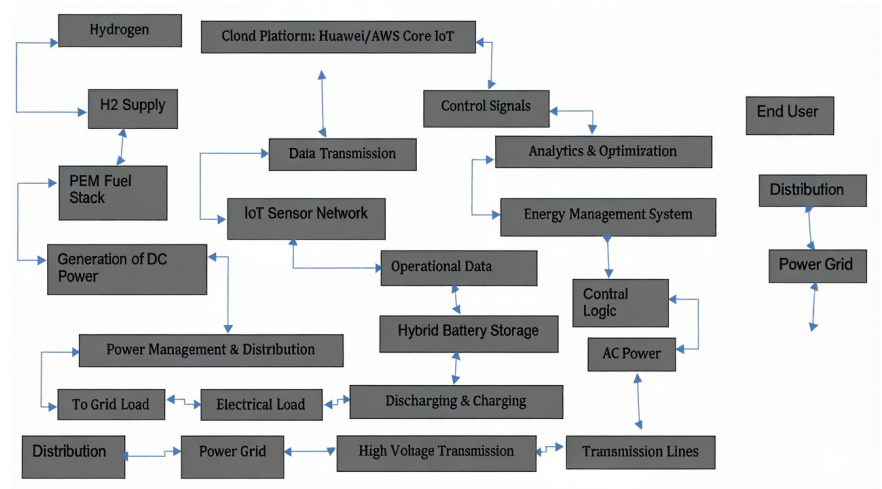
Our research focuses on IoT-integrated hydrogen fuel cells for clean energy in Inner Mongolia and Hebei, China. The system features a 100 kW PEMFC array (65–80 ℃, 98% pure H2, 850 mbar) paired with an optimized AWS IoT Cloud using MQTT/LoRaWAN for 1 Hz data communication. AI-driven EMS optimizes operations (35–85% load, 30–80% battery charge), while predictive maintenance via Random Forests achieves 96% fault detection, maintaining 5 mΩ membrane resistance and 0.8% voltage deviation. The system consumes 4.1 kg/h of H2, operates for 720 h (−25 ℃ to 38 ℃, 20–100 kW load), and reduces unscheduled downtime by 68%. Estimated results show 58% efficiency, 28% battery cycle reduction, and 814 t of annual CO2 savings per unit. Advanced security (AES-256/TLS, blockchain) ensures data integrity, supporting clean energy access and industrial growth in remote regions. The proposed system holds significance in adding sustainable energy, but it is challenged by high initial cost, extreme range of weather adaptability, complications in scalability, and industrial acceptance. These challenges are addressed by feasible solutions, including the cost reduction through mass production, advanced hydrogen infrastructure development, data security with cybersecurity enhancements (AES-256/TLS, blockchain), and thermal management. The research paper aims to add a feasible and sustainable technology helping in achieving energy goals set for China’s futuristic industrial growth, and ensuring sustainable energy access in Inner Mongolia and the Hebei region.
Keywords:
Internet of Things (IoT) Proton Exchange Membrane Fuel Cells (PEMFCs) Machine Learning (ML) Message Queuing Telemetry Transport (MQTT) LoRaWAN Sustainable Energy Weather Adaptability Industrial GrowthReferences
- Ahluwalia, A., 2024. Leveraging IoT for Smart Grids and Energy Management in Electrical Systems: Applications, Benefits, and Challenges. Journal of Electrical Systems. 20(2), 2802–2809. DOI: https://doi.org/10.52783/jes.6853
- Akyuz, E., Çobanoğlu, İ., Demircan, B., 2025. Internet of Things and Cloud-Based Monitoring of an Electrolysis and Fuel Cell System. Journal of Scientific & Industrial Research. 84(7). DOI: https://doi.org/10.56042/jsir.v84i7.14515
- Alblehai, F., 2025. Artificial intelligence-driven cybersecurity system for internet of things using self-attention deep learning and metaheuristic algorithms. Scientific Reports. 15(1), 13215. DOI: https://doi.org/10.1038/s41598-025-98056-2
- Alhasnawi, B.N., Hashim, H.K., Zanker, M., et al., 2025. The rising, applications, challenges, and future prospects of energy in smart grids and smart cities systems. Energy Conversion and Management: X. 27, 101162. DOI: https://doi.org/10.1016/j.ecmx.2025.101162
- Bagdadee, A.H., Rahman, Md.S., Al Mamoon, I., et al., 2025. Empowering smart homes by IoT-driven hybrid renewable energy integration for enhanced efficiency. Scientific Reports. 15(1), 41491. DOI: https://doi.org/10.1038/s41598-025-25328-2
- Basu, M., 2025. Effect of fuel constraints on day-ahead optimal bidding strategy for power, clean water and hydrogen dispatch of microgrid. International Journal of Hydrogen Energy. 138, 733–744. DOI: https://doi.org/10.1016/j.ijhydene.2025.05.119
- Bekmyrza, K.Z., Kuterbekov, K.A., Kabyshev, A.M., et al., 2025. Integrating machine learning and IoT in hydrogen production, storage, and distribution for a decarbonized transport future. International Journal of Low-Carbon Technologies. 20, 1554–1570. DOI: https://doi.org/10.1093/ijlct/ctaf103
- Castañeda-Arias, N., Díaz-Aldana, N.L., Hernandez, A.L., et al., 2025. Energy Management in Microgrid Systems: A Comprehensive Review Toward Bio-Inspired Approaches for Enhancing Resilience and Sustainability. Electricity. 6(4), 73. DOI: https://doi.org/10.3390/electricity6040073
- Chizubem, B., Subbiah, A., Izuchukwu, O.C., et al., 2025. Real-time monitoring using digital platforms for enhanced safety in hydrogen facilities—Current perspectives and future directions. International Journal of Hydrogen Energy. 98, 487–499. DOI: https://doi.org/10.1016/j.ijhydene.2024.12.128
- Ribeiro, B., Baptista, J., Cerveira, A., 2025. Optimizing Renewable Microgrid Performance Through Hydrogen Storage Integration. Algorithms. 18(10), 656. DOI: https://doi.org/10.3390/a18100656
- Gao, J., Tan, Q., Cui, B., 2024. Reducing Carbon Emissions from Coal-Fired Power Plants: An Analysis Using Evolutionary Game Theory. Sustainability. 16(23), 10550. DOI: https://doi.org/10.3390/su162310550
- Gao, L., He, S., Zheng, Y., et al., 2025. Decarbonizing and transforming coal-fired power plants into hybrid cycle systems using CaL-CLC process: A comprehensive techno-economic-environmental evaluation. Journal of Environmental Chemical Engineering. 13(6), 119867. DOI: https://doi.org/10.1016/j.jece.2025.119867
- Zheng, Y., Jia, J., An, D., 2025. Energy Management for Microgrids with Hybrid Hydrogen-Battery Storage: A Reinforcement Learning Framework Integrated Multi-Objective Dynamic Regulation. Processes. 13(8), 2558. DOI: https://doi.org/10.3390/pr13082558
- Kumar, A., Maulik, A., Chinmaya, K.A., 2025. Energy Management Strategies for Active Distribution Networks and Microgrids—A Comprehensive Survey. IETE Technical Review. 42(4), 502–541. DOI: https://doi.org/10.1080/02564602.2025.2522083
- Kushal, K.A., Gueniat, F., 2025. AI-Enhanced IoT Systems for Predictive Maintenance and Affordability Optimization in Smart Microgrids: A Digital Twin Approach. arXiv preprint. arXiv:2511.12175. DOI: https://doi.org/10.48550/arXiv.2511.12175
- Liu, X., Yu, H., Liu, H., et al., 2025. Multi-Factor Carbon Emissions Prediction in Coal-Fired Power Plants: A Machine Learning Approach for Carbon Footprint Management. Energies. 18(7), 1715. DOI: https://doi.org/10.3390/en18071715
- Lugo, J.V., Torres, N.N.S., Cavalcante, R.D.L.D.S., et al., 2025. Evaluation of Technological Alternatives for the Energy Transition of Coal-Fired Power Plants, with a Multi-Criteria Approach. Energies. 18(17), 4473. DOI: https://doi.org/10.3390/en18174473
- Mallala, B., Manyam, R.R., Saini, J., et al., 2025. IoT enabled smart power quality analysis in three phase electrical systems with practical implementation. Scientific Reports. 15(1), 39665. DOI: https://doi.org/10.1038/s41598-025-23317-z
- Moazzen, F., Hossain, M., Li, L., et al., 2025. Energy Management Under Uncertainty for Hybrid Microgrids: From Data to Decision‐Making. IET Renewable Power Generation. 19(1), e70174. DOI: https://doi.org/10.1049/rpg2.70174
- Moss, J., Gordon, J., Duclos, W., et al., 2025. Explainable AI in IoT: A Survey of Challenges, Advancements, and Pathways to Trustworthy Automation. Electronics. 14(23), 4622. DOI: https://doi.org/10.3390/electronics14234622
- Mutambik, I., 2025. AI-Driven Cybersecurity in IoT: Adaptive Malware Detection and Lightweight Encryption via TRIM-SEC Framework. Sensors. 25(22), 7072. DOI: https://doi.org/10.3390/s25227072
- Qamar, H.G.M., Guo, X., Ahmad, F., 2024. Intelligent energy management system of hydrogen based microgrid empowered by AI optimization technique. Renewable Energy. 237, 121738. DOI: https://doi.org/10.1016/j.renene.2024.121738
- Qi, N., Huang, K., Fan, Z., et al., 2025. Long-Term Energy Management for Microgrid with Hybrid Hydrogen-Battery Energy Storage: A Prediction-Free Coordinated Optimization Framework. Applied Energy. 377, 124485. DOI: https://doi.org/10.1016/j.apenergy.2024.124485
- Sarwar, F.A., Hernando‐Gil, I., Vechiu, I., 2024. Review of energy management systems and optimization methods for hydrogen‐based hybrid building microgrids. Energy Conversion and Economics. 5(4), 259–279. DOI: https://doi.org/10.1049/enc2.12126
- Shi, T., Zhou, H., Shi, T., et al., 2024. Research on Energy Management in Hydrogen–Electric Coupled Microgrids Based on Deep Reinforcement Learning. Electronics. 13(17), 3389. DOI: https://doi.org/10.3390/electronics13173389
- Thankaraj Ambujam, S., Mallala, B., Aggarwal, P.K., et al., 2025. Enhanced IoT-enabled community microgrid energy management with hybrid COA-HQNN approach with battery degradation consideration. Journal of Energy Storage. 107, 114739. DOI: https://doi.org/10.1016/j.est.2024.114739.
- Wang, R., Cai, W., Cui, R.Y., et al., 2025. Reducing transition costs towards carbon neutrality of China’s coal power plants. Nature Communications. 16(1), 241. DOI: https://doi.org/10.1038/s41467-024-55332-5
- Wang, S., Bi, Y., Shi, J., et al., 2025. Real-time reconstruction of hydrogen leakage concentration field based on transient sparse monitoring data in hydrogen refueling stations. Renewable Energy. 254, 123690. DOI: https://doi.org/10.1016/j.renene.2025.123690
- Wang, X., Xiao, X., Su, C., et al., 2025. Strategic Decision-Making for Carbon Capture, Utilization, and Storage in Coal-Fired Power Plants: The Roles of Pollution Right Trading and Environmental Benefits. Systems. 13(10), 919. DOI: https://doi.org/10.3390/systems13100919
- Yang, B., Ma, K., Lin, J., et al., 2025. Black-Start Power Capacity Sizing and Control Strategy for an Islanded DFIG Wind-to-Hydrogen System. arXiv preprint. arXiv:2512.16263. DOI: https://doi.org/10.48550/arXiv.2512.16263
- Zhang, Y.-L., Kang, J.-N., Liu, L.-C., et al., 2024. Unveiling the evolution and future prospects: A comprehensive review of low-carbon transition in the coal power industry. Applied Energy. 371, 123649. DOI: https://doi.org/10.1016/j.apenergy.2024.123649