
Article
Techno‑Enviroeconomic Modeling of a Solar‑Green Hydrogen System with Industrial Wastewater Reuse via Integrated Hourly Simulation‑LCA‑DCF
 Download

This work is licensed under a Creative Commons Attribution 4.0 International License.
Copyright
The authors shall retain the copyright of their work but allow the Publisher to publish, copy, distribute, and convey the work.
License
New Energy Exploitation and Application (NEEA) publishes accepted manuscripts under Creative Commons Attribution 4.0 International (CC BY 4.0). Authors who submit their papers for publication by New Energy Exploitation and Application (NEEA) agree to have the CC BY 4.0 license applied to their work, and that anyone is allowed to reuse the article or part of it free of charge for any purpose, including commercial use. As long as the author and original source is properly cited, anyone may copy, redistribute, reuse and transform the content.
Authors
-
Irtaza Bashir Raja
 College of Electrical and Mechanical Engineering, National University of Sciences and Technology, Islamabad 43701, Pakistan
-
Yasir Ahmad
College of Electrical and Mechanical Engineering, National University of Sciences and Technology, Islamabad 43701, Pakistan
-
Tariq Feroze
Department of Sustainable Advanced Geomechanical Engineering, Military College of Engineering, National University of Sciences and Technology, Risalpur 23200, Pakistan
-
Bekir Genc
School of Mining Engineering, University of the Witwatersrand, Johannesburg 2050, South Africa
Received: 5 November 2025; Revised: 24 December 2025; Accepted: 31 December 2025; Published: 12 January 2026
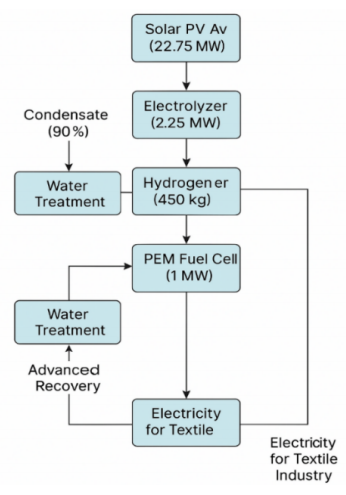
Solar–hydrogen hybrid systems provide low-carbon and dispatchable energy, yet most existing configurations implicitly assume freshwater availability, thereby overlooking the role of water reuse in water-stressed regions. In semi-arid industrial contexts, the integration of clean energy systems with circular water management is essential for long-term sustainability. This study develops a closed-loop Solar–Green Hydrogen Hybrid System (SGHHS) in which industrial effluent is treated through a membrane bioreactor–reverse osmosis–deionization (MBR→RO→DI) sequence to satisfy proton exchange membrane (PEM) electrolyzer water-quality requirements, while water recovered from fuel-cell exhaust is captured as condensate, achieving an overall water recovery rate of approximately 90%. The proposed system consists of a 22.75 MW photovoltaic array, a 2.25 MW electrolyzer, 450 kg of hydrogen storage, and a 1 MW fuel cell, and is evaluated using a 25-year hourly-resolution simulation framework. Economic performance is assessed through discounted cash-flow analysis, while environmental impacts are quantified using life-cycle assessment. Results demonstrate that integrating water reuse reduces the levelized cost of electricity from 0.10 to 0.0866 USD/kWh, avoids approximately 157,000 tonnes of CO₂-equivalent (tCO₂-eq)emissions, and enables the recovery of nearly 400,000 L/day of process water. By explicitly internalizing water-treatment capital and operating costs alongside water-savings benefits within the energy cost formulation, the study presents a generalizable framework linking hydrogen-based energy systems with circular water infrastructure, supporting industrial decarbonization and Sustainable Development Goals related to clean energy, responsible resource use, and climate action.
Keywords:
Solar–Hydrogen Hybrid System Wastewater Reuse Water–Energy Nexus Techno‑Economic Modelling Lifecycle Assessment Industrial DecarbonizationReferences
- Gielen, D.; Boshell, F.; Saygin, D.; et al. The role of renewable energy in the global energy transformation. Energy Strateg. Rev. 2019, 24, 38–50. DOI: https://doi.org/10.1016/j.esr.2019.01.006
- Nasser, M.; Megahed, T.F.; Ookawara, S.; et al. A review of water electrolysis–based systems for hydrogen production using hybrid/solar/wind energy systems. Environ. Sci. Pollut. Res. 2022, 29, 86994–87018. DOI: https://doi.org/10.1007/s11356-022-23323-y
- Gu, X.; Ying, Z.; Zheng, X.; et al. Photovoltaic-based energy system coupled with energy storage for all-day stable PEM electrolytic hydrogen production. Renew. Energy 2023, 209, 53–62. DOI: https://doi.org/10.1016/j.renene.2023.03.135
- Odhiambo, J.O.; Ngũgĩ, R.; Onsomu, E.; et al. Pathways to green hydrogen production as a sustainable energy solution in Kenya by 2040. Discov. Energy 2025, 5, 37. DOI: https://doi.org/10.1007/s43937-025-00098-0
- Yue, M.; Lambert, H.; Pahon, E.; et al. Hydrogen energy systems: A critical review of technologies, applications, trends and challenges. Renew. Sustain. Energy Rev. 2021, 146, 111180. DOI: https://doi.org/10.1016/j.rser.2021.111180
- Yang, D.; Wang, W.; Gueymard, C.A.; et al. A review of solar forecasting, its dependence on atmospheric sciences and implications for grid integration: Towards carbon neutrality. Renew. Sustain. Energy Rev. 2022, 161, 112348. DOI: https://doi.org/10.1016/j.rser.2022.112348
- Ferrero, D.; Gamba, M.; Lanzini, A.; et al. Power-to-Gas Hydrogen: Techno-economic Assessment of Processes towards a Multi-purpose Energy Carrier. Energy Procedia 2016, 101, 50–57. DOI: https://doi.org/10.1016/j.egypro.2016.11.007
- Mazloomi, S.K.; Sulaiman, N. Influencing factors of water electrolysis electrical efficiency. Renew. Sustain. Energy Rev. 2012, 16, 4257–4263. DOI: https://doi.org/10.1016/j.rser.2012.03.052
- Rakousky, C.; Keeley, G.P.; Wippermann, K.; et al. The stability challenge on the pathway to high-current-density polymer electrolyte membrane water electrolyzers. Electrochim. Acta 2018, 278, 324–331. DOI: https://doi.org/10.1016/j.electacta.2018.04.154
- Singh, B.J.; Chakraborty, A.; Sehgal, R. A systematic review of industrial wastewater management: Evaluating challenges and enablers. J. Environ. Manage. 2023, 348, 119230. DOI: https://doi.org/10.1016/j.jenvman.2023.119230
- Cairone, S.; Hasan, S.W.; Choo, K.-H.; et al. Revolutionizing wastewater treatment toward circular economy and carbon neutrality goals: Pioneering sustainable and efficient solutions for automation and advanced process control with smart and cutting-edge technologies. J. Water Process Eng. 2024, 63, 105486. DOI: https://doi.org/10.1016/j.jwpe.2024.105486
- Alrbai, M.; Al-Dahidi, S.; Al-Ghussain, L.; et al. Minimizing grid energy consumption in wastewater treatment plants: Towards green energy solutions, water sustainability, and cleaner environment. Sci. Total Environ. 2024, 926, 172139. DOI: https://doi.org/10.1016/j.scitotenv.2024.172139
- Moser, P.B.; Ricci, B.C.; Reis, B.G.; et al. Effect of MBR-H2O2/UV Hybrid pre-treatment on nanofiltration performance for the treatment of petroleum refinery wastewater. Sep. Purif. Technol. 2018, 192, 176–184. DOI: https://doi.org/10.1016/j.seppur.2017.09.070
- Hafeez, A.; Shamair, Z.; Shezad, N.; et al. Solar powered decentralized water systems: A cleaner solution of the industrial wastewater treatment and clean drinking water supply challenges. J. Clean. Prod. 2021, 289, 125717. DOI: https://doi.org/10.1016/j.jclepro.2020.125717
- Merabet, N.H.; Kerboua, K.; Hoinkis, J. Hydrogen production from wastewater: A comprehensive review of conventional and solar powered technologies. Renew. Energy 2024, 226, 120412. DOI: https://doi.org/10.1016/j.renene.2024.120412
- Zarei, M. Wastewater resources management for energy recovery from circular economy perspective. Water-Energy Nexus 2020, 3, 170–185. DOI: https://doi.org/10.1016/j.wen.2020.11.001
- Pal, P. Industry-Specific Water Treatment. In Industrial Water Treatment Process Technology; Elsevier: New York, NY, USA, 2017; pp. 243–511. DOI: https://doi.org/10.1016/B978-0-12-810391-3.00006-0
- Samanta, K.K.; Pandit, P.; Samanta, P.; et al. Water consumption in textile processing and sustainable approaches for its conservation. In Water in Textiles and Fashion; Elsevier: New York, NY, USA, 2019; pp. 41–59. DOI: https://doi.org/10.1016/B978-0-08-102633-5.00003-8
- Nahar, N.; Haque, M.S.; Haque, S.E. Groundwater conservation, and recycling and reuse of textile wastewater in a denim industry of Bangladesh. Water Resour. Ind. 2024, 31, 100249. DOI: https://doi.org/10.1016/j.wri.2024.100249
- Ahmed, S.; Huang, Y.; Kinjo, M.; et al. Sustainable and reliable energy management for urban hybrid energy systems: A case study in Islamabad Pakistan on hydrogen and battery integration using transient search optimization algorithm. Results Eng. 2025, 27, 106272. DOI: https://doi.org/10.1016/j.rineng.2025.106272
- Sojitra, D.; Kandya, A.; Shabiimam, M.A. Assessing the Effectiveness of Common Effluent Treatment Plants (CETPs) in the State of Gujarat, India Using Reliability Analysis. Clean. Water 2024, 2, 100038. DOI: https://doi.org/10.1016/j.clwat.2024.100038
- Amutha, K. Sustainable chemical management and zero discharges. In Sustainable Fibres and Textiles; Elsevier: New York, NY, USA, 2017; pp. 347–366. DOI: https://doi.org/10.1016/B978-0-08-102041-8.00012-3
- Abbas, S.; Hsieh, L.H.C.; Techato, K.; et al. Sustainable production using a resource–energy–water nexus for the Pakistani textile industry. J. Clean. Prod. 2020, 271, 122633. DOI: https://doi.org/10.1016/j.jclepro.2020.122633
- Amir, M.; Deshmukh, R.G.; Khalid, H.M.; et al. Energy storage technologies: An integrated survey of developments, global economical/environmental effects, optimal scheduling model, and sustainable adaption policies. J. Energy Storage 2023, 72, 108694. DOI: https://doi.org/10.1016/j.est.2023.108694
- Muhammadi, A.; Wasib, M.; Muhammadi, S.; et al. Solar Energy Potential in Pakistan: A Review. Proc. Pak. Acad. Sci. B: Life Environ. Sci. 2024, 61. DOI: https://doi.org/10.53560/PPASB(61-1)931
- Hassan, Q.; Viktor, P.; J. Al-Musawi, T.; et al. The renewable energy role in the global energy Transformations. Renew. Energy Focus 2024, 48, 100545. DOI: https://doi.org/10.1016/j.ref.2024.100545