
Articles
Cedar: A Federated Meta-Learning Framework for Secure and Scalable Personalized IoT
 Download

This work is licensed under a Creative Commons Attribution 4.0 International License.
Copyright
The authors shall retain the copyright of their work but allow the Publisher to publish, copy, distribute, and convey the work.
License
Journal of Artificial Intelligence and Science Communication (JAISC) publishes accepted manuscripts under Creative Commons Attribution 4.0 International (CC BY 4.0). Authors who submit their papers for publication by Journal of Artificial Intelligence and Science Communication (JAISC) agree to have the CC BY 4.0 license applied to their work, and that anyone is allowed to reuse the article or part of it free of charge for any purpose, including commercial use. As long as the author and original source is properly cited, anyone may copy, redistribute, reuse and transform the content.
Authors

Received: 26 February 2025; Revised: 6 June 2025; Accepted: 9 July 2025; Published: 15 July 2025
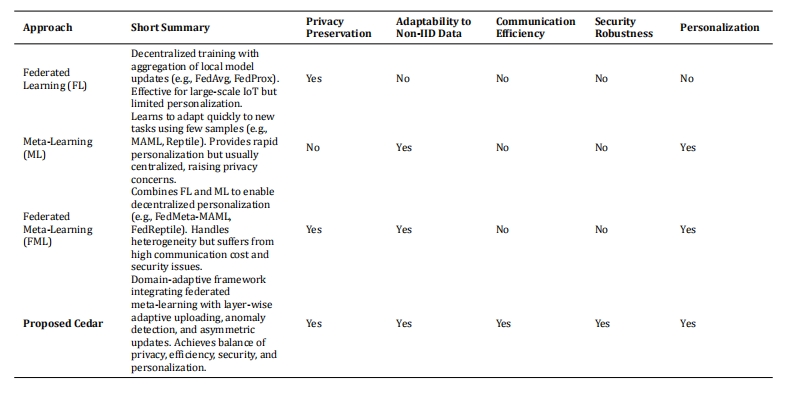
The Personalized Internet of Things (PIoT) demands intelligent learning models that can adapt to highly heterogeneous user data while preserving privacy, scalability, and security. Centralized learning approaches are impractical in PIoT settings due to privacy regulations, non-independent and identically distributed (non-IID) data distributions, and vulnerability to adversarial attacks. To address these challenges, this paper proposes Consent-Driven Ethical Data Access and Regulation (CEDAR), a federated meta-learning framework that enables secure and adaptive personalization across the cloud–edge–device continuum. CEDAR integrates meta-learning with federated learning to extract transferable representations from distributed data, allowing rapid adaptation to individual user contexts with minimal local updates. A layer-wise adaptive uploading mechanism selectively communicates model updates based on parameter importance, substantially reducing communication overhead and accelerating convergence. In addition, asymmetric uploading and anomaly-aware aggregation enhance robustness against gradient inversion and model poisoning attacks. Extensive evaluations on six benchmark datasets covering regression, text classification, and image recognition tasks demonstrate that CEDAR achieves up to 60.39% higher accuracy compared to FedAvg-based federated learning, while reducing communication cost by 23.36% and improving adversarial robustness relative to other state-of-the-art baselines. Ablation studies further confirm the complementary contributions of CEDAR’s core components. By jointly optimizing personalization, privacy, efficiency, and security, CEDAR provides a scalable and ethically aligned learning framework for next-generation PIoT applications in domains such as smart mobility, healthcare, and the digital economy.
Keywords:
Federated Learning Meta‑Learning Personalized Internet of Things (PIoT) Edge Intelligence Privacy Preservation Adversarial RobustnessReferences
- Khan, A.A.; Laghari, A.A.; Li, P.; et al. The collaborative role of blockchain, artiϐicial intelligence, and industrial Internet of Things in digitalization of small and medium‑size enterprises. Sci. Rep. 2023, 13, 1656.
- Aminizadeh, S.; Heidari, A.; Toumaj, S.; et al. The applications of machine learning techniques in medical data processing based on distributed computing and the Internet of Things. Comput. Methods Programs Biomed. 2023, 241, 107745. DOI: https://doi.org/10.1016/j.cmpb.2023.107745
- Shao, S.; Zheng, J.; Guo, S.; et al. Decentralized AI‑enabled trusted wireless network: A new collaborative computing paradigm for Internet of Things. IEEE Netw. 2023, 37, 54–61.
- Liu, S.; You, L.; Zhu, R.; et al. AFM3D: An asynchronous federated meta‑learning framework for driver distraction detection. IEEE Trans. Intell. Transp. Syst. 2024, 25, 9659–9674.
- Pallathadka, H.; Ramirez‑Asis, E.H.; Loli‑Poma, T.P.; et al. Applications of artiϐicial intelligence in business management, e‑commerce and ϐinance. Mater. Today Proc. 2023, 80, 2610–2613.
- Lai, J.; Tan, H.; Wang, J.; et al. Practical intelligent diagnostic algorithm for wearable 12‑lead ECG via self‑supervised learning on a large‑scale dataset. Nat. Commun. 2023, 14, 3741.
- Liu, X.; Deng, Y.; Nallanathan, A.; et al. Federated learning and meta learning: Approaches, applications, and directions. IEEE Commun. Surv. Tutor. 2024, 26, 571–618.
- You, L.; Liu, S.; Wang, T.; et al. AIFED: An adaptive and integrated mechanism for asynchronous federated data mining. IEEE Trans. Knowl. Data Eng. 2023, 36, 4411–4427.
- Soltoggio, A.; Ben‑Iwhiwhu, E.; Braverman, V.; et al. A collective AI via lifelong learning and sharing at the edge. Nat. Mach. Intell. 2024, 6, 251–264.
- McMahan, B.; Moore, E.; Ramage, D.; et al. Communication‑efϐicient learning of deep networks from decentralized data. In Proceedings of the 20th International Conference on Artiϐicial Intelligence and Statistics, Fort Lauderdale, FL, USA, 20–22 April 2017; pp. 1273–1282.
- Zhang, X.; Li, C.; Han, C.; et al. A personalized federated meta‑learning method for intelligent and privacy‑preserving fault diagnosis. Adv. Eng. Inform. 2024, 62, 102781. DOI: https://doi.org/10.1016/j.aei.2024.102781
- Jiang, S.; Li, Y.; Firouzi, F.; et al. Federated clustered multi‑domain learning for health monitoring. Sci. Rep. 2024, 14, 903.
- Almaniϐi, O.R.A.; Chow, C.O.; Tham, M.‑L.; et al. Communication and computation efϐiciency in federated learning: A survey. Internet Things 2023, 22, 100742. DOI: https://doi.org/10.1016/j.iot.2023.100742
- You, L.; Guo, Z.; Yuen, C.; et al. A framework reforming personalized Internet of Things by federated meta‑learning. Nat. Commun. 2025, 16, 3739.
- Chen, G.; Li, K.; Abdelmoniem, A.M.; et al. Exploring representational similarity analysis to protect federated learning from data poisoning. In Proceedings of the ACM Web Conference, Singapore, 13–17 May 2024; pp. 525–528.
- Vahidian, S.; Morafah, M.; Chen, C.; et al. Rethinking data heterogeneity in federated learning: Introducing a new notion and standard benchmarks. IEEE Trans. Artif. Intell. 2024, 5, 1386–1397.
- Wehbi, O.; Arisdakessian, S.; Wahab, O.A.; et al. FedMint: Intelligent bilateral client selection in federated learning with newcomer IoT devices. IEEE Internet Things J. 2023, 10, 20884–20898.
- Li, P.; Zhang, H.; Wu, Y.; et al. Filling the missing: Exploring generative AI for enhanced federated learning over heterogeneous mobile edge devices. IEEE Trans. Mob. Comput. 2024, 23, 10001–10015.
- Wang, X.; Zhu, T.; Zhou, W. Supplement data in federated learning with a generator transparent to clients. Inf. Sci. 2024, 666, 120437. DOI: https://doi.org/10.1016/j.ins.2024.120437
- Ren, H.; Anicic, D.; Runkler, T.A. TinyReptile: TinyML with federated meta‑learning. In Proceedings of the International Joint Conference on Neural Networks, Gold Coast, Australia, 18–23 June 2023; pp. 1–9.
- Shao, J.; Wu, F.; Zhang, J. Selective knowledge sharing for privacy‑preserving federated distillation without a good teacher. Nat. Commun. 2024, 15, 349.
- Dai, Y.; Chen, Z.; Li, J.; et al. Tackling data heterogeneity in federated learning with class prototypes. Proc. AAAI Conf. Artif. Intell. 2023, 37, 7314–7322.
- Chen, R.; Shi, D.; Qin, X.; et al. Service delay minimization for federated learning over mobile devices. IEEE J. Sel. Areas Commun. 2023, 41, 990–1006.
- Khan, F.M.A.; Abou‑Zeid, H.; Hassan, S.A. Deep compression for efϐicient and accelerated over‑the‑air federated learning. IEEE Internet Things J. 2024, 11, 25802–25817.
- Jiang, Z.; Xu, Y.; Xu, H.; et al. Computation and communication efϐicient federated learning with adaptive model pruning. IEEE Trans. Mob. Comput. 2024, 23, 2003–2021.
- Chen, X.; Xu, G.; Xu, X.; et al. Multicenter hierarchical federated learning with fault‑tolerance mechanisms for resilient edge computing networks. IEEE Trans. Neural Netw. Learn. Syst. 2024, 36, 47–61.
- Deng, Y.; Lyu, F.; Xia, T.; et al. A communication‑efϐicient hierarchical federated learning framework via shaping data distribution at edge. IEEE/ACM Trans. Netw. 2024, 32, 2600–2615.
- You, L.; Liu, S.; Zuo, B.; et al. Federated and asynchronized learning for autonomous and intelligent things. IEEE Netw. 2024, 38, 286–293.
- Hijazi, N.M.; Aloqaily, M.; Guizani, M.; et al. Secure federated learning with fully homomorphic encryption for IoT communications. IEEE Internet Things J. 2024, 11, 4289–4300.
- Wang, B.; Li, H.; Guo, Y.; et al. PPFLHE: A privacy‑preserving federated learning scheme with homomorphic encryption for healthcare data. Appl. Soft Comput. 2023, 146, 110677. DOI: https://doi.org/10.1016/j.asoc.2023.110677