
Article
Exploring Omani EFL Learners' Perceptions of AI Tools
 Download

This work is licensed under a Creative Commons Attribution 4.0 International License.
Copyright
The authors shall retain the copyright of their work but allow the Publisher to publish, copy, distribute, and convey the work.
License
Digital Technologies Research and Applications (DTRA) publishes accepted manuscripts under Creative Commons Attribution 4.0 International (CC BY 4.0). Authors who submit their papers for publication by DTRA agree to have the CC BY 4.0 license applied to their work, and that anyone is allowed to reuse the article or part of it free of charge for any purpose, including commercial use. As long as the author and original source are properly cited, anyone may copy, redistribute, reuse, and transform the content.
Authors
-
Eassa Ali
 Faculty of Language Studies, Sohar University, Sohar 311, Sultanate of Oman
-
Roy Pushpavilasam Veettil
Faculty of Language Studies, Sohar University, Sohar 311, Sultanate of Oman
-
Mohammed Ali Al‑Zaabi
Department of English, Shinas Vocational College, Shinas 324, Sultanate of Oman
-
Misaj Sharafudeen
Department of Computer Science, University of Kerala, Thiruvananthapuram 695581, India
-
Tanveer Qureshi
Department of Education, International Open University, Kanifing 2340, The Gambia
Received: 4 October 2025; Revised: 28 October 2025; Accepted: 13 November 2025; Published: 2 December 2025
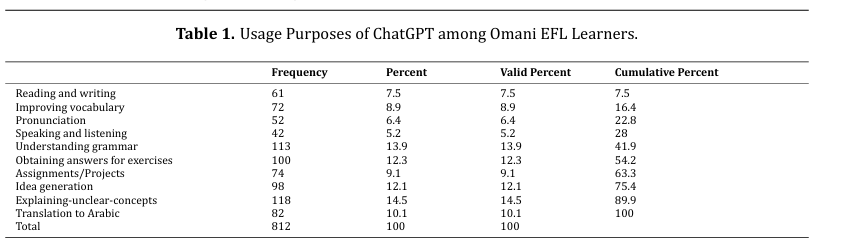
This study employed the Technology Acceptance Model to investigate Omani English as a foreign language (EFL) learners’ perceptions and use of ChatGPT in English learning settings. A predominantly quantitative descriptive design was adopted, using a questionnaire that included primarily closed‑ended items with three open‑ended items added to support the quantitative findings. The data were collected from 198 students of two higher education institutions in Oman. Quantitative findings revealed that Omani EFL learners used ChatGPT both inside and outside class for learning English, mainly for obtaining explanations for unclear concepts and ideas, obtaining answers for English exercises, grammar correction and support, and idea generation. The correlation analysis shows that more frequent and longer use of ChatGPT was associated with a wider range of English learning purposes. The learners reported strong ease of use, positive attitudes towards ChatGPT, and an intention to pursue using it. The qualitative findings supported the quantitative results, emphasizing that ChatGPT improved learners’performance in terms of grammar, writing fluency, vocabulary building, confidence and learning autonomy. However, the qualitative findings revealed some concerns about overreliance, accuracy, limited contextual depth, and academic integrity. Both sets of findings suggest that while Omani EFL learners are ready to adopt and integrate ChatGPT into EFL learning, they are cautious about the unguided use of it. Future research may extend this work to examine the long‑term impact of ChatGPT on EFL learners across a wider range of higher education institutions within and beyond the Sultanate of Oman.
Keywords:
Omani EFL Learners AI in English Education Technology Acceptance Model ChatGPT‑Assisted Learn‑ingReferences
- Qu, K.; Wu, X. ChatGPT as a CALL Tool in Language Education: A Study of Hedonic Motivation Adoption Models in English Learning Environments. Educ. Inf. Technol. 2024, 29, 19471–19503. DOI: https://doi.org/10.1007/s10639-024-12598-y
- Teng, M.F. “ChatGPT Is the Companion, Not Enemies”: EFL Learners’ Perceptions and Experiences in Using ChatGPT for Feedback in Writing. Comput. Educ. Artif. Intell. 2024, 7, 100270. DOI: https://doi.org/10.1016/j.caeai.2024.100270
- Giray, L.; Nemeño, J.; Edem, J. Self-Directed Learning Using ChatGPT Positively Affects Student Engagement. Int. J. Technol. Educ. 2025, 8, 667–680. DOI: https://doi.org/10.46328/ijte.1162
- Xiao, Y.; Zhi, Y. An Exploratory Study of EFL Learners’ Use of ChatGPT for Language Learning Tasks: Experience and Perceptions. Languages 2023, 8, 212. DOI: https://doi.org/10.3390/languages8030212
- Al-Fanar Media. As AI Transforms Arab Higher Education, Universities Navigate Benefits and Challenges. Available online: https://al-fanarmedia.org/2024/11/as-ai-transforms-arab-higher-education-universities-navigate-benefits-and-challenges/ (accessed on 10 August 2025).
- Gulf Magazine. 7 Bright EdTech Shifts Digital Transformation in Education across the Middle East. Available online: https://gulfmagazine.co/digital-transformation-in-education-middle-east/ (accessed on 10 August 2025).
- Traidi, A. AI Integration in Education in the MENA Region: Will it be a Driver of Social Inequality? Policy Briefs 2024; Global Campus of Human Rights: Venice, Italy, 2024. Available online: https://repository.gchumanrights.org/server/api/core/bitstreams/d3c58797-06ec-469e-bf66-d07490a34f07/content
- Mahrooqi, R.; Denman, C. English Language Proficiency and Communicative Competence in Oman: Implications for Employability and Sustainable Development. In English Language Education; Al-Mahrooqi, R., Denman, C., Eds.; Springer: Singapore, 2018; Volume 15, pp. 181–193. DOI: https://doi.org/10.1007/978-981-13-0265-7_11
- Al Shanfari, H.S. English as a Foreign Language Constraints in Oman. Available online: https://www.researchgate.net/publication/347054647 (accessed on 2 October 2025).
- Al-Raimi, M.; Mudhsh, B.A.; Al Yafaei, Y.; et al. Utilizing Artificial Intelligence Tools for Improving Writing Skills: Exploring Omani EFL Learners' Perspectives. Forum Linguist. Stud. 2024, 6, 1177. DOI: https://doi.org/10.59400/fls.v6i2.1177
- Ngorima, T.; Mutambara, D. Investigating the Drivers of Artificial Intelligence in Higher Education: A Study at Sohar University. J. Humanit. Soc. Sci. SU 2025, 2.
- Dehdary, N.; Meschi, R. The Role of ChatGPT in Language Education: A Study of Omani Students' Perspectives. Stud. Technol. Enhanc. Learn. 2024, 4, 1–15. DOI: https://doi.org/10.21428/8c225f6e.6c5360d1
- Granić, A.; Marangunić, N. Technology Acceptance Model in Educational Context: A Systematic Literature Review. Br. J. Educ. Technol. 2019, 50, 2572–2593. DOI: https://doi.org/10.1111/bjet.12864
- Schorr, A. The Technology Acceptance Model (TAM) and Its Importance for Digitalization Research: A Review. In International Symposium on Technikpsychologie (TecPsy) 2023; Gerber, N., Zimmermann, V., Eds.; Sciendo: Warsaw, Poland, 2023; pp. 55–65. DOI: https://doi.org/10.2478/9788366675896-005
- Moradi, H. Integrating AI in Higher Education: Factors Influencing ChatGPT Acceptance Among Chinese University EFL Students. Int. J. Educ. Technol. High. Educ. 2025, 22, 30. DOI: https://doi.org/10.1186/s41239-025-00530-4
- Lo, C.K.; Yu, P.L.H.; Xu, S.; et al. Exploring the Application of ChatGPT in ESL/EFL Education and Related Research Issues: A Systematic Review of Empirical Studies. Environ. 2024, 11, 50. DOI: https://doi.org/10.1186/s40561-024-00342-5
- Mogavi, R.H.; Deng, C.; Kim, J.J.; et al. Exploring User Perspectives on ChatGPT: Applications, Perceptions, and Implications for AI-Integrated Education. arXiv preprint 2023, arXiv: 2305.13114. DOI: https://doi.org/10.48550/arXiv.2305.13114
- Auenthaisong, S. Learners’ Attitudes Toward Using AI Tools in English Language Learning: Classroom Context. Sripatum Chonburi Interdiscip. J. 2025, 11, 55–65. Available online: https://so04.tci-thaijo.org/index.php/ISCJ/article/view/276181
- Belda-Medina, J.; Calvo-Ferrer, J.R. Using Chatbots as AI Conversational Partners in Language Learning. Appl. Sci. 2022, 12, 8427. DOI: https://doi.org/10.3390/app12178427
- Gozali, I.; Wijaya, A.R.T.; Lie, A.; et al. Leveraging the Potential of ChatGPT as an Automated Writing Evaluation (AWE) Tool: Students' Feedback Literacy Development and AWE Tools Integration Framework. JALT CALL J. 2024, 20, 1200. DOI: https://doi.org/10.29140/jaltcall.v20n1.1200
- Zhang, J.; Wang, J. Student Perceptions of Hybrid Feedback: Using Gen-AI to Enhance Engagement with EAP Writing Feedback. JALT CALL J. 2025, 21, 2175. DOI: https://doi.org/10.29140/jaltcall.v21n2.2175
- Alshammri, A. ChatGPT in English Writing: Experiences and Perceptions of Saudi EFL Students. Amazonia Investig. 2024, 13, 47–57. DOI: https://doi.org/10.34069/AI/2024.78.06.4
- Alsaedi, N.S. Exploring ChatGPT’s Role in EFL Learning Through the Technology Acceptance Model: Perspectives from Saudi Students. Contemp. Educ. Technol. 2025, 17, ep594. DOI: https://doi.org/10.30935/cedtech/17302
- Govindarajan, R.; Christuraj, G. Opportunities and Challenges of Using ChatGPT in the ELT Scenario of UTAS, Nizwa, Oman. J. Teach. Engl. Specif. Acad. Purp. 2023, 11, 593–605. DOI: https://doi.org/10.22190/JTESAP230529046G
- Alharthi, S.M. Beyond Traditional Language Learning: EFL Student Views on ChatGPT in Saudi Arabia. Arab World Engl. J. 2024, 10, 15–35. DOI: https://doi.org/10.24093/awej/call10.2
- Alsalem, M.S. EFL Students’ Perception and Attitude Towards the Use of ChatGPT to Promote English Speaking Skills in the Saudi Context. Arab World Engl. J. 2024, 15, 73–84. DOI: https://doi.org/10.24093/awej/vol15no4.5
- Mudawy, A.M.A. Exploring EFL Learners’ Perceptions on the Use of AI-Powered Conversational Tools to Improve Speaking Fluency: A Case Study at Majmaah University. Forum Linguist. Stud. 2025, 7, 589–598. DOI: https://doi.org/10.30564/fls.v7i1.7774
- Reina Marín, Y.; Cruz Caro, O.; Maicelo Rubio, Y.d.C.; et al. Artificial Intelligence as a Teaching Tool in University Education. Front. Educ. 2025, 10, 1578451. DOI: https://doi.org/10.3389/feduc.2025.1578451
- Davis, F.D. A Technology Acceptance Model for Empirically Testing New End-User Information Systems: Theory and Results [PhD Thesis]. Massachusetts Institute of Technology, Cambridge, MA, USA, 1986.
- Davis, F.D. Perceived Usefulness, Perceived Ease of Use, and User Acceptance of Information Technology. MIS Q. 1989, 13, 319–340. DOI: https://doi.org/10.2307/249008
- Sánchez, R.A.; Hueros, A.D. Motivational Factors That Influence the Acceptance of Moodle Using TAM. Comput. Hum. Behav. 2010, 26, 1632–1640. DOI: https://doi.org/10.1016/j.chb.2010.06.011
- Braun, V.; Clarke, V. Using Thematic Analysis in Psychology. Qual. Res. Psychol. 2006, 3, 77–101. DOI: https://doi.org/10.1191/1478088706qp063oa
- Lai, C.; Zheng, D. Self-Directed Use of Mobile Devices for Language Learning Beyond the Classroom. ReCALL 2017, 30, 299–318. DOI: https://doi.org/10.1017/S0958344017000258
- Kasneci, E.; Sessler, K.; Küchemann, S.; et al. ChatGPT for Good? On Opportunities and Challenges of Large Language Models for Education. Learn. Individ. Differ. 2023, 103, 102274. DOI: https://doi.org/10.1016/j.lindif.2023.102274
- Chen, X.; Xie, H.; Zou, D.;et al. Application and Theory Gaps During the Rise of Artificial Intelligence in Education. Comput. Educ. Artif. Intell. 2020, 1, 100002. DOI: https://doi.org/10.1016/j.caeai.2020.100002
- Venkatesh, V.; Morris, M.G.; Davis, G.B.; et al. User Acceptance of Information Technology: Toward A Unified View1. MIS Q. 2003, 27, 425–478. DOI: https://doi.org/10.2307/30036540
- Zou, B.; Reinders, H.; Thomas, M.; et al. Editorial: Using Artificial Intelligence Technology for Language Learning. Front. Psychol. 2023, 14, 1287667. DOI: https://doi.org/10.3389/fpsyg.2023.1287667
- Fuchs, K. Exploring the Opportunities and Challenges of NLP Models in Higher Education: Is Chat GPT a Blessing or a Curse? Front. Educ. 2023, 8, 1166682. DOI: https://doi.org/10.3389/feduc.2023.1166682
- Alshamy, A.; Al-Harthi, A.S.A.; Abdullah, S. Perceptions of Generative AI Tools in Higher Education: Insights from Students and Academics at Sultan Qaboos University. Educ. Sci. 2025, 15, 501. DOI: https://doi.org/10.3390/educsci15040501