
Article
Operationalizing SAMR Redefinition in EFL Reading: AI as a Mediating Tool for Literacy Innovation
 Download

This work is licensed under a Creative Commons Attribution 4.0 International License.
Copyright
The authors shall retain the copyright of their work but allow the Publisher to publish, copy, distribute, and convey the work.
License
Digital Technologies Research and Applications (DTRA) publishes accepted manuscripts under Creative Commons Attribution 4.0 International (CC BY 4.0). Authors who submit their papers for publication by DTRA agree to have the CC BY 4.0 license applied to their work, and that anyone is allowed to reuse the article or part of it free of charge for any purpose, including commercial use. As long as the author and original source are properly cited, anyone may copy, redistribute, reuse, and transform the content.
Authors

Received: 18 November 2025; Revised: 10 December 2025; Accepted: 23 January 2026; Published: 5 February 2026
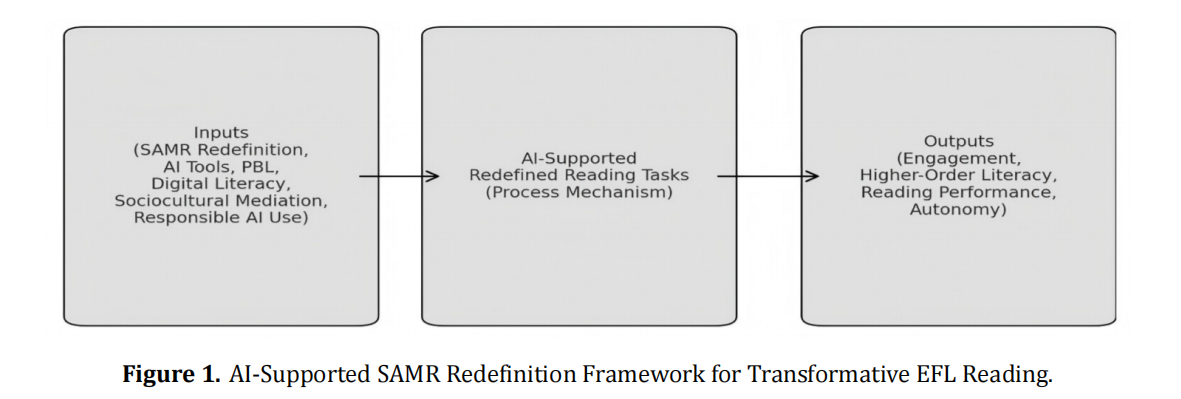
This study examines how Artificial Intelligence (AI) can leverage the concept of Redefinition—the highest level of the Substitution-Augmentation-Modification-Redefinition (SAMR) model—to transform the teaching of English as a Foreign Language (EFL) reading from comprehension-focused activities to inquiry-driven and effective reading and writing activities. Based on socio-cultural theory, Project-Based Learning (PBL), and theoretical frameworks of digital competence, this study conceptualizes AI as a cognitive mediating framework that supports knowledge transformation rather than task automation. Using a multi-method action research design, interventions were conducted with 130 Vietnamese university students enrolled in intermediate-level English reading courses over eight weeks. Traditional reading activities were redesigned into AI-assisted projects, including multimedia infographics, podcasts, and investigative reading tasks. Quantitative data were collected through a validated 40-item questionnaire, and qualitative insights were gathered from semistructured interviews with six purposefully selected participants. The study results indicate that AI-assisted redefined reading tasks promoted higher-order thinking, synthesis, and practical application, demonstrating the successful implementation of the SAMR Redefinition methodology. Students perceive AI as a supportive learning partner, enhancing comprehension, reducing frustration, and increasing motivation and confidence. A fairly strong positive correlation (r = 0.62) was found between purposeful AI use and student engagement and reading performance. Qualitative results further suggest that AI supports continuous reading, collaborative preparation, and multimodal knowledge building, while encouraging responsible and critical use of AI. The study proposes an AI-powered SAMR framework and a pedagogical sequence of read-interpret-transform-create, providing a scalable model for teaching English as a transformative foreign language reading.
Keywords:
SAMR Redefinition AI-Supported Reading EFL Pedagogy Digital Literacy Project-Based Learning (PBL) Learner EngagementReferences
- Hamilton, E.R.; Rosenberg, J.M.; Akcaoglu, M. The Substitution Augmentation Modification Redefinition (SAMR) Model: A Critical Review and Suggestions for Its Use. TechTrends 2016, 60, 433–441. DOI: https://doi.org/10.1007/s11528-016-0091-y
- Blundell, C.N.; Mukherjee, M.; Nykvist, S. A scoping review of the application of the SAMR model in research. Comput. Educ. Open 2022, 3, 100093. DOI: https://doi.org/10.1016/j.caeo.2022.100093
- Vygotsky, L.S. Mind in Society: Development of Higher Psychological Processes; Harvard University Press: Cambridge, MA, USA, 1980. DOI: https://doi.org/10.2307/j.ctvjf9vz4
- Romrell, D.; Kidder, L.C.; Wood, E. The SAMR Model as a Framework for Evaluating mLearning. Online Learn. 2014, 18, DOI: https://doi.org/10.24059/olj.v18i2.435
- Kessler, G. Technology and the future of language teaching. Foreign Lang. Ann. 2018, 51, 205–218. DOI: https://doi.org/10.1111/flan.12318
- Shadiev, R.; Yang, M. Review of Studies on Technology-Enhanced Language Learning and Teaching. Sustainability 2020, 12, 524. DOI: https://doi.org/10.3390/su12020524
- Ratten, V.; Jones, P. Generative artificial intelligence (ChatGPT): Implications for management educators. Int. J. Manag. Educ. 2023, 21, 100857. DOI: https://doi.org/10.1016/j.ijme.2023.100857
- Thomas, J.W. A Review of Research on Project-Based Learning; Autodesk Foundation: San Rafael, CA, USA, 2000.
- Warschauer, M. A literacy approach to the digital divide. Educ Technol. 2007, 7, 4–10.
- Lai, C.; Morrison, B. Towards an Agenda for Learner Preparation in Technology-Enhanced Language Learning Environments. CALICO J. 2013, 30, 154–162. DOI: https://doi.org/10.11139/cj.30.2.154-162
- Lo, C.K.; Hew, K.F.; Jong, M.S. The influence of ChatGPT on student engagement: A systematic review and future research agenda. Comput. Educ. 2024, 219, 105100. DOI: https://doi.org/10.1016/j.compedu.2024.105100
- Xia, Q.; Zhang, P.; Huang, W.; et al. The impact of generative AI on university students’ learning outcomes via Bloom’s taxonomy: a meta-analysis and pattern mining approach. Asia Pac. J. Educ. 2025, 1–31. DOI: https://doi.org/10.1080/02188791.2025.2530503
- Dewey, J. Experience and Education; Macmillan: New York, NY, USA, 1938.
- Kolb, D.A. Experiential Learning: Experience as the Source of Learning and Development; Prentice-Hall: Englewood Cliffs, NJ, USA, 1984.
- Cope, B.; Kalantzis, M. “Multiliteracies”: New Literacies, New Learning. Pedagog.: Int. J. 2009, 4, 164–195. DOI: https://doi.org/10.1080/15544800903076044
- Grabe, W.P.; Stoller, F.L. Teaching and Researching: Reading; Routledge: London, UK, 2013. DOI: https://doi.org/10.4324/9781315833743
- Wallace, C. Critical Reading in Language Education; Palgrave Macmillan: London, UK, 2003. DOI: https://doi.org/10.1057/9780230514447
- Coiro, J.; Knobel, M.; Lankshear, C.; et al. Handbook of Research on New Literacies; Routledge: London, UK, 2014. DOI: https://doi.org/10.4324/9781410618894
- Janks, H. Literacy and Power; Routledge: New York, NY, USA, 2010.
- Freire, P. Pedagogy of the Oppressed; Continuum: New York, NY, USA, New York, 2000.
- Anderson, L.W.; Krathwohl, D. A Taxonomy For Learning, Teaching, and Assessing: A Revision of Bloom’s Taxonomy; Longman: New York, NY, USA, 2001.
- Reinking, D.; Bradley, B.A. On Formative and Design Experiments: Approaches to Language and Literacy Research; Teachers College Press: New York, NY, USA, 2008.
- Robin, B.R. The power of digital storytelling to support teaching and learning. Digit Educ Rev. 2016, 30, 17–29.
- Mayer, R.E. Multimedia Learning, 2nd ed; Cambridge University Press: New York, NY, USA, 2009.
- Lea, M.R.; Street, B.V. Student writing in higher education: An academic literacies approach. Stud. High. Educ. 1998, 23, 157–172. DOI: https://doi.org/10.1080/03075079812331380364
- Bandura, A. Social Cognitive Theory: An Agentic Perspective. Annu. Rev. Psychol. 2001, 52, 1–26. DOI: https://doi.org/10.1146/annurev.psych.52.1.1
- Hubbard, P. CALL and the Future of Language Teacher Education. CALICO J. 2008, 25, 175–188. DOI: https://doi.org/10.1558/cj.v25i2.175-188
- Jonassen, D. Designing Constructivist Learning Environments. In Instructional-design Theories and Models; Routledge: London, UK, 2013; pp. 215–239. DOI: https://doi.org/10.4324/9781410603784-12
- Kasneci, E.; Sessler, K.; Küchemann, S.; et al. ChatGPT for good? On opportunities and challenges of large language models for education. Learn. Individ. Differ. 2023, 103, 102274. DOI: https://doi.org/10.1016/j.lindif.2023.102274
- Dwivedi, Y.K.; Kshetri, N.; Hughes, L.; et al. “So what if ChatGPT wrote it?” Multidisciplinary perspectives on opportunities, challenges and implications of generative conversational AI for research, practice and policy. Int. J. Inf. Manage. 2023, 71, 102642. DOI: https://doi.org/10.1016/j.ijinfomgt.2023.102642
- Su, Y.; Lin, Y.; Lai, C. Collaborating with ChatGPT in argumentative writing classrooms. Assess. Writ. 2023, 57, 100752. DOI: https://doi.org/10.1016/j.asw.2023.100752
- Rahman, Md.M.; Watanobe, Y. ChatGPT for Education and Research: Opportunities, Threats, and Strategies. Appl. Sci. 2023, 13, 5783. DOI: https://doi.org/10.3390/app13095783
- Yousefi, M.; Askari, M.I. Exploring the Effectiveness of Artificial Intelligence (AI) on Reading Comprehension among Iranian EFL Learners. J. New Trends Engl. Lang. Learn. 2024. DOI: https://doi.org/10.71528/2024.202406221123351
- Zhang, L.; Xu, M.; Huang, Y.; et al. Reading differently with ChatGPT: EFL learners’ use of Question-Answer Relationship strategy. Read. Foreign Lang. 2025, 37, 1–21. DOI: https://doi.org/10.64152/10125/67520
- Teng, M.F. “ChatGPT is the companion, not enemies”: EFL learners’ perceptions and experiences in using ChatGPT for feedback in writing. Comput. Educ.: Artif. Intell. 2024, 7, 100270. DOI: https://doi.org/10.1016/j.caeai.2024.100270
- Zhao, Y.; Yue, Y.; Sun, Z.; et al. Does Generative Artificial Intelligence Improve Students’ Higher-Order Thinking? A Meta-Analysis Based on 29 Experiments and Quasi-Experiments. J. Intell. 2025, 13, 160. DOI: https://doi.org/10.3390/jintelligence13120160
- Wang, J.; Fan, W. The effect of ChatGPT on students’ learning performance, learning perception, and higher-order thinking: insights from a meta-analysis. Humanit Soc Sci Commun 2025, 12, 621. DOI: https://doi.org/10.1057/s41599-025-04787-y
- Carr, W.; Kemmis, S. Becoming Critical: Education Knowledge and Action Research; Routledge: London, UK, 2003, DOI: https://doi.org/10.4324/9780203496626
- Creswell, J.; Plano Clark, V. Designing and Conducting Mixed Methods Research, 3rd ed.; Sage: Thousand Oaks, CA, USA, 2018.
- Patton, M.Q. Qualitative Research and Evaluation Methods, 4th ed.; Sage: Thousand Oaks, CA, USA, 2015.
- Nunnally J.C. Psychometric Theory, 2nd ed.; McGraw-Hill: New York, NY, USA, 1978.
- Yin, R.K. Qualitative Research from Start to Finish, 2nd ed.; Guilford: New York, NY, USA, 2014.
- Puentedura, R. SAMR: A Contextualized Introduction; Hippasus: Williamstown, MA, USA, 2014.
- Kokotsaki, D.; Menzies, V.; Wiggins, A. Project-based learning: A review of the literature. Improv. Sch. 2016, 19, 267–277. DOI: https://doi.org/10.1177/1365480216659733
- Braun, V.; Clarke, V. Using thematic analysis in psychology. Qual. Res. Psychol. 2006, 3, 77–101. DOI: https://doi.org/10.1191/1478088706qp063oa
- Denzin, N.K. The Research Act: A Theoretical Introduction to Sociological Methods, 3rd ed.; Routledge: London, UK, 2012.
- British Educational Research Association. Ethical Guidelines for Educational Research, 4th ed.; BERA: London, UK, 2018.
- Li, L.; Zhang, X.; Zou, B.; et al. AI partner or peer partner? Exploring AI-mediated interaction in EFL pronunciation from a socio-cultural perspective. Learn. Cult. Soc. Interact. 2025, 55, 100958. DOI: https://doi.org/10.1016/j.lcsi.2025.100958
- Laupichler, M.C.; Aster, A.; Schirch, J.; et al. Artificial intelligence literacy in higher and adult education: A scoping literature review. Comput. Educ.: Artif. Intell. 2022, 3, 100101. DOI: https://doi.org/10.1016/j.caeai.2022.100101
- Ci, F.; Jiang, L. The integration of generative artificial intelligence into digital multimodal composing in second language classrooms: a scoping review from the perspective of tasks. Digit. Appl. Linguist. 2025, 2, 102939. DOI: https://doi.org/10.29140/dal.v2.102939
- Chandel, P.; Lim, F.V. Generative AI and Literacy Development in the Language Classroom: A Systematic Review of Literature. Ubiquitous Learn.: Int. J. 2024, 18, 31–49. DOI: https://doi.org/10.18848/1835-9795/CGP/v18i02/31-49
- Xie, W.; Zou, D.; Wu, W.; et al. Exploring the relationship between growth mindset, self-efficacy, anxiety, and perceived learning performance in AI-enhanced language learning. Artif Intell Lang Educ. 2025, 1.
- Lee, S.; Choe, H.; Zou, D.; et al. Generative AI (GenAI) in the language classroom: A systematic review. Interact. Learn. Environ. 2026, 34, 335–359. DOI: https://doi.org/10.1080/10494820.2025.2498537
- Ng, D.T.K.; Leung, J.K.L.; Chu, S.K.W.; et al. Conceptualizing AI literacy: An exploratory review. Comput. Educ.: Artif. Intell. 2021, 2, 100041. DOI: https://doi.org/10.1016/j.caeai.2021.100041
- Li, B.; Tan, Y.L.; Wang, C.; et al. Two years of innovation: A systematic review of empirical generative AI research in language learning and teaching. Comput. Educ.: Artif. Intell. 2025, 9, 100445. DOI: https://doi.org/10.1016/j.caeai.2025.100445
- Sanz-Tejeda, A.; Domínguez-Oller, J.C.; Baldaquí-Escandell, J.M.; et al. The impact of generative AI on academic reading and writing: a synthesis of recent evidence (2023–2025). Front. Educ. 2026, 10, 1711718. DOI: https://doi.org/10.3389/feduc.2025.1711718
- Kyaw, E.M.; Deng, J. Systematic review of artificial intelligence integration in English language teaching: Trends, applications, and pedagogical implications. Engl Educ Linguist Lit J. 2025, 4, 153–181. Available online: https://journal.unupurwokerto.ac.id/index.php/educalitra/article/view/502