
Article
Mapping the Landscape of Technology-Related Research on Foreign Language Anxiety: A Bibliometric Review (2001–2025)
 Download

This work is licensed under a Creative Commons Attribution 4.0 International License.
Copyright
The authors shall retain the copyright of their work but allow the Publisher to publish, copy, distribute, and convey the work.
License
Digital Technologies Research and Applications (DTRA) publishes accepted manuscripts under Creative Commons Attribution 4.0 International (CC BY 4.0). Authors who submit their papers for publication by DTRA agree to have the CC BY 4.0 license applied to their work, and that anyone is allowed to reuse the article or part of it free of charge for any purpose, including commercial use. As long as the author and original source are properly cited, anyone may copy, redistribute, reuse, and transform the content.
Authors
-
Hui Jiang
 School of Languages, Civilization and Philosophy, Universiti Utara Malaysia, Sintok 06010, Malaysia
Department of General Education, Anqing Medical College, Anqing 246052, China -
Rafizah Mohd Rawian
School of Languages, Civilization and Philosophy, Universiti Utara Malaysia, Sintok 06010, Malaysia
Received: 4 February 2026; Revised: 5 March 2026; Accepted: 26 March 2026; Published: 3 July 2026
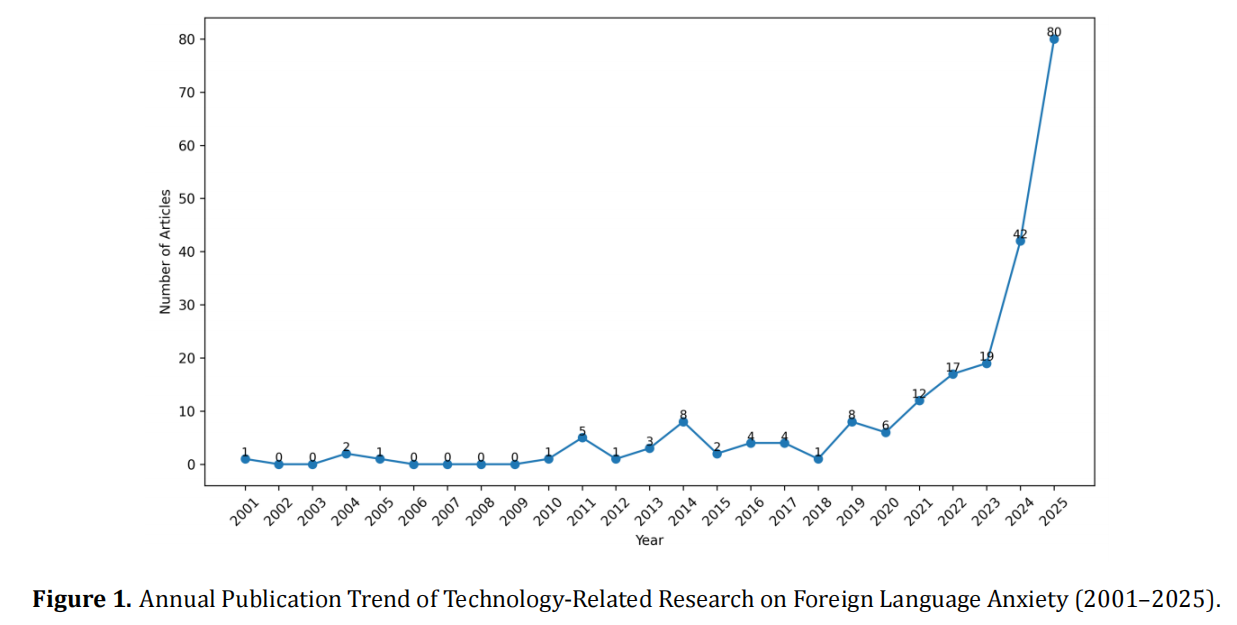
This study uses bibliometric analysis of journal papers published between 2001 and 2025 to investigate the state of the research on technology-related foreign language anxiety (FLA). 224 articles that were indexed in the Scopus database were included in the data. This study used the Bibliometrix package in R to examine publishing patterns, top journals, authors, and institutions, records of international collaboration, and the thematic structure of the field using bibliometric performance indicators and scientific mapping approaches. The findings indicate a consistent and incredibly rapid rise in publications during the past ten years. The majority of the research field's progress is published by a small number of writers and institutions in a limited number of journals. Although China now accounts for the majority of articles geographically, extensive international collaborative networks are still limited and in the early stages of development. Research focus has clearly changed throughout time, as seen by thematic and keyword analysis. While computer-assisted language learning and technology-enhanced learning environments have historically been the focus of education technology research, more recent literature shows a growing interest in artificial intelligence, immersive technologies, and data-informed digital learning contexts. Foreign language anxiety is the subject of an increasing amount of study, which typically places it in positive psychological contexts and focuses on its relationship to motivation, self-efficacy, and communication willingness. These findings will help better understand the origins of technology FLA research and how it is evolving. They can also provide references for upcoming investigations into the potential effects of digital technologies on language learners' emotions.
Keywords:
Foreign Language Learning Anxiety Technology Bibliometric Analysis Learner AffectReferences
- Al-Rubaie, A. From cadavers to codes: The evolution of anatomy education through digital technologies. Med. Sci. Educ. 2025, 35, 1101–1109. DOI: https://doi.org/10.1007/s40670-024-02268-6
- Huang, L.; Liu, M. The impact of technology on foreign language anxiety: A systematic review of empirical studies from 2004 to 2024. Humanit. Soc. Sci. Commun. 2025, 12, 1665. DOI: https://doi.org/10.1057/s41599-025-05921-6
- Qu, J. Research on mobile learning in a teaching information service system based on a big data driven environment. Educ. Inf. Technol. 2021, 26, 6183–6201. DOI: https://doi.org/10.1007/s10639-021-10614-z
- Lee, S.M. A systematic review of context-aware technology use in foreign language learning. Comput. Assist. Lang. Learn. 2022, 35, 294–318. DOI: https://doi.org/10.1080/09588221.2019.1688836
- Ahmed, A. Affective affordances in technology-mediated language teaching and learning. Technol. Lang. Teach. Learn. 2024, 6, 1720. DOI: https://doi.org/10.29140/tltl.v6n4.1720
- Dai, K.; Wang, Y. Enjoyable, anxious, or bored? Investigating Chinese EFL learners’ classroom emotions and their engagement in technology-based EMI classrooms. System 2024, 123, 103339. DOI: https://doi.org/10.1016/j.system.2024.103339
- Khoso, A.K.; Honggang, W.; Darazi, M.A. Trust and attitude towards AI as pathways to creativity: A TAM model study of EFL students’ digital literacy and AI acceptance. Humanit. Soc. Sci. Commun. 2026, 13, 69. DOI: https://doi.org/10.1057/s41599-025-06362-x
- Khoso, A.K.; Honggang, W.; Younas, M.; et al. The dual forces of AI: How generative AI and perceived AI dependency influence fear of missing out (FoMO) and EFL students' vocabulary acquisition. J. Vis. Exp. 2025, 226, e69637. DOI: https://doi.org/10.3791/69637
- Scovel, T. The effect of affect on foreign language learning: A review of the anxiety research. Lang. Learn. 1978, 28, 129–142. DOI: https://doi.org/10.1111/j.1467-1770.1978.tb00309.x
- MacIntyre, P.; Gregersen, T. Affect: The role of language anxiety and other emotions in language learning. In Psychology for Language Learning: Insights from Research, Theory and Practice; Palgrave Macmillan: London, UK, 2012; pp. 103–118. DOI: https://doi.org/10.1057/9781137032829_8
- Ai, Y.; Hu, Y.C.; Zhao, W. Interactive learning: Harnessing technology to alleviate foreign language anxiety in foreign literature education. Interact. Learn. Environ. 2025, 33, 2440–2459. DOI: https://doi.org/10.1080/10494820.2024.2409990
- Vistorte, A.O.R.; Deroncele-Acosta, A.; Ayala, J.L.M.; et al. Integrating artificial intelligence to assess emotions in learning environments: A systematic literature review. Front. Psychol. 2024, 15, 1387089. DOI: https://doi.org/10.3389/fpsyg.2024.1387089
- Taskynbayeva, M.; Gutoreva, A. Machine learning approaches to anxiety detection: Trends, model evaluation, and future directions. Front. Artif. Intell. 2025, 8, 1630047. DOI: https://doi.org/10.3389/frai.2025.1630047
- Aydın, S. Technology and foreign language anxiety: Implications for practice and future research. J. Lang. Linguist. Stud. 2018, 14, 193–211.
- Zainuddin, N. Technology enhanced language learning research trends and practices: A systematic review (2020–2022). Electron. J. e-Learn. 2023, 21, 69–79. DOI: https://doi.org/10.34190/ejel.21.2.2835
- Jing, Y.; Wang, C.; Chen, Y.; et al. Bibliometric mapping techniques in educational technology research: A systematic literature review. Educ. Inf. Technol. 2024, 29, 9283–9311. DOI: https://doi.org/10.1007/s10639-023-12178-6
- Pan, C.; Zhang, X. A longitudinal study of foreign language anxiety and enjoyment. Lang. Teach. Res. 2023, 27, 1552–1575. DOI: https://doi.org/10.1177/1362168821993341
- Resnik, P.; Dewaele, J.M. Learner emotions, autonomy and trait emotional intelligence in ‘in-person’ versus emergency remote English foreign language teaching in Europe. Appl. Linguist. Rev. 2023, 14, 473–501. DOI: https://doi.org/10.1515/applirev-2020-0096
- Gregersen, T. Dynamic properties of language anxiety. Stud. Second Lang. Learn. Teach. 2020, 10, 67–87. DOI: https://doi.org/10.14746/ssllt.2020.10.1.4
- Huang, Q. Integrating IT to foster engagement and reduce anxiety in foreign language learning. Inf. Dev. 2025, 02666669251325520. DOI: https://doi.org/10.1177/02666669251325520
- Figueiredo, S. The effect of mobile‐assisted learning in real language attainment: A systematic review. J. Comput. Assist. Learn. 2023, 39, 1083–1102. DOI: https://doi.org/10.1111/jcal.12811
- Effiong, O. Getting them speaking: Classroom social factors and foreign language anxiety. TESOL J. 2016, 7, 132–161. DOI: https://doi.org/10.1002/tesj.194
- Rassaei, E. Recasts, foreign language anxiety and L2 development during online mobile-mediated interaction. Lang. Teach. Res. 2024, 13621688241238045. DOI: https://doi.org/10.1177/13621688241238045
- Chapelle, C. The changing world of English language teaching. In English Language Learning and Technology: Lectures on Applied Linguistics in the Age of Information and Communication Technology; John Benjamins Publishing Company: Amsterdam, The Netherlands, 2003; pp. 1–33. DOI: https://doi.org/10.1075/lllt.7.02the
- Kılıçkaya, F. The Impact of Call Instruction on English Language Teachers’ Use of Technology in Language Teaching; Middle East Technical University: Ankara, Turkey, 2012.
- Fischer, C.; Pardos, Z.A.; Baker, R.S.; et al. Mining big data in education: Affordances and challenges. Rev. Res. Educ. 2020, 44, 130–160. DOI: https://doi.org/10.3102/0091732X20903304
- Ross, S.M.; Morrison, G.R.; Lowther, D.L. Educational technology research past and present: Balancing rigor and relevance to impact school learning. Contemp. Educ. Technol. 2010, 1, 17–35.
- Sun, X.; Dou, W.; Yang, Y. The socio-emotional dangers of using artificial intelligence (AI) technologies in second language (L2) education: Unveiling Chinese EFL teachers' perceptions and experiences. Acta Psychol. 2025, 261, 105956. DOI: https://doi.org/10.1016/j.actpsy.2025.105956
- Gozali, A.A.; Nurhayati, I.K.; Rahmasari, G.; et al. Analyzing key predictors of language anxiety: Machine learning models for ELAS prediction. In Proceedings of the 2024 International Conference on Intelligent Cybernetics Technology & Applications (ICICyTA), Bali, Indonesia, 17–19 December 2024. DOI: https://doi.org/10.1109/ICICYTA64807.2024.10913470
- Paniagua-Gómez, M.; Fernandez-Carmona, M. Trends and Challenges in Real-Time Stress Detection and Modulation: The Role of the IoT and Artificial Intelligence. Electronics 2025, 14, 2581. DOI: https://doi.org/10.3390/electronics14132581
- Donthu, N.; Kumar, S.; Mukherjee, D.; et al. How to conduct a bibliometric analysis: An overview and guidelines. J. Bus. Res. 2021, 133, 285–296. DOI: https://doi.org/10.1016/j.jbusres.2021.04.070
- Göksu, İ.; Özkaya, E.; Gündüz, A. Content analysis and bibliometric mapping of the CALL Journal. Comput. Assist. Lang. Learn. 2022, 35, 2018–2048. DOI: https://doi.org/10.1080/09588221.2020.1857409
- Aria, M.; Cuccurullo, C. bibliometrix: An R-tool for comprehensive science mapping analysis. J. Informetr. 2017, 11, 959–975. DOI: https://doi.org/10.1016/j.joi.2017.08.007
- Sun, Y.C. Microteaching writing on YouTube for pre-service teacher training: Lessons learned. CALICO J. 2014, 31, 179–200.
- Tai, T.Y.; Chen, H.H.J. The impact of Google Assistant on adolescent EFL learners’ willingness to communicate. Interact. Learn. Environ. 2023, 31, 1485–1502. DOI: https://doi.org/10.1080/10494820.2020.1841801
- El Shazly, R. Effects of artificial intelligence on English speaking anxiety and speaking performance: A case study. Expert Syst. 2021, 38, e12667. DOI: https://doi.org/10.1111/exsy.12667
- Jeon, J. Exploring AI chatbot affordances in the EFL classroom: Young learners’ experiences and perspectives. Comput. Assist. Lang. Learn. 2024, 37, 1–26. DOI: https://doi.org/10.1080/09588221.2021.2021241
- Su, F.; Zou, D. Technology-enhanced collaborative language learning: theoretical foundations, technologies, and implications. Comput. Assist. Lang. Learn. 2022, 35, 1754–1788. DOI: https://doi.org/10.1080/09588221.2020.1831545
- Zhang, C.; Meng, Y.; Ma, X. Artificial intelligence in EFL speaking: Impact on enjoyment, anxiety, and willingness to communicate. System 2024, 121, 103259. DOI: https://doi.org/10.1016/j.system.2024.103259
- York, J.; Shibata, K.; Tokutake, H.; et al. Effect of SCMC on foreign language anxiety and learning experience: A comparison of voice, video, and VR-based oral interaction. ReCALL 2021, 33, 49–70. DOI: https://doi.org/10.1017/S0958344020000154
- Xie, X.; Teng, M.F.; Zhang, L.J.; et al. Exploring AI Literacy and AI‐Induced Emotions among Chinese University English Language Teachers: The Partial Least Square Structural Equation Modeling (PLS‐SEM) Approach. Int. J. Appl. Linguist. 2025, 35, 1897–1911. DOI: https://doi.org/10.1111/ijal.12798
- Alsager, H. To look from another window in education: Artificial intelligence assisted language learning and its reflections on academic demotivation, foreign language learning anxiety and autonomy. Comput.-Assist. Lang. Learn. Electron. J. 2024, 25, 124–147.
- Miguel, E.; Carney, W. Foreign language acquisition anxiety and project-based learning in collaborative L2 instruction: A case study. Theory Pract. Lang. Stud. 2022, 12, 1. DOI: https://doi.org/10.17507/tpls.1201.01
- Chen, H.H.J.; Yang, C.T.Y.; Lai, K.K.W. Investigating college EFL learners’ perceptions toward the use of Google Assistant for foreign language learning. Interact. Learn. Environ. 2023, 31, 1335–1350. DOI: https://doi.org/10.1080/10494820.2020.1833043
- Hwang, G.J.; Xie, H.; Wah, B.W.; et al. Vision, challenges, roles and research issues of Artificial Intelligence in Education. Comput. Educ. Artif. Intell. 2020, 1, 100001. DOI: https://doi.org/10.1016/j.caeai.2020.100001
- He, M.; Abbasi, B.N.; He, J. AI-driven language learning in higher education: An empirical study on self-reflection, creativity, anxiety, and emotional resilience in EFL learners. Humanit. Soc. Sci. Commun. 2025, 12, 1525. DOI: https://doi.org/10.1057/s41599-025-05817-5
- Al-Ahdal, A.A.M.H.; Aljabr, F.S. The Role of Interlanguage Practices in Feedback Mechanisms: A Case Study with Saudi EFL Learners. World J. Engl. Lang. 2023, 13. DOI: https://doi.org/10.5430/wjel.v13n8p638
- Hwang, G.J.; Fu, Q.K. Trends in the research design and application of mobile language learning: A review of 2007–2016 publications in selected SSCI journals. Interact. Learn. Environ. 2019, 27, 567–581. DOI: https://doi.org/10.1080/10494820.2018.1486861