
Article
Smart Tourism Technologies and Revisit Intention in Vietnam’s Agritourism Destinations: An Expectation–Confirmation Model with Novelty and Worry
 Download

This work is licensed under a Creative Commons Attribution 4.0 International License.
Copyright
The authors shall retain the copyright of their work but allow the Publisher to publish, copy, distribute, and convey the work.
License
Digital Technologies Research and Applications (DTRA) publishes accepted manuscripts under Creative Commons Attribution 4.0 International (CC BY 4.0). Authors who submit their papers for publication by DTRA agree to have the CC BY 4.0 license applied to their work, and that anyone is allowed to reuse the article or part of it free of charge for any purpose, including commercial use. As long as the author and original source are properly cited, anyone may copy, redistribute, reuse, and transform the content.
Authors
-
Hai Ha Hoang
 Faculty of Economic Information System and Electronic Commerce, Thuongmai University, Hanoi 100000, Vietnam
-
Thi Thuy Hang Vu
Faculty of Economic Information System and Electronic Commerce, Thuongmai University, Hanoi 100000, Vietnam
-
Hang Thi Bich Tran
Department of Training Administration, Thuongmai University, Hanoi 100000, Vietnam
-
Duc-Minh Nguyen
Faculty of Economic Information System and Electronic Commerce, Thuongmai University, Hanoi 100000, Vietnam
Received: 28 February 2026; Revised: 24 March 2026; Accepted: 15 April 2026; Published: 12 June 2026
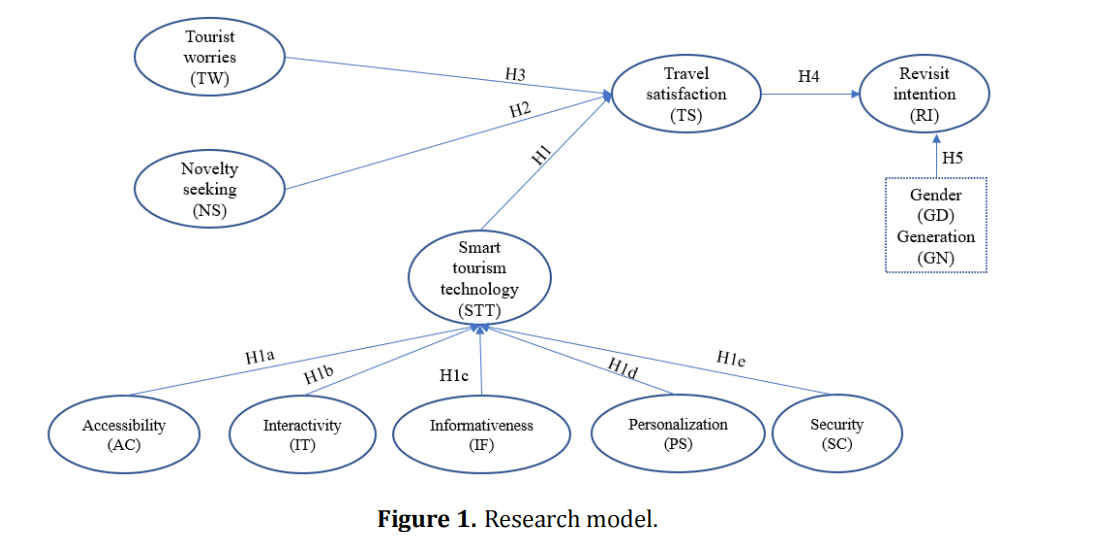
Smart tourism technology (STTs) is increasingly being used by agritourism locations in Vietnam to help travellers prior to, during, and following their travels. However, there is little empirical data on how digital technologies function that affect visitors' intentions to return, especially in rural and agritourism. Based on the expectation-confirmation paradigm and smart tourism studies, this study looks at how STTs, novelty-seeking behaviour, and travel anxiety affect visitors' satisfaction and, consequently, their propensity to return to Vietnam's agritourism sites. A structured survey of 230 agritourism visitors was used to gather primary data, which was then analysed using Partial least squares structural equation modeling (PLS-SEM) with bootstrapping and an Importance–performance map analysis (IPMA) to determine practical improvement goals. The results show that the main factor influencing the propensity to return is visitor pleasure. STTs enhance pleasure through immersion and reassurance, while novelty-seeking boosts experiential value. Notably, travel anxiety is positively correlated with satisfaction, suggesting that in technology-mediated contexts, moderate levels of apprehension may enhance information engagement and appreciation when expectations are adequately met. IPMA emphasises that satisfaction and novelty-related experiences are crucial factors in enhancing revisit intentions, while also underscoring the need to ensure dependable access to information and prompt digital assistance. By establishing STTs as pivotal drivers within the expectation-confirmation framework, this study elucidates how digital systems shape tourists' cognitive and emotional paths toward loyalty, offering destination managers and platform providers strategic blueprints for enhancing revisit intentions through technology-driven experience design and service quality.
Keywords:
Agritourism Expectation-Confirmation Model Revisit Intention PLS-SEM Smart Tourism Technologies Tourist SatisfactionReferences
- Suanpang, P.; Pothipassa, P. Integrating Generative AI and IoT for Sustainable Smart Tourism Destinations. Sustainability 2024, 16, 7435. DOI: https://doi.org/10.3390/su16177435
- Mak, H.W.L.; Lam, Y.F. Comparative assessments and insights of data openness of 50 smart cities in air quality aspects. Sustain. Cities Soc. 2021, 69, 102868. DOI: https://doi.org/10.1016/j.scs.2021.102868
- Le-Dinh, T.; Le, T.D.; Labelle, F. Digital technologies in the circular economy: A bibliometric analysis. J. Trade Sci. 2025, 13, 252–278. DOI: https://doi.org/10.1108/JTS-04-2025-0016
- Viet Nam National Authority of Tourism. Viet Nam records more than 17.5 million international visitor arrivals in 2024. Available online: https://vietnamtourism.gov.vn/en/post/20764 (accessed on 5 January 2026).
- Nhan Dan Online. OCOP and tourism in relation to the rural economy. Available online: https://en.nhandan.vn/ocop-and-tourism-with-the-rural-economy-post155748.html (accessed on 5 January 2026).
- DataReportal. Digital 2025: Vietnam. Available online: https://datareportal.com/reports/digital-2025-vietnam (accessed on 5 January 2026).
- Vu, T.T.H.; Nguyen, T.H. Smart Tourism Research: Where Are We Going: A Science Map of the Field. Int. J. Hosp. Tour. Syst. 2026, 19, 66–80. DOI: https://doi.org/10.21863/ijhts/2026.19.1.005
- Gretzel, U.; Sigala, M.; Xiang, Z.; et al. Smart tourism: Foundations and developments. Electron. Mark. 2015, 25, 179–188. DOI: https://doi.org/10.1007/s12525-015-0196-8
- Buhalis, D.; Harwood, T.; Bogicevic, V.; et al. Technological disruptions in services: Lessons from tourism and hospitality. J. Serv. Manag. 2019, 30, 484–506. DOI: https://doi.org/10.1108/JOSM-12-2018-0398
- Au, W.C.W.; Tsang, N.K.F. Smart Travel Experiences: A Bibliometric Analysis of Knowledge Domains and Research Areas. J. Hosp. Tour. Res. 2024, 48, 920–936. DOI: https://doi.org/10.1177/10963480221130998
- Yap, Y.-Y.; Tan, S.-H.; Tan, B.-C.; et al. Smart tourism technologies and tourist satisfaction: A systematic literature review and research agenda. Acta Psychol. 2025, 258, 105191. DOI: https://doi.org/10.1016/j.actpsy.2025.105191
- Oliver, R.L. Whence Consumer Loyalty? J. Mark. 1999, 63, 33–44. DOI: https://doi.org/10.2307/1252099
- Torabi, Z.-A.; Pourtaheri, M.; Hall, C.M.; et al. Smart Tourism Technologies, Revisit Intention, and Word-of-Mouth in Emerging and Smart Rural Destinations. Sustainability 2023, 15, 10911. DOI: https://doi.org/10.3390/su151410911
- Larsen, S.; Brun, W.; Øgaard, T. What tourists worry about—Construction of a scale measuring tourist worries. Tour. Manag. 2009, 30, 260–265. DOI: https://doi.org/10.1016/j.tourman.2008.06.004
- Borkovec, T.D. The nature, functions, and origins of worry. In Worrying: Perspectives on Theory, Assessment and Treatment; John Wiley & Sons: Hoboken, NJ, USA, 1994; pp. 5–33.
- Freeston, M.H.; Rhéaume, J.; Letarte, H.; et al. Why do people worry? Pers. Individ. Dif. 1994, 17, 791–802. DOI: https://doi.org/10.1016/0191-8869(94)90048-5
- Rezaei, M.; Rokni, L.; Kim, D.H. Contribution of ‘Agritourism’ Activities in Visitors’ Wellbeing and Improved Mental Health in Society. Iran. J. Public Health 2021. DOI: https://doi.org/10.18502/ijph.v50i6.6434
- Goo, J.; Huang, C.D.; Yoo, C.W.; et al. Smart Tourism Technologies’ Ambidexterity: Balancing Tourist’s Worries and Novelty Seeking for Travel Satisfaction. Inf. Syst. Front. 2022, 24, 2139–2158. DOI: https://doi.org/10.1007/s10796-021-10233-6
- Urry, J. The Consumption of Tourism. Sociology 1990, 24, 23–35. DOI: https://doi.org/10.1177/0038038590024001004
- Pearson, P.H. Relationships between global and specified measures of novelty seeking. J. Consult. Clin. Psychol. 1970, 34, 199–204. DOI: https://doi.org/10.1037/h0029010
- Lee, T.-H.; Crompton, J. Measuring novelty seeking in tourism. Ann. Tour. Res. 1992, 19, 732–751. DOI: https://doi.org/10.1016/0160-7383(92)90064-V
- Toyama, M.; Yamada, Y. The Relationships among Tourist Novelty, Familiarity, Satisfaction, and Destination Loyalty: Beyond the Novelty-familiarity Continuum. Int. J. Mark. Stud. 2012, 4, 10–18. DOI: https://doi.org/10.5539/ijms.v4n6p10
- Oliver, R.L. A cognitive model of the antecedents and consequences of satisfaction decisions. J. Mark. Res. 1980, 17, 460–469.
- Buhalis, D.; Amaranggana, A. Smart Tourism Destinations Enhancing Tourism Experience Through Personalisation of Services. In Proceedings of the Information and Communication Technologies in Tourism 2015, Lugano, Switzerland, 3–6 February 2015; pp. 377–389. DOI: https://doi.org/10.1007/978-3-319-14343-9_28
- Sigala, M. Tourism and COVID-19: Impacts and implications for advancing and resetting industry and research. J. Bus. Res. 2020, 117, 312–321. DOI: https://doi.org/10.1016/j.jbusres.2020.06.015
- Alsharif, A.; Isa, S.M.; Alqudah, M.N. Smart Tourism, Hospitality, and Destination: A Systematic Review and Future Directions. J. Tour. Serv. 2024, 15, 72–110.
- Buhalis, D. Technology in tourism-from information communication technologies to eTourism and smart tourism towards ambient intelligence tourism: A perspective article. Tour. Rev. 2020, 75, 267–272. DOI: https://doi.org/10.1108/TR-06-2019-0258
- Azis, N.; Amin, M.; Chan, S.; et al. How smart tourism technologies affect tourist destination loyalty. J. Hosp. Tour. Technol. 2020, 11, 603–625. DOI: https://doi.org/10.1108/JHTT-01-2020-0005
- Huang, C.D.; Goo, J.; Nam, K.; et al. Smart tourism technologies in travel planning: The role of exploration and exploitation. Inf. Manag. 2017, 54, 757–770. DOI: https://doi.org/10.1016/j.im.2016.11.010
- Tosyali, H.; Tosyali, F.; Coban-Tosyali, E. Role of tourist-chatbot interaction on visit intention in tourism: The mediating role of destination image. Curr. Issues Tour. 2025, 28, 511–526. DOI: https://doi.org/10.1080/13683500.2023.2288937
- Tran, H.T.B.; Nguyen, T.H.; Le, X.C. What Boosts Users’ Intention to Follow Generative Artificial Intelligence-Assisted Recommendations in Tourism. Tour. Hosp. 2026, 7, 64. DOI: https://doi.org/10.3390/tourhosp7030064
- Yuksel, F.; Kement, U.; Dogan, S.; et al. Effect of smart tourism technology experience (STTE) on tourist satisfaction and tourist happiness in Bordeaux: The mediation role of self-gratification. Int. J. Tour. Cities 2025, 11, 218–241. DOI: https://doi.org/10.1108/IJTC-06-2024-0119
- Nadee, W.; Kaewkitipong, L.; Ractham, P.; et al. An Investigation of the Intention to Visit Smart Tourism Destinations: Domestic Travelers vs. International Travelers. Sustainability 2024, 16, 10484. DOI: https://doi.org/10.3390/su162310484
- Yan, D.; Marzuki, A.B.; Yang, J.; et al. Bibliometric Analysis of Smart Tourism Destination: Knowledge Structure and Research Evolution (2013–2025). Tour. Hosp. 2025, 6, 194. DOI: https://doi.org/10.3390/tourhosp6040194
- Yoo, C.W.; Goo, J.; Huang, C.D.; et al. Improving travel decision support satisfaction with smart tourism technologies: A framework of tourist elaboration likelihood and self-efficacy. Technol. Forecast. Soc. Change 2017, 123, 330–341. DOI: https://doi.org/10.1016/j.techfore.2016.10.071
- Vu, T.T.H.; Hoang, H.H.; Hoang, T.N.N.; et al. Bibliometric and Content Analysis of Global Trends in Digital Transformation and Rural Tourism. Geoj. Tour. Geosites 2025, 58, 161–175. DOI: https://doi.org/10.30892/gtg.58114-1399
- Mitas, O.; Bastiaansen, M. Novelty: A mechanism of tourists’ enjoyment. Ann. Tour. Res. 2018, 72, 98–108. DOI: https://doi.org/10.1016/j.annals.2018.07.002
- Tjokrosaputro, M.; Ekawati, S.; Keni, K.; et al. Cultural Tourist Loyalty: Investigating Novelty, Authenticity, and Tourist Satisfaction as Mediation. In Proceedings of the Twelfth International Conference on Entrepreneurship and Business Management 2023 (ICEBM 2023), Surakarta, Indonesia, 2024; pp. 158–172. DOI: https://doi.org/10.2991/978-94-6463-508-9_13
- Strickland, P.C.; Ratten, V. Study motivations of Bhutanese students in hospitality and tourism courses. J. Trade Sci. 2024, 12, 22–36. DOI: https://doi.org/10.1108/JTS-10-2023-0023
- Nguyen, H.Q.T.; Vu, T.T.H.; Nguyen, T.H. A Study on Factors Affecting Work Engagement of Employees in Travel Businesses in Vietnam. Int. J. Hosp. Tour. Syst. 2025, 18, 32–42.
- Muñoz-Navarro, R.; Malonda, E.; Llorca-Mestre, A.; et al. Worry about COVID-19 contagion and general anxiety: Moderation and mediation effects of cognitive emotion regulation. J. Psychiatr. Res. 2021, 137, 311–318. DOI: https://doi.org/10.1016/j.jpsychires.2021.03.004
- Le, B.N.; Nguyen, H.V.; Nguyen, D.M. Understanding how perceived value enhances consumer loyalty toward energy-efficient appliances: The role of satisfaction and product category. J. Trade Sci. 2025, 13, 23–43. DOI: https://doi.org/10.1108/JTS-08-2024-0054
- Nguyen Huu, T.; Nguyen Ngoc, H.; Nguyen Dai, L.; et al. Effect of tourist satisfaction on revisit intention in Can Tho City, Vietnam. Cogent Bus. Manag. 2024, 11, 2322779. DOI: https://doi.org/10.1080/23311975.2024.2322779
- Hari, R.; Mohan, D.R. Tourist Satisfaction and Revisit Intention in Responsible Tourism Destinations: Insights for Sustaining Engagement and Growth. Int. J. Environ. Sci. 2025, 11, 1221–1226. DOI: https://doi.org/10.64252/v95rn963
- Nguyen, T.Q.; Bui, T.-P. Tourist satisfaction and revisit intention in tropical mountain resorts: A structural equation modeling study in a developing country context. Tour. Hosp. Res. 2025. DOI: https://doi.org/10.1177/14673584251387349
- Baghirov, F.; Bozbay, Z.; Zhang, Y. Individual factors impacting tourist satisfaction and revisit intention in slow tourism cities: An extended model. Int. J. Tour. Cities 2025, 11, 63–82. DOI: https://doi.org/10.1108/IJTC-05-2023-0094
- No, E.; Kim, J.K. Comparing the attributes of online tourism information sources. Comput. Hum. Behav. 2015, 50, 564–575. DOI: https://doi.org/10.1016/j.chb.2015.02.063
- Teng, X.; Wu, Z.; Yang, F. Research on the Relationship between Digital Transformation and Performance of SMEs. Sustainability 2022, 14, 6012. DOI: https://doi.org/10.3390/su14106012
- Um, T.; Chung, N. Does smart tourism technology matter? Lessons from three smart tourism cities in South Korea. Asia Pac. J. Tour. Res. 2021, 26, 396–414. DOI: https://doi.org/10.1080/10941665.2019.1595691
- Hair Jr, J.F.; Sarstedt, M.; Hopkins, L.; et al. Partial least squares structural equation modeling (PLS-SEM). Eur. Bus. Rev. 2014, 26, 106–121. DOI: https://doi.org/10.1108/EBR-10-2013-0128
- Chin, W.W. The partial least squares approach to structural equation modeling. In Modern Methods for Business Research; Psychology Press: Hove, UK, 1998.
- Fornell, C.; Larcker, D.F. Evaluating Structural Equation Models with Unobservable Variables and Measurement Error. J. Mark. Res. 1981, 18, 39–50. DOI: https://doi.org/10.2307/3151312