
Article
Generative Dialogue Agent Design for Research Integrity Education: Behavioral Intervention and Cognitive Training Evidence
 Download

This work is licensed under a Creative Commons Attribution 4.0 International License.
Copyright
The authors shall retain the copyright of their work but allow the Publisher to publish, copy, distribute, and convey the work.
License
Digital Technologies Research and Applications (DTRA) publishes accepted manuscripts under Creative Commons Attribution 4.0 International (CC BY 4.0). Authors who submit their papers for publication by DTRA agree to have the CC BY 4.0 license applied to their work, and that anyone is allowed to reuse the article or part of it free of charge for any purpose, including commercial use. As long as the author and original source are properly cited, anyone may copy, redistribute, reuse, and transform the content.
Authors
-
Li You
 Southwest University Hospital, Chongqing 400715, China
-
Yongguo Hu
Editorial Department of Health Medicine Research and Practice, Southwest University, Chongqing 400715, China
-
Zhipeng Li
Southwest University Hospital, Chongqing 400715, China
-
Li Dai
Editorial Department of Health Medicine Research and Practice, Southwest University, Chongqing 400715, China
-
Jie Zhao
Department of Commerce and Trade Circulation, Inner Mongolia Business & Trade Vocational College, Hohhot 010070, China
-
Jie Liu
Editorial Department of Health Medicine Research and Practice, Southwest University, Chongqing 400715, China
-
Wenjie Huang
Editorial Department of Health Medicine Research and Practice, Southwest University, Chongqing 400715, China
-
Zonghui Wu
Southwest University Hospital, Chongqing 400715, China
Editorial Department of Health Medicine Research and Practice, Southwest University, Chongqing 400715, China -
Yahui Li
Editorial Department of Computer Science, Chongqing Southwest Information Co., Ltd., Chongqing 401121, China
-
Yongsong Yan
Editorial Department of Nano Materials Science, Chongqing University, Chongqing 400044, China
Received: 9 February 2026; Revised: 18 March 2026; Accepted: 9 April 2026; Published: 19 May 2026
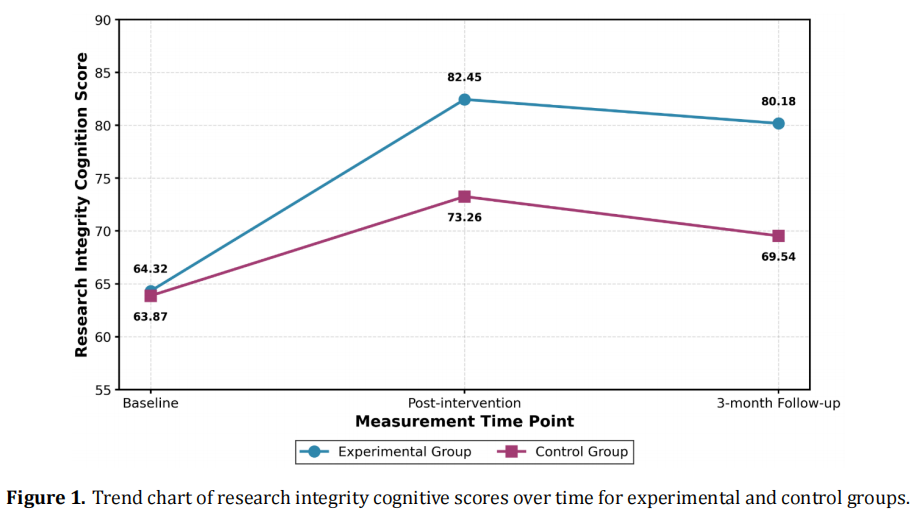
Research integrity education may demonstrate that these programs establish critical foundations for maintaining healthy academic ecosystems. The traditional educational approaches might indicate limitations including insufficient interactivity and low personalization. Moreover, this study could examine a generative conversational agent system for research integrity education. The system appears to enhance integrity literacy through dual behavioral intervention mechanisms. The research employed a quasi-experimental design with 126 graduate students. Given that participants received random assignment into experimental and control groups, the experimental group participated in an eight-week agent-based intervention. The control group received traditional lecture-based training instead. Furthermore, we measured indicators at baseline, immediate post-intervention, and three-month follow-up points. These indicators may show cognition level, behavioral norms, moral reasoning ability, and critical thinking. The results could demonstrate that the significant experimental group showed greater improvements than the control group across all important indicators. Research integrity cognition might indicate increases by 25.5%. Notwithstanding these critical empirical findings, the important academic behavioral norms could be improved by 25.1% substantially. Nonetheless, several limitations warrant acknowledgment: the sample was drawn from a single institution, limiting generalizability; the three-month follow-up period may be insufficient to capture long-term behavioral transfer; and the system's performance in handling culturally nuanced or highly ambiguous ethical dilemmas remains suboptimal. These findings contribute empirical evidence for the application of generative artificial intelligence in professional ethics education while offering practical guidance for the intelligent transformation of research integrity training in academic institutions.
Keywords:
Generative Conversational Agent Research Integrity Education Behavioral Intervention Cognitive Training Personalized LearningReferences
- Horbach, P.S.; Fishberg, R.; Ulpts, S.; et al. Thou Shalt Not!—How the institutional afterlife of research misconduct scandals shapes research integrity training. J. Responsible Innov. 2024, 11, 2414500. DOI: https://doi.org/10.1080/23299460.2024.2414500
- Wang, P.; Jia, Y. Exploration and Practice of Research Integrity Education for Graduate Students in Universities in the Digital Intelligence Era. Pop. Lit. Art 2025, 135–137. DOI: https://doi.org/10.20112/j.cnki.ISSN1007-5828.2025.16.045 (in Chinese)
- Francesca, G.; Ceruti, S.; Martini, S.; et al. Educating and Training in Research Integrity (RI): A Study on the Perceptions and Experiences of Early Career Researchers Attending an Institutional RI Course. J. Acad. Ethics 2023, 22, 413–430. DOI: https://doi.org/10.1007/S10805-023-09497-1
- Dubbaka, S. Incorporating Implicit bias into research integrity education: Response to 'Why and how to incorporate issues of race/ethnicity and gender in research integrity education'. Account. Res. 2023, 32, 193–194. DOI: https://doi.org/10.1080/08989621.2023.2247974
- Labib, K., Evans, N., Pizzolato, D.; et al. Co-creating Research Integrity Education Guidelines for Research Institutions. Sci. Eng. Ethics 2023, 29, 28. DOI: https://doi.org/10.1007/S11948-023-00444-2
- Panpakdee, C.; Khanbut, K. Pathways to food security: Perceptions of resilience between organic farmers and extension agents in Thung Kala Ronghai, Thailand. Cogent Food Agric. 2025, 11, 2546989. DOI: https://doi.org/10.1080/23311932.2025.2546989
- Antunes, D.; Oliveira, R.; Paulino, M.; et al. Severe acute asthma exacerbations under biological agents: A new therapeutic paradigm? Pulmonology 2025, 31, 2571016. DOI: https://doi.org/10.1080/25310429.2025.2571016
- Najafi, F.; Ghasemian, N.; Safari, M.; et al. Poly(propylene imine) dendrimer as reducing agent for chloroauric acid to fabricate and stabilize gold nanoparticles. J. Phys. Chem. Solids 2021, 148, 109682. DOI: https://doi.org/10.1016/j.jpcs.2020.109682
- Moyns, E.; Looms, J.; Jagpal, S.P.; et al. A review of cardiotoxic agent poisoning and the role of VA-ECMO as reported to the National Poisons Information Service (NPIS) 2018–2023. Toxicol. Commun. 2025, 9, 2524302. DOI: https://doi.org/10.1080/24734306.2025.2524302
- Lam, W.; Paynter, Q.; Zhang, Z.-Q. Functional response of Amblyseius herbicolus (Acari: Phytoseiidae) on Sericothrips staphylinus (Thysanoptera: Thripidae), an ineffective biocontrol agent of gorse. Biol. Control 2021, 152, 104468. DOI: https://doi.org/10.1016/j.biocontrol.2020.104468
- Cao, Y.; Jiang, Y.; Zhao, Y. A study on the content of integrity policies and research integrity management in Chinese universities. Front. Res. Metr. Anal. 2023, 8, 943228. DOI: https://doi.org/10.3389/frma.2023.943228
- Vitiello, G.; Venezia, V.; Verrillo, M.; et al. Hybrid humic acid/titanium dioxide nanomaterials as highly effective antimicrobial agents against gram(−) pathogens and antibiotic contaminants in wastewater. Environ. Res. 2021, 193, 110562. DOI: https://doi.org/10.1016/j.envres.2020.110562
- Manne, A.A.; Arigela, B.; Giduturi, A.K.; et al. Pterocarpus marsupium Roxburgh heartwood extract/chitosan nanoparticles loaded hydrogel as an innovative wound healing agent in the diabetic rat model. Mater. Today Commun. 2021, 26, 101916. DOI: https://doi.org/10.1016/j.mtcomm.2020.101916
- Davoodi, M.; Faryadi, S.; Velni, M.J. A Graph Theoretic-Based Approach for Deploying Heterogeneous Multi-agent Systems with Application in Precision Agriculture. J. Intell. Robot. Syst. 2021, 101, 10. DOI: https://doi.org/10.1007/s10846-020-01263-4
- Kaviarasan, B.; Kwon, O.-M.; Park, J.M.; et al. Stochastic faulty estimator-based non-fragile tracking controller for multi-agent systems with communication delay. Appl. Math. Comput. 2021, 392, 125704. DOI: https://doi.org/10.1016/j.amc.2020.125704
- Formanek, M. Exploring the potential of large language models and generative artificial intelligence (GPT): Applications in Library and Information Science. J. Librariansh. Inf. Sci. 2025, 57, 09610006241241066. DOI: https://doi.org/10.1177/09610006241241066
- Byun, J.H.; Jung, I.H. Phase-specific cancer-immune model considering acquired resistance to therapeutic agents. Appl. Math. Comput. 2021, 391, 125555. DOI: https://doi.org/10.1016/j.amc.2020.125555
- Lee, Y.H.; Park, J.Y.; Lee, I.Y.; et al. Effects of cryoprotective agents and treatment methods on sperm cryopreservation of stone flounder, Kareius bicoloratus. Aquaculture 2021, 531, 735969. DOI: https://doi.org/10.1016/j.aquaculture.2020.735969
- Silva, L.d.L.; Souza, C.d.F.; Parodi, T.V.; et al. Ethanolic extract of Hyptis mutabilis (Rich.) Briq.: An effective sedative and antioxidant agent in fish. Aquaculture 2021, 531, 735940. DOI: https://doi.org/10.1016/j.aquaculture.2020.735940
- Cosenza, B.; Popov, N.; Juurlink, B.; et al. Easy and efficient agent-based simulations with the OpenABL language and compiler. Future Gener. Comput. Syst. 2021, 116, 61–75. DOI: https://doi.org/10.1016/j.future.2020.10.014
- Hidayat, R.; Chowdhury, T.; Kim, Y.; et al. Density functional theory study on the reducing agents for atomic layer deposition of tungsten using tungsten chloride precursor. Appl. Surf. Sci. 2021, 538, 148156. DOI: https://doi.org/10.1016/j.apsusc.2020.148156
- Duan, A.; Chen, M.; Lu, Q. Design of Railway Customer Service Agent Based on Large Language Model. Yangtze River Inf. Commun. 2025, 38, 86–93. DOI: https://doi.org/10.20153/j.issn.2096-9759.2025.08.024 (in Chinese)
- Roh, D.K.; Jae, H.; Mun, H.; et al. Precise tuning of morphology and pore size of amine-functionalized MIL metal–organic frameworks using a directing agent. Mater. Sci. Eng. B 2021, 263, 114833. DOI: https://doi.org/10.1016/j.mseb.2020.114833
- Riddle, M.E.; Tatara, E.; Olson, C.; et al. Agent-based modeling of supply disruptions in the global rare earths market. Resour. Conserv. Recycl. 2021, 164, 105193. DOI: https://doi.org/10.1016/j.resconrec.2020.105193
- Lou, K.; Kang, A.; Xiao, P.; et al. Effects of basalt fiber coated with different sizing agents on performance and microstructures of asphalt mixture. Constr. Build. Mater. 2021, 266, 121155. DOI: https://doi.org/10.1016/j.conbuildmat.2020.121155
- Somboon, P.; Soontorngun, N. An actin depolymerizing agent 19,20-epoxycytochalasin Q of Xylaria sp. BCC 1067 enhanced antifungal action of azole drugs through ROS-mediated cell death in yeast. Microbiol. Res. 2021, 243, 126646. DOI: https://doi.org/10.1016/j.micres.2020.126646
- Mannekote, A.; Davies, R.; Pinto, J.D.; et al. Large language models for whole-learner support: Opportunities and challenges. Front. Artif. Intell. 2024, 7, 1460364. DOI: https://doi.org/10.3389/frai.2024.1460364
- Lee, S.-Y.; Jang, D.-I.; Kim, D.-Y.; et al. UV laser decontamination of chemical warfare agent simulants CEPS and malathion. J. Photochem. Photobiol. A 2021, 406, 112989. DOI: https://doi.org/10.1016/j.jphotochem.2020.112989
- Scoppa, V. Social pressure in the stadiums: Do agents change behavior without crowd support? J. Econ. Psychol. 2021, 82, 102344. DOI: https://doi.org/10.1016/j.joep.2020.102344
- Oliveira, L.d.F.; Camargos, E.F.; Martini, L.L.L.; et al. Use of psychotropic agents to treat agitation and aggression in Brazilian patients with Alzheimer's disease: A naturalistic and multicenter study. Psychiatry Res. 2021, 295, 113591. DOI: https://doi.org/10.1016/j.psychres.2020.113591
- Zhang, L.; Zhang, J.; Li, Y.; et al. Design of Integrated Energy System Agent Based on Reinforcement Learning. Electron. Des. Eng. 2024, 32, 145–149. DOI: https://doi.org/10.14022/j.issn1674-6236.2024.12.030 (in Chinese)
- Yepes, A.; Ochoa-Bautista, D.; Murillo-Arango, W.; et al. Purple passion fruit seeds (Passiflora edulis f. edulis Sims) as a promising source of skin anti-aging agents: Enzymatic, antioxidant and multi-level computational studies. Arab. J. Chem. 2021, 14, 202101. DOI: https://doi.org/10.1016/j.arabjc.2020.11.011
- Zupko, R. Application of agent-based modeling and life cycle sustainability assessment to evaluate biorefinery placement. Biomass Bioenergy 2021, 144, 105916. DOI: https://doi.org/10.1016/j.biombioe.2020.105916
- Munjita, S.M.; Kalonda, A.; Mubemba, B.; et al. Evidence of multiple bacterial, viral, and parasitic infectious disease agents in Mastomys natalensis rodents in riverine areas in selected parts of Zambia. Infect. Ecol. Epidemiol. 2025, 15, 2441537. DOI: https://doi.org/10.1080/20008686.2024.2441537
- Arita, T.; Namerikawa, T. Probabilistic multi-agent pose graph filtering on SE(3) via distributed ADMM and stein particle gradient descent. SICE J. Control Meas. Syst. Integr. 2025, 18, 2570573. DOI: https://doi.org/10.1080/18824889.2025.2570573
- Sushma, K.; Lakshmi, T.N.; Arunodhayam, K.; et al. In Vitro Evaluation of Fungicides, Botanicals and Bio-control agents against Stagonosporopsis cucurbitacearum Causing Gummy Stem Blight. J. Adv. Biol. Biotechnol. 2025, 28, 1681–1691. DOI: https://doi.org/10.9734/JABB/2025/V28I123547
- Puttasakul, T.; Sirisangwang, P.; Aroonrote, N.; et al. Optimizing Dispersion of Silver Nanoparticle Incorporated Hydrogel Matrix by Silver Ion-Reducing Agent Self-Assembly. ACS Omega 2025, 10, 62667–62674. DOI: https://doi.org/10.1021/ACSOMEGA.5C06979
- Vendé, B.; Barberousse, A.; Ruphy, S. From 2015 to 2023, eight years of empirical research on research integrity: a scoping review. Res. Integr. Peer Rev. 2025, 10, 5. DOI: https://doi.org/10.1186/s41073-025-00163-1
- Elayaraja, S.; Liu, G.; Zagorsek, K.; et al. TEMPO-oxidized biodegradable bacterial cellulose (BBC) membrane coated with biologically-synthesized silver nanoparticles (AgNPs) as a potential antimicrobial agent in aquaculture (In vitro). Aquaculture 2021, 530, 735746. DOI: https://doi.org/10.1016/j.aquaculture.2020.735746
- Mahale, S.A.; Dhadse, P.; Mahale, A.; et al. In vitro assessment of copper nanoparticles gel efficacy as a futuristic drug delivery agent against periodontal pathogens. J. Taibah Univ. Sci. 2025, 19, 2549161. DOI: https://doi.org/10.1080/16583655.2025.2549161
- Bermejo-Casado, R.; Bazaga-Fernández, I.; Carrasco-Granger, S. Law enforcement agents at European borders: perceptions of migration, and the networked and relational exercise of discretion in policy implementation. Polit. Res. Exch. 2025, 7, 2561948. DOI: https://doi.org/10.1080/2474736X.2025.2561948
- Xu, W. Dilemmas and Countermeasures for Research Integrity Education of Graduate Students. Tianjin Sci. Technol. 2025, 52, 95–102. DOI: https://doi.org/10.14099/j.cnki.tjkj.2025.01.014 (in Chinese)
- Nitayaphat, W.; Jintakosol, T. Sustainable Dyeing of Sugarcane Leaves-Cotton Blended Yarn with Dayak Onion (Eleutherine americana) Bulb Extract Using Eco-Friendly Mordanting Agents. J. Nat. Fibers 2025, 22, 2511998. DOI: https://doi.org/10.1080/15440478.2025.2511998
- Sousa, N. Ethical and practical implications of AI in academic library research. J. Librariansh. Inf. Sci. 2025, 57, 03400352251391753. DOI: https://doi.org/10.1177/03400352251391753
- Leong, H.J.-Y.; Tan, H.-D.; Teoh, M.-L. In silico discovery of skin depigmenting agents from Chlorella vulgaris: A network pharmacology and molecular simulation approach. Appl. Phycol. 2025, 6, 350–365. DOI: https://doi.org/10.1080/26388081.2025.2558516
- Grzyb, T.; Kulczyk, S. Well-being derived from the riverscape: Linking comfort and discomfort agents. Ecosyst. People 2025, 21, 2578178. DOI: https://doi.org/10.1080/26395916.2025.2578178
- Iwata, S.; Yamasita, N.; Asukabe, K.; et al. Discovery and characterization of antitumor gut microbiota from amphibians and reptiles: Ewingella americana as a novel therapeutic agent with dual cytotoxic and immunomodulatory properties. Gut Microbes 2025, 17, 2599562. DOI: https://doi.org/10.1080/19490976.2025.2599562
- Pavlovic, A.; Rajovic, N.; Masic, S.; et al. Assessing attitudes toward research and plagiarism among medical students: A multi-site study. Res. Integr. Peer Rev. 2024, 19, 11. DOI: https://doi.org/10.1186/s13010-024-00161-z
- Donabauer, M.; Sawall, S.; Ayx, I.; et al. Development and characterization of new contrast agents for Photon-Counting CT. Eur. J. Radiol. 2025, 195, 112643. DOI: https://doi.org/10.1016/J.EJRAD.2025.112643
- Snellman, J.E.; Barrio, R.A.; Kaski, K.K. Social structure formation in a network of agents playing a hybrid of ultimatum and dictator games. Physica A 2021, 561, 125257. DOI: https://doi.org/10.1016/j.physa.2020.125257