
Review
Examining Neuro-Linguistic Programming Practice in English Language Teaching: A Systematic Review and Qualitative Meta-Synthesis
 Download

This work is licensed under a Creative Commons Attribution 4.0 International License.
Copyright
The authors shall retain the copyright of their work but allow the Publisher to publish, copy, distribute, and convey the work.
License
Digital Technologies Research and Applications (DTRA) publishes accepted manuscripts under Creative Commons Attribution 4.0 International (CC BY 4.0). Authors who submit their papers for publication by DTRA agree to have the CC BY 4.0 license applied to their work, and that anyone is allowed to reuse the article or part of it free of charge for any purpose, including commercial use. As long as the author and original source are properly cited, anyone may copy, redistribute, reuse, and transform the content.
Authors
-
Nallamuthu Perumal
 Department of English, School of Social Sciences and Languages, Vellore Institute of Technology, Vellore 632014, India
-
Gandhimathi Shanmuham Natarajan Shanmuhavelu
Department of English, School of Social Sciences and Languages, Vellore Institute of Technology, Vellore 632014, India
Received: 12 December 2025; Revised: 26 January 2026; Accepted: 6 February 2026; Published: 28 February 2026
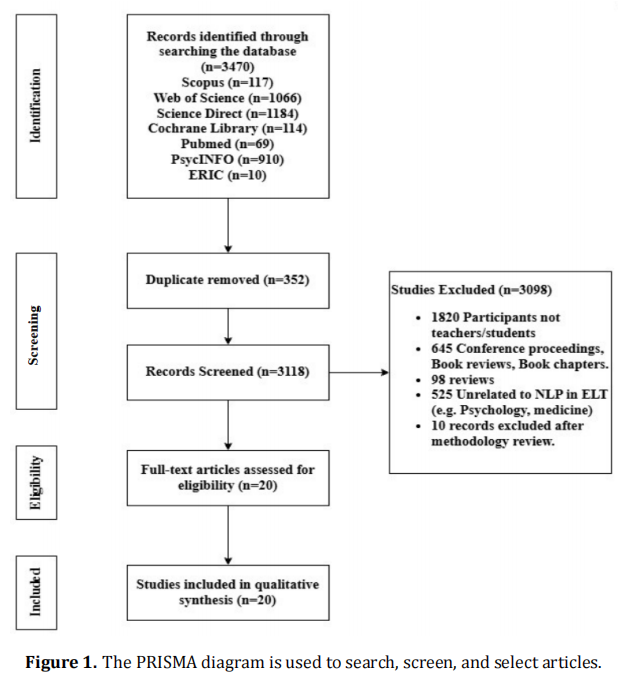
Neuro-Linguistic Programming (NLP) is an instructive approach that enhances teacher effectiveness, learner-centric environments, and language skills. Despite its widespread use in English Language Teaching (ELT), no thorough, systematic review and meta-synthesis evaluating its effectiveness has been conducted to date. The present research adhered to the Preferred Reporting Items for Systematic Reviews and Meta-Analysis (PRISMA) guidelines and conducted a systematic review and qualitative meta-synthesis to evaluate the application of NLP in ELT. Research articles for the present review were obtained from academic research databases, including Scopus, Web of Science, Science Direct, Cochrane Library, PubMed, Psyndex, and ERIC. A total of 3470 articles were identified across the five electronic databases listed above; of these, 20 pertained to NLP in ELT. This research also shows that the use of NLP has a significant effect on improving students’ emotional intelligence and cognitive development. Evidence also indicates that NLP interventions have reduced learning anxiety, improved classroom communication, and enhanced language-learning outcomes among language learners. In addition, NLP (i) enforces pedagogical methods and (ii) learner-centered educational milieu, and professional identity. The results underscore the transformative potential of NLP in contemporary teaching and learning and recommend its systematic implementation in ELT through changes in teaching methodology and learner competence.
Keywords:
Neuro-Linguistic Programming PRISMA Pedagogical Strategies Learning Anxiety Cognitive Development Meta-SynthesisReferences
- Revell, J.; Norman, S. In Your Hands: NLP in ELT; Saffire Press: London, UK, 1997.
- Knight, S. NLP at Work: The Difference That Makes a Difference in Business, 2nd ed.; Nicholas Brealey Publishing: London, UK, 2002.
- Kulinska, A.; Socha, J. The implementation of aspects of NLP in teaching English. Forum Filol. Ateneum 2022, 1, 201–213. DOI: https://doi.org/10.36575/2353-2912/1(10)2022.201
- Bandler, R.; Grinder, J. Frogs into Princes: Neuro-Linguistic Programming; Real People Press: Moab, UT, USA, 1979.
- Thornbury, S. An A–Z of ELT: A Dictionary of Terms and Concepts Used in English Language Teaching; Macmillan Education: London, UK, 2006.
- Craft, A. Neuro-linguistic programming and learning theory. Curric. J. 2001, 12, 125–136. DOI: https://doi.org/10.1080/09585170122455
- Pishghadam, R. Introducing applied ELT as a new approach in second/foreign language studies. Iran EFL J. 2011, 7, 8–14.
- Khasanov, J.B. The history and transformation of neuro-linguistic programming. Foreign Lang. Uzbekistan 2023, 10, 55–62. DOI: https://doi.org/10.36078/1696489965
- Tosey, P.; Mathison, J. Neuro-linguistic programming as an innovation in education and teaching. Innov. Educ. Teach. Int. 2010, 47, 317–326. DOI: https://doi.org/10.1080/14703297.2010.498183
- Sunitha, S.; Jayanthy, A.C.; Kalaiyarasan, G.; et al. The concept of neuro-linguistic programming in improving the receptive skills in English. Rupkatha J. Interdiscip. Stud. Humanit. 2021, 13, 1–11. DOI: https://doi.org/10.21659/rupkatha.v13n1.49
- Sunitha, S.; Jayanthy, A.C. Psychoanalytic perspectives on learning English as a second language through neuro-linguistic programming. Think India J. 2019, 22, 225–232.
- Purnama, Y.; Sobirov, B.; Ino, L.; et al. Neuro-linguistic programming as an instructional strategy to enhance foreign language teaching. Stud. Media Commun. 2023, 11, 50–59. DOI: https://doi.org/10.11114/smc.v11i5.6035
- Thakre, N.K.; Ansari, M.; Fatma, D.G.; et al. Neuro-linguistic programming: An effective tool for teaching English as a second language. Int. J. Sci. Res. Sci. Technol. 2023, 10, 529–536. DOI: https://doi.org/10.32628/IJSRST2310172
- Nahi, K.A.; Al-Thamery, A.A. The role of neuro-linguistic programming in improving EFL reading comprehension students with special reference to the University of Basra. Hawlyat Al-Montada 2018, 1, 3–18. Available online: https://www.researchgate.net/publication/338293407
- Farhadi, A.; Mozayeni, N. LLMs for personalized medicine and treatment planning. In Applications of Large Language Models (LLM) in Healthcare Systems; Chapman & Hall/CRC: Boca Raton, FL, USA, 2025. DOI: https://doi.org/10.1201/9781003665083-4
- Doğan, A.; Dal, N.A.; Beydag, K.D. Effect of neuro-linguistic programming on comfort after cesarean: A randomized controlled trial neuro-linguistic programming comfort level cesarean. BMC Pregnancy Childbirth 2025, 25, 902. DOI: https://doi.org/10.1186/s12884-025-08043-8
- Farhadi, A.; Zamanifar, A.; Bahrpeyma, F. Explainable AI (XAI): Making LLM decisions transparent and trustworthy. In Applications of Large Language Models (LLM) in Healthcare Systems; Chapman & Hall/CRC: Boca Raton, FL, USA, 2025. DOI: https://doi.org/10.1201/9781003665083-7
- Lashkarian, A.; Sayadian, S. The effect of neuro-linguistic programming (NLP) techniques on young Iranian EFL learners’ motivation, learning improvement, and teachers’ success. Procedia Soc. Behav. Sci. 2015, 199, 510–516. DOI: https://doi.org/10.1016/j.sbspro.2015.07.540
- Keezhatta, M.S. The impact of neuro-linguistic programming on English language teaching: Perceptions of NLP-trained English teachers. Int. J. Engl. Linguist. 2019, 9, 454. DOI: https://doi.org/10.5539/ijel.v9n6p454
- Hedayat, N.; Raissi, R.; Asl, S.A. Neuro-linguistic programming and its implications for English language learners and teachers. Theory Pract. Lang. Stud. 2020, 10, 1141–1147. DOI: https://doi.org/10.17507/tpls.1009.19
- Ginting, S.A.; Hartati, R. Neuro-linguistic programming in the English classroom: Perceptions and applications among teachers. Voices Engl. Lang. Educ. Soc. 2023, 7. DOI: https://doi.org/10.29408/veles.v7i2.22549
- Rayati, M. Neuro-linguistic programming and its applicability in EFL classrooms: Perceptions of NLP-trained English teachers. Lang. Teach. Res. Q. 2021, 24, 44–64. DOI: https://doi.org/10.32038/ltrq.2021.24.03
- Arora, A.; Mehta, N.K.; Yadav, S. An exploratory study on teachers’ perspective on applicability of neuro-linguistic programming in developing language learning at the high school level. Educ. Role Lang. J. 2024, 2024, 11. DOI: https://doi.org/10.36534/erlj.2024.01.05
- Merkviladze, M. Teachers’ perspective on the applicability of neuro-linguistic programming to address EFL learners’ speaking anxiety: Case of the universities in Georgia. J. Educ. Black Sea Reg. 2023, 9, 106–124.
- Zeb, F.; Hameed, A. Neuro-linguistic programming and English language teaching: An exploration of linguistic variants in NLP for its connection to ELT. Sir Syed J. Educ. Soc. Res. 2020, 3, 96–105. DOI: https://doi.org/10.36902/sjesr-vol3-iss4-2020(96-105)
- Pishghadam, R.; Shayesteh, S. Neuro-linguistic programming (NLP) for language teachers: Revalidation of an NLP scale. Theory Pract. Lang. Stud. 2014, 4, 2096–2104. DOI: https://doi.org/10.4304/tpls.4.10.2096-2104
- Farahani, F. The effect of neuro-linguistic programming (NLP) on reading comprehension in English for specific purposes courses. Int. J. Educ. Lit. Stud. 2018, 6, 79–85. DOI: https://doi.org/10.7575/aiac.ijels.v.6n.1p.79
- Arjulayana, Z.R.; Ansoriyah, S. Neuro-linguistics programming concept for teaching productive skill. ELS J. Interdiscip. Stud. Humanit. 2019, 2, 232–239.
- Kushwaha, S.S.; Suresh, K.P. Neuro-linguistic programming in English teaching classroom. Shiksha Shodh Manthan 2021, 7, 141–145. Available online: https://www.researchgate.net/publication/351904414_Neuro-Linguistic_Programming_in_English_Teaching_Classroom
- Alroudhan, H.E. The effect of neuro-linguistic programming coaching on learning English. Int. J. Appl. Linguist. Engl. Lit. 2018, 7, 184. DOI: https://doi.org/10.7575/aiac.ijalel.v.7n.4p.184
- Amirnudin, M.T.M.; Saleh, S. Effectiveness of Disney’s NLP-based strategy to improve students’ higher order thinking skills. Int. J. Instr. 2020, 13, 293–306. DOI: https://doi.org/10.29333/iji.2020.13320a
- Subbu Nisha, M.; Rajasekaran, V. NLP strategies: An innovative tool to enhance employability skills. Int. J. Recent Technol. Eng. 2019, 8, 1205–1209.
- Keezhatta, M.S. Exploring nascent trends and developments emanating in the domain of learning and assessment of English as a foreign language at undergraduate English majors of Saudi Arabia. Asian EFL J. 2020, 27, 41–62.
- Sarac, H.S.; Daglioglu Yazici, O. Comparing NLP and communicative approach: A study on spoken performance in ELT. Glob. J. Foreign Lang. Teach. 2018, 8, 63–67. DOI: https://doi.org/10.18844/gjflt.v8i2.573
- Mehdi, M.; Abbasi, A.; Ali, A. A critical analysis of the effects of neuro-linguistic programming on human behaviour. Pak. J. Soc. Res. 2022, 4, 108–188. DOI: https://doi.org/10.52567/pjsr.v4i1.350
- Tosey, P.; Mathison, J. Neuro-Linguistic Programming: A Critical Appreciation for Managers and Developers; Palgrave Macmillan: London, UK, 2009.
- Siniahovska, I.; Bohun, O. Formation of language competence of future economists in English language studying using neuro-linguistic programming. Intell. Pers. Civ. 2019, 19, 11–17. DOI: https://doi.org/10.33274/2079-4835-2019-19-2-11-17 (in Ukrainian)
- Sturt, J.; Ali, S.; Robertson, W.; et al. Neurolinguistic programming: A systematic review of the effects on health outcomes. Br. J. Gen. Pract. 2012, 62, e757–e764. DOI: https://doi.org/10.3399/bjgp12X658287
- Rustan, E. Language learning with neurolinguistic programming: An integrative review. J. Lang. Teach. Res. 2022, 13, 1251–1258.
- Denyer, D.; Tranfield, D. Producing a systematic review. In Doing a Systematic Review, 1st ed.; Dickson, R., Cherry, M., Boland, A., Eds.; Sage: Thousand Oaks, CA, USA, 2009; pp. 1–15.
- Tranfield, D.; Denyer, D.; Smart, P. Towards a methodology for developing evidence-informed management knowledge by means of systematic review. Br. J. Manag. 2003, 14, 207–222. DOI: https://doi.org/10.1111/1467-8551.00375
- Moher, D.; Liberati, A.; Tetzlaff, J.; et al. Preferred reporting items for systematic reviews and meta-analyses: The PRISMA statement. Ann. Intern. Med. 2009, 151, 264–269. DOI: https://doi.org/10.7326/0003-4819-151-4-200908180-00135
- Klassen, T.P.; Jadad, A.R.; Moher, D. Guides for reading and interpreting systematic reviews: I. Getting started. Arch. Pediatr. Adolesc. Med. 1998, 152, 700–704. DOI: https://doi.org/10.1001/archpedi.152.7.700
- Dickson, R.; Cherry, M.G.; Boland, A. Doing a Systematic Review: A Student’s Guide, 1st ed.; Sage Publications: London, UK, 2013; p. 240.
- Sackett, D.L. Evidence-based medicine. Semin. Perinatol. 1997, 21, 3–5. DOI: https://doi.org/10.1016/S0146-0005(97)80013-4
- Aromataris, E.; Lockwood, C.; Porritt, K.; et al., Eds. JBI Manual for Evidence Synthesis; JBI: London, UK, 2024.
- Kraus, S.; Breier, M.; Dasí-Rodríguez, S. The art of crafting a systematic literature review in entrepreneurship research. Int. Entrep. Manag. J. 2020, 16, 1023–1042. DOI: https://doi.org/10.1007/s11365-020-00635-4
- Thomas, J.; Harden, A. Methods for the thematic synthesis of qualitative research in systematic reviews. BMC Med. Res. Methodol. 2008, 8, 45. DOI: https://doi.org/10.1186/1471-2288-8-45
- Frampton, G.; Schofield, K.; Kohl, C.; et al. Principles and framework for assessing the risk of bias for studies included in comparative quantitative environmental systematic reviews. Environ. Evid. 2022, 11, 12. DOI: https://doi.org/10.1186/s13750-022-00264-0
- Seo, H.J.; Kim, S.Y.; Park, J.E.; et al. RoBANS 2: A revised risk of bias assessment tool for nonrandomized studies of interventions. Korean J. Fam. Med. 2023, 44, 249–260.
- Higgins, J.P.T.; Altman, D.G.; Gøtzsche, P.C.; et al. The Cochrane Collaboration’s tool for assessing risk of bias in randomized trials. BMJ 2011, 343, d5928. DOI: https://doi.org/10.1136/bmj.d5928
- CASP Qualitative Checklist. Available online: https://casp-uk.net/casp-tools-checklists/ (accessed on 15 July 2025).
- The Newcastle–Ottawa Scale (NOS) for Assessing the Quality of Nonrandomized Studies in Meta-Analyses. Available online: https://www.ohri.ca/programs/clinical_epidemiology/oxford.asp (accessed on 12 July 2025).
- Hong, Q.N.; Gonzalez-Reyes, A.; Pluye, P. Improving the usefulness of a tool for appraising the methodological quality of qualitative, quantitative, and mixed methods studies. J. Eval. Clin. Pract. 2018, 24, 459–467. DOI: https://doi.org/10.1111/jep.12884
- Kudliskis, V. Teaching assistants, neuro-linguistic programming (NLP) and special educational needs: “Reframing” the learning experience for students with mild SEN. Pastoral Care Educ. 2014, 32, 251–263. DOI: https://doi.org/10.1080/02643944.2014.960533
- Hosseinzadeh, E.; Baradaran, A. Investigating the relationship between Iranian EFL teachers’ autonomy and their neuro-linguistic programming. Eng. Lang. Teach. 2015, 8, 68. DOI: https://doi.org/10.5539/elt.v8n7p68
- Hamid, M.; Marzieh, A. The impact of neurolinguistic programming on EFL teachers’ reflective teaching. i-manager’s J. Engl. Lang. Teach. 2017, 7, 22. DOI: https://doi.org/10.26634/jelt.7.3.13589
- Caballero, D.R.; Rosado, N. Neurolinguistic programming and regular verbs past tense pronunciation teaching. Eng. Lang. Teach. 2018, 11, 1. DOI: https://doi.org/10.5539/elt.v11n11p1
- Zeb, F.; Hameed, A. An implication of Milton model of NLP for ESL learners. Asian EFL J. 2021, 28, 153–169.
- Almosa, A. Using neuro-linguistic programming and transactional analysis tools to measure the English proficiency of foreign language learners. Res. J. Adv. Humanit. 2023, 4, 238–254. DOI: https://doi.org/10.58256/5ryw2v96
- Zhang, X.; Davarpanah, N.; Izadpanah, S. The effect of neurolinguistic programming on academic achievement, emotional intelligence, and critical thinking of EFL learners. Front. Psychol. 2022, 13, 888797. DOI: https://doi.org/10.3389/fpsyg.2022.888797
- Rosa, D.C.B.; Lopes, L.W.; Lopes-Herrera, S.A. Voice and communication training programs improve university students' performance in oral presentations. CoDAS 2023, 35, e20220146. DOI: https://doi.org/10.1590/2317-1782/20232022146pt (in Portuguese)
- Rayati, M. On the relationship between neuro-linguistic programming and professional identity: A case study of EFL teachers. Lang. Teach. Res. Q. 2024, 42, 88–108. DOI: https://doi.org/10.32038/ltrq.2024.42.06
- Zarfsaz, E.; Salamat, M. The effect of using NLP techniques on the writing ability of EFL learners. Acuity J. Engl. Lang. Pedagogy Lit. Cult. 2024, 9, 17–33. Available online: https://jurnal.unai.edu/index.php/acuity/article/view/2952
- Rahman, S.; Jinu, R. Empowering deaf and hard-of-hearing undergraduates: Innovative ESL teaching strategies. Edelweiss Appl. Sci. Technol. 2024, 8, 5693–5706. DOI: https://doi.org/10.55214/25768484.v8i6.3241
- John, A.; Selvaraj, V.; Thennavan, S.; et al. The impact of neuro-linguistic programming on speaking skills: An intervention study. Forum Linguist. Stud. 2025, 7, 862–875. DOI: https://doi.org/10.30564/fls.v7i4.9274
- Lakoff, G.; Johnson, M. Metaphors We Live By, 1st ed.; University of Chicago Press: Chicago, IL, USA, 1980; pp. 1–13, 44–48.
- Langacker, R.W. Cognitive Grammar: A Basic Introduction; 1st ed.; Oxford University Press: Oxford, UK, 2008; pp. 3–14, 230–231.
- Gee, J.P. An Introduction to Discourse Analysis: Theory and Method, 4th ed.; Routledge: London, UK, 2014; pp. 11–39, 80–98.
- Fairclough, N. Critical discourse analysis. In The Routledge Handbook of Discourse Analysis; Handford, M., Gee, J.P., Eds.; Routledge: London, UK, 2013; pp. 9–21.
- Goleman, D. Emotional Intelligence: Why It Can Matter More Than IQ ,1st ed.; Bantam Books: New York, NY, USA, 1995; pp. 46–78, 203–230.